

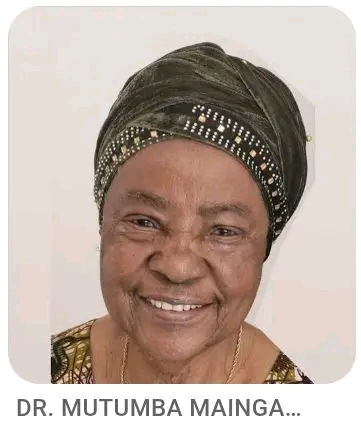
DR. MUTUMBA MAINGA BULL (1938–2026): THE WOMAN WHO DOCUMENTED THE HISTORY OF BULOZI AND MADE ZAMBIAN HISTORY
A daughter of Bulozi, a distinguished historian, an academic pioneer and Zambia’s first female Cabinet Minister.
The history of Zambia cannot be complete without recognising the remarkable contribution of Dr. Mutumba Mainga Bull, a woman whose intellectual achievements, political leadership and historical research placed her among the important figures in the country’s history.
Born Mutumba Mainga, she became widely known as Dr. Mutumba Mainga Bull following her marriage to Nicholas Theodore Bull in 1965. She was not only a pioneering woman in Zambian politics but also one of the scholars whose academic work helped preserve and explain the history of the Lozi people and the Kingdom of Bulozi.
Her story is particularly significant to the people of Barotseland because she dedicated an important part of her academic career to researching the historical development of the Luyana and Lozi kingdoms.
1. HER EARLY LIFE AND EDUCATIONAL JOURNEY
Dr. Mutumba Mainga Bull was born in 1938 and grew up in the Sefula area of Mongu District, in present-day Western Province, Zambia.
Her early life and educational journey took her through several schools before she proceeded to higher education. Her upbringing in Bulozi gave her an important connection to the society, traditions and historical experiences that would later become central to her academic research.
She pursued university education and specialised in history, eventually obtaining a Bachelor of Arts degree in History from the University of London in 1963.
In 1969, she obtained her PhD in History from the School of Oriental and African Studies (SOAS), University of London. This achievement made her the first Zambian woman to obtain a doctoral degree.
Her academic journey also included postgraduate research at the University of Cambridge.
At a time when opportunities for African women in higher education and professional leadership were limited, her achievements represented a significant milestone.
2. HER CONTRIBUTION TO THE UNIVERSITY OF ZAMBIA
In 1969, Dr. Mainga Bull joined the University of Zambia as a lecturer in the Department of History.
She became the first Zambian woman to lecture at the institution, opening another important chapter in the history of women’s participation in higher education.
She served at UNZA until 1973, when she entered national politics.
However, her relationship with academic research did not end with her departure from teaching.
In 1996, she returned to the University of Zambia as a Senior Research Fellow. Between 2005 and 2008, she served as Director of the Institute of Economic and Social Research.
She later continued her academic work as a Senior Research Fellow and Coordinator of the Institute’s Governance Research Programme.
Her career demonstrated that scholarship and public service could complement one another.
3. HER HISTORICAL CONTRIBUTION TO BULOZI AND THE LOZI KINGDOM
One of Dr. Mutumba Mainga Bull’s most important contributions was her research into the history of the Lozi people and the political development of the Kingdom of Bulozi.
Her famous scholarly work, Bulozi under the Luyana Kings: Political Evolution and State Formation in Pre-colonial Zambia, was first published in 1973.
This book remains an important historical reference for people interested in understanding the formation and development of the Lozi Kingdom.
Her research examined several important historical subjects, including:
– The origins and development of the Luyana and Lozi people.
– The establishment of the Luyana central kingship.
– The political organisation of the Kingdom of Bulozi.
– The Makololo invasion and its consequences for the kingdom.
– The restoration of the Lozi monarchy.
– The reign and political achievements of Litunga Lubosi Lewanika.
– The interaction between Bulozi and European missionaries, traders and colonial authorities.
What makes her work particularly valuable is its use of both oral traditions and written historical sources.
She examined traditional accounts alongside documentary evidence to develop a scholarly interpretation of the history of Bulozi.
For generations of students, researchers and people interested in Barotseland history, her work has provided an important foundation for further historical investigation.
4. HER POLITICAL CAREER: A WOMAN WHO BROKE BARRIERS
Dr. Mainga Bull was not only an academic. She also entered the political arena and became a pioneer in Zambia’s national leadership.
In 1973, she was elected Member of Parliament for Nalolo Constituency under the United National Independence Party (UNIP) government.
She subsequently made history when President Kenneth Kaunda appointed her Minister of Health.
She became Zambia’s first female full Cabinet Minister.
Her political career continued through several ministerial responsibilities, including:
– Minister of Health (1973–1976).
– Minister of Commerce (1976–1977).
– Minister of State for Information and Broadcasting Services (1978–1979).
– Minister of State for Foreign Affairs (1980–1981).
– Minister of State for the Civil Service (1982–1983).
She represented Nalolo in Parliament from 1973 to 1983.
Her journey demonstrated that women from rural communities could rise to positions of national responsibility and participate in shaping the direction of the country.
5. HER CONTRIBUTION TO AFRICAN HISTORICAL SCHOLARSHIP
Dr. Mainga Bull’s academic contribution extended beyond Zambia.
She participated in international scholarly discussions on African history and served on the International Scientific Committee for the Drafting of a General History of Africa, an important UNESCO-associated historical undertaking.
This placed her in the company of scholars working to ensure that African history was researched, documented and understood through African experiences and perspectives.
Her academic interests were not restricted to political leadership and traditional institutions. She also contributed to wider discussions about governance, African society, religion and historical interpretation.
Her publications and research helped bring Zambian and Lozi history into wider academic conversations.
6. HER LEGACY TO BAROTSELAND AND FUTURE GENERATIONS
For the people of Bulozi, Dr. Mutumba Mainga Bull’s legacy carries particular historical significance.
Her book is more than an academic publication. It is an important contribution to the documentation of the political evolution of the Lozi Kingdom.
The history of the Luyana kings, the Makololo period, the restoration of the monarchy and the reign of Lubosi Lewanika are subjects that continue to attract interest among researchers, traditional historians and younger generations.
Her work reminds us of the importance of recording our history before valuable knowledge disappears with the passing of elders and traditional custodians.
It also reminds us that the history of Barotseland deserves serious academic attention, preservation and continued research.
Our younger generation should be encouraged to read the works of scholars such as Dr. Mainga Bull, investigate historical sources, document oral traditions and contribute to the preservation of our heritage.
7. HER PASSING AND NATIONAL RECOGNITION
Dr. Mutumba Mainga Bull passed away in Lusaka on 13 February 2026, at the age of 88.
Her death marked the end of a remarkable life dedicated to education, historical research and public service.
At her requiem service on 19 February 2026, President Hakainde Hichilema paid tribute to her achievements and urged Zambians to learn from her dedication and resilience.
Her passing was a reminder that the country must do more to document and preserve the contributions of its historical pioneers.
CONCLUSION:
A DAUGHTER OF BULOZI WHO LEFT A NATIONAL LEGACY
Dr. Mutumba Mainga Bull’s story is one that deserves to be told repeatedly.
She was a daughter of Bulozi who rose through education to become a respected historian, a university lecturer, an international scholar and Zambia’s first female Cabinet Minister.
Her contribution to the documentation of the history of the Luyana and Lozi kingdoms remains an important part of her legacy.
As we celebrate the history of Barotseland, let us also recognise the scholars who dedicated their lives to researching and documenting our past.
A people who do not document their history risk losing valuable knowledge about their origins, institutions, leadership and identity.
May the younger generation of Bulozi take inspiration from her life and continue the work of researching, writing and preserving our history.
May the legacy of Dr. Mutumba Mainga Bull continue to inspire generations.
May her soul rest in eternal peace.
HISTORICAL FIGURE: Dr. Mutumba Mainga Bull (1938–2026)
FIELD:
History, academia, politics and public service
HISTORICAL CONNECTION: Bulozi, Mongu District, Barotseland
NOTABLE BOOK:
Bulozi under the Luyana Kings:Political Evolution and State Formation in Pre-colonial Zambia (1973).