

WHO IS REALLY BEING KEPT OUT OF AMERICA?
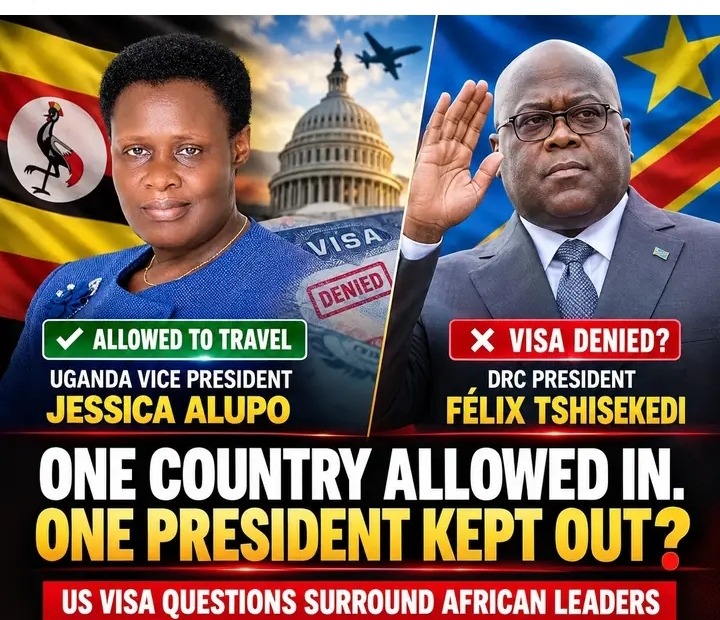
DRC PRESIDENT REPORTEDLY DENIED VISA — WHILE OTHER SENIOR OFFICIALS CAN TRAVEL. UGANDAN DELEGATION CUT TO JUST FIVE.
A diplomatic question is quietly getting louder as world leaders gather in New York for the United Nations General Assembly.
In the Democratic Republic of Congo, President Félix Tshisekedi has reportedly been unable to travel to the United States, with the explanation linked to the ongoing Ebola-related travel restrictions.But his prime minister was allowed.
But here is where the story becomes difficult to ignore:
If the issue is public health, how are some senior officials from the same country able to travel while others cannot?
That question becomes even more interesting when we look at Uganda.
Uganda’s delegation to the UN General Assembly was reportedly reduced dramatically after numerous visa applications were refused.
Only five officials were cleared to travel:
🇺🇬 Vice President Jessica Rose Alupo
🇺🇬 Her bodyguard
🇺🇬 Health Minister Dr Chris Baryomunsi
🇺🇬 Health Ministry Permanent Secretary Dr. Diana Atwine
🇺🇬 Foreign Affairs official Adonia Ayebare
Meanwhile, several other senior government officials and accompanying staff reportedly failed to obtain visas. The specific identities of many of those denied have not been publicly disclosed.
And that raises a very uncomfortable question:
IS THIS REALLY ONLY ABOUT HEALTH?
If Ebola is the determining factor, why can some people from the same country travel to the United States while others are denied?
Does the distinction depend on their role? Their travel history? Their health status? Or something else?
The U.S. government has publicly linked its measures to protecting public health from Ebola. (Travel State)
But from an African perspective, the pattern inevitably invites another question:
Could Washington be sending a diplomatic message without saying it openly?
Is the message:
“We don’t want all of you here.”
Or is this simply a carefully targeted public-health and security policy being applied according to specific criteria?
There is also a broader diplomatic irony.
The United Nations General Assembly is a gathering where governments are expected to meet, speak and engage with one another. Yet some African delegations are arriving in New York significantly smaller than planned because of U.S. visa restrictions.
So, where exactly is the line between public health, national security and diplomacy?
Perhaps there is a perfectly reasonable explanation.
But until the U.S. authorities clearly explain why some officials are allowed in while others from the same country are not, the questions will continue.
What do YOU think?
Is this genuinely about Ebola and public health?
Or are we witnessing a new form of diplomatic signalling by Washington?
Could America be saying “we don’t want you here” without actually saying it?