

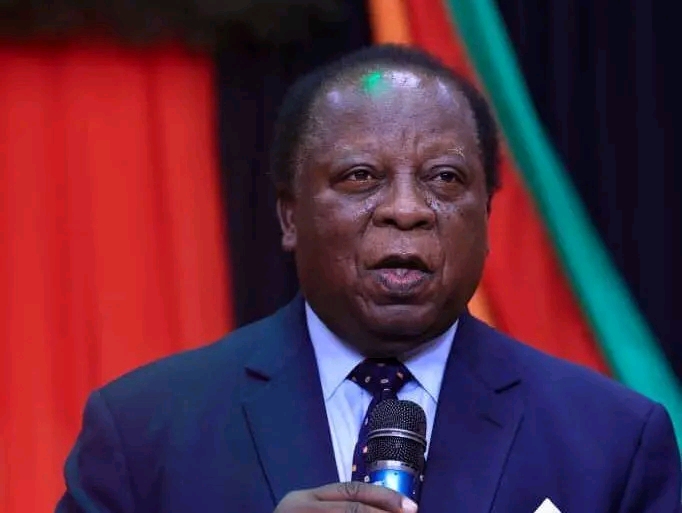
ENOCK KAVINDELE: THE EXTRAORDINARY STORY OF ZAMBIA’S BUSINESSMAN, POLITICIAN AND FORMER VICE-PRESIDENT
By Bill Hamapumbu Jr.
I grew up hearing stories about Enock Kavindele, and some of them sounded almost unbelievable.
He was one of those names that seemed larger than life. A businessman with enormous wealth, a man who owned businesses across different sectors, a politician who challenged the political establishment, a Cabinet minister and eventually Vice-President of Zambia.
And then there was the story that fascinated me most as I was growing up:
Kavindele kept lions at his residence.
I never really knew whether that was true. You know how stories are told when you are young. Someone tells you something, another person adds a little more, and eventually the story becomes almost legendary.
So I always wondered: Did Enock Kavindele really have lions at his home?
Years later, I came across veteran journalist Dickson Jere’s article on LinkedIn “Zambia’s Big Boys.” Jere wrote about sitting down with Kavindele for a conversation about life and his remarkable wealth during his heyday. Among the things Jere mentioned were a private plane, a large mansion, luxurious vehicles, expensive jewellery, a chain of companies—and, remarkably, lions kept as pets at his house.
Suddenly, that childhood story didn’t sound quite as unbelievable.
Of course, there are still details I cannot independently verify—such as how many lions there were, exactly where they were kept or for how long. But the fact that the story appears in Jere’s published account makes it far more interesting than something passed around purely by word of mouth.
The businessman before the politician
What is sometimes forgotten is that Kavindele was a businessman long before he became a senior politician.
His business career began in the 1970s, when he established Woodgate Holdings. The company developed interests in areas including agriculture, tourism, mining and transportation. NorthWest Rail’s own account of his career also highlights Woodgate’s involvement in vehicle assembly through Woodgate Motors, including the assembly of Isuzu vehicles at Livingstone Motor Assemblers.
This was a different era in Zambia’s economic history.
For someone to build a diversified business empire at that time required considerable ambition. Kavindele was not simply interested in one business. He was involved in different sectors and built a reputation as one of the country’s prominent entrepreneurs.
And his ambitions were not confined to business.
From the boardroom to Parliament
Kavindele entered politics and was first elected to Parliament for Chingols in a 1987 by-election. His political journey was anything but straightforward.
He was initially associated with UNIP, later formed his own United Democratic Party, and eventually joined the MMD. He returned to Parliament for Chingola in 1995 and retained the seat in the 1996 elections.
He subsequently served in Cabinet, holding portfolios including Science and Technology, Commerce, Trade and Industry, and Health.
Then came the moment that would permanently place his name in Zambia’s political history.
In 2001, Enock Kavindele was appointed Vice-President of Zambia under President Frederick Chiluba. He remained Vice-President until May 2003, when President Levy Mwanawasa removed him from the position.
At the time, Kavindele was also a Member of Parliament for Kabompo West. Parliament’s historical records confirm his service there from 2001 to 2006 and record that he served as Vice-President from 2001 to 2003.
That makes his political journey particularly interesting.
He had moved from being a businessman in the private sector to becoming a Cabinet minister and eventually the country’s Vice-President.
So what happened to the wealth?
This is perhaps the most intriguing part of the story.
Today, when people hear the name Enock Kavindele, they may remember the former Vice-President, but the enormous business profile associated with his heyday is less visible.
It would be tempting to say that he simply lost his wealth, but the public record does not support such a simple conclusion.
His businesses went through different challenges, disputes and changes over the years. One example came in 2011, when ZCCM Investment Holdings sued Woodgate Holdings for more than US$1.9 million over copper-concentrate proceeds.
The High Court dismissed ZCCM-IH’s claim and instead found that Woodgate Holdings had overpaid by K19.4 million and was entitled to recover the amount, together with interest and costs.
That case alone doesn’t explain what happened to Kavindele’s broader wealth, but it shows that his business empire continued to be involved in substantial commercial dealings long after his time in government.
There is simply not enough reliable public information to conclude that his wealth disappeared because of one particular event.
The NorthWest Rail dream
Perhaps one of the most important parts of Kavindele’s later story was his pursuit of NorthWest Rail
The idea was to establish a railway connection linking the Copperbelt with North-Western Province, a region that would become increasingly important because of its mineral resources.
Kavindele saw the bigger picture.
Copper could be mined, but without adequate infrastructure, transportation would remain a major constraint. A railway could move minerals more efficiently, reduce pressure on the Chingola-Solwezi road and potentially stimulate economic activity along the route.
In 2016, Kavindele said construction of the Chingola-Solwezi railway was expected to begin, with projections of thousands of jobs during construction and additional employment once the railway was operational.
Whether the full vision has been realised is another question, but the ambition itself tells us something about the man.
Kavindele was always thinking on a large scale.