

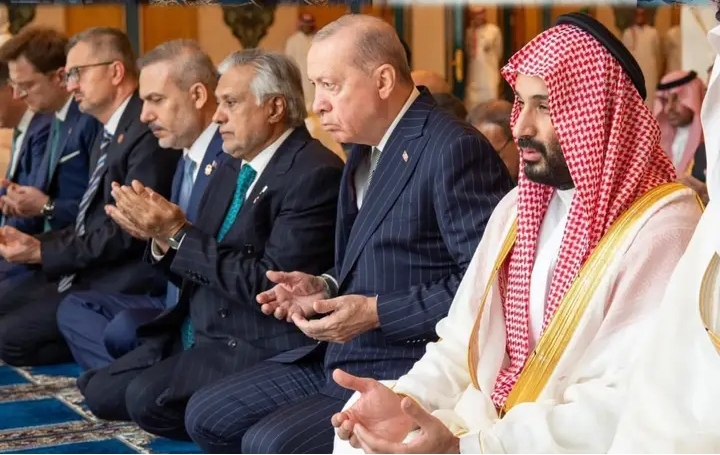
Erdoğan Details the “Makkah Agreement,” Outlining a Joint Defense Response by Türkiye, Saudi Arabia and Pakistan
Turkish President Recep Tayyip Erdoğan has provided his most detailed public explanation to date of the defense framework known as the Makkah Agreement, saying Türkiye, Saudi Arabia and Pakistan would respond collectively if any one of the signatories were subjected to external aggression.
Speaking to Al Jazeera, Erdoğan said the agreement establishes a principle of mutual defense under which an attack or act of aggression against one of the three countries would trigger a coordinated response from the other
According to Erdoğan, the arrangement means that Türkiye, Saudi Arabia and Pakistan would act together in the event that one of the member states comes under external military attack. He described the mechanism as a significant step toward strengthening strategic coordination and collective security among the three countries
The Turkish president’s remarks suggest that the agreement is intended to go beyond political solidarity, potentially creating a framework for a joint military response to external aggression. In practical terms, Erdoğan indicated that a country attacking one of the three signatories could face a coordinated and forceful response from the other members.
Erdoğan also stressed that the framework is not necessarily limited to its current three members. He said other countries could join the arrangement in the future as the defense partnership develops.
Among the countries he specifically mentioned was Egypt, which Erdoğan indicated could potentially become part of the alliance.
If Egypt were eventually to join, the framework could expand significantly in both political and strategic importance, bringing together four major Muslim-majority states with substantial military capabilities and important geographic positions spanning the Middle East, the Red Sea, the Arabian Peninsula and South Asia.
The Turkish president’s comments therefore portray the Makkah Agreement as an emerging collective-security framework, rather than simply a bilateral or diplomatic partnership. Its evolution, particularly the possible inclusion of additional countries such as Egypt, could have major implications for the regional balance of power and the security architecture of the wider Middle East and South Asia.