

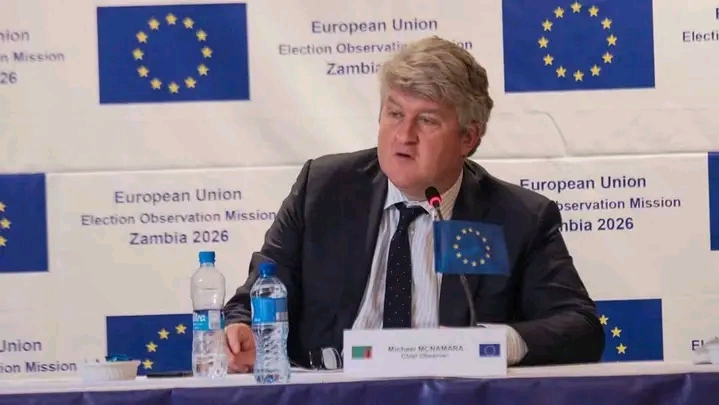
EU observers question 2026 election results
…Mission cites serious tabulation irregularities and ECZ failure to publish complete presidential results
By EMV REPORTER
THE European Union Election Observation Mission (EU EOM) has raised serious concerns over the transparency and credibility of Zambia’s August 13, 2026 general elections.
The EU EOM has cited procedural irregularities during the tabulation of results and the Electoral Commission of Zambia’s (ECZ) failure to publish complete presidential election results.
Presenting the mission’s final report yesterday, EU EOM chief observer and Member of the European Parliament Michael McNamara said observers witnessed a deterioration in tabulation procedures at totaling centres, where public scrutiny of the process was reduced.
“At totaling centres, EU Election Observation Mission [EOM] observers saw tabulation procedures deteriorate, with less public scrutiny after that point. Serious incidents and procedural irregularities were noted by the EU EOM during the totaling process, impacting its transparency and credibility. The ECZ declared the presidential results on 18 August, but no full publicly available results have been posted by them, undermining transparency,” Mr McNamara said.
He noted that although election day was generally calm and voting and counting at polling stations were conducted transparently in the presence of party and candidate agents, the situation changed after the ECZ announced a nationwide suspension of the counting and announcement of results on August 14.
The suspension, which lasted six hours, was ordered on security grounds, but the mission said the scale of the security concerns cited to justify the decision was not sufficiently explained.
Mr McNamara said the tabulation process deteriorated after counting resumed, with procedural omissions and a lack of integrity safeguards observed at totaling centres.
He said local observers had also flagged inconsistencies in the results, while the absence of polling-station results published centrally by the ECZ further compounded uncertainty surrounding the outcome.
Mr McNamara said the EU EOM observed the opening of 39 polling stations, voting at 419 polling stations, counting at 38 polling stations and tabulation at 64 totaling centres.
He said while the mission acknowledged that the ECZ had generally prepared well for the elections and managed operations up to polling day within the stipulated schedule and legal timelines, there was an urgent need to strengthen transparency and accountability mechanisms.
The report also raised concerns about the post-election environment, which it described as tense and turbulent, with shrinking democratic space, inadequate respect for fundamental rights and due process, and a series of opaque security-related actions.
It cited the August 14 raid by joint security forces on a property linked to the opposition leadership, which resulted in the death former Cabinet minister and the arrest of 11 key opposition figures.
Mr McNamara said said the subsequent arrests, including those of opposition presidential candidate Brian Mundubile and his running mate Makebi Zulu, who were charged with treason and later sedition, heightened public anxiety.
The report noted that the prolonged absence of official information surrounding the raid, arrests, whereabouts of those targeted and charges brought against them created room for speculation.
The EU EOM further observed that the physical closure of access to the courts between August 24 and 26 curtailed access to justice and electoral due process during two of the seven constitutionally provided days for filing election petitions.
On the campaign environment, Mr McNamara said fundamental democratic rights, particularly freedom of assembly and expression, were restricted, while incumbency advantages blurred the distinction between the state and the ruling party, creating an uneven playing field.
The report cited misuse of state resources, campaign-related violence, cadreism, police bias and detentions as factors that undermined fair competition.
Mr McNamara also highlighted the imbalance in state-owned media coverage, saying its monitoring of 10 media outlets found that 96.2 per cent of ZNBC Television airtime and 90.5 per cent of ZNBC Radio airtime favoured the United Party for National Development (UPND).
He said restrictive cyber laws had contributed to self-censorship among media practitioners, while one prominent journalist was arrested during the election period.
Mr McNamara also said raised concerns over the low participation of women, who accounted for only nine per cent of candidates across all levels of the elections, as well as the continued marginalisation of young people and persons with disabilities.
The EU EOM has made 13 recommendations to improve the organisation, management and conduct of elections in Zambia, eight of which it has classified as priority recommendations.
Among the key recommendations are reforms to the electoral legal framework through an inclusive and consultative process, stronger transparency in electoral decision-making, protection of freedom of assembly, and equal campaign opportunities for all contestants.
The mission has also recommended that state-owned media be disengaged from direct government control and that ZNBC be transformed into a genuine public service broadcaster with editorial independence and balanced programming.
Other priority recommendations include aligning the Cyber Security and Cyber Crimes Acts with international commitments on freedom of expression and privacy, guaranteeing unhindered access for election observers, strengthening access to electoral justice and ensuring prompt publication of complete polling-station-disaggregated election results.
The mission noted that limited action had been taken on the 22 recommendations made following its 2021 election observation mission, underscoring what it described as a lack of effective political effort on key electoral reforms.