

EU-EOM PRELIMINARY REPORT
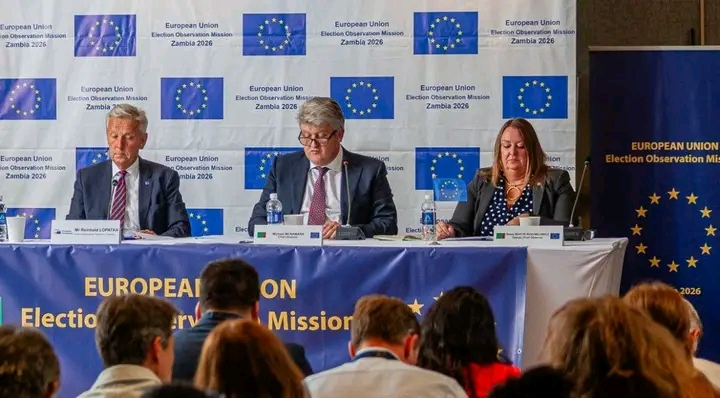
The European Union Election Observation Mission (EU EOM) to Zambia today presented its Preliminary Statement on the 13 August 2026 general elections. Critical stages of the electoral process, including the tabulation of results, are still ongoing. The statement, therefore, only reflects the mission’s findings to date and the EU EOM will continue to observe and assess the remaining stages of the process before its final assessment. The Delegation of Members of the European Parliament, led by Reinhold Lopatka (MEP), fully endorsed the mission’s statement.
“The elections offered Zambian voters a competitive choice, and election day was calm overall with polling staff efficiently facilitating voting in polling stations observed by the EU EOM.
At the same time, the broader electoral process took place in an environment that limited fundamental freedoms. Late legal changes, legal uncertainty, and unequal campaign conditions distorted the playing field” said Michael McNamara, Chief Observer of the EU EOM.
Zambia’s legal framework constitutes an adequate basis for democratic elections. However, significant changes, including to the electoral system, were adopted only three months ago. This made it difficult to implement all changes adequately and for stakeholders to be aware of them. It also led to uncertainty regarding the procedures.
Referring to the pause of the process yesterday, the Chief Observer pointed out: “We understand that this has caused concern, which is why what happens next matters so much – and why transparency, clear communication and strict adherence to procedure are crucial for guaranteeing public confidence in the process. In that light, disaggregated data at polling station level should be made publicly available “.
Reinhold Lopatka, the Head of the European Parliament Delegation, said: “Despite the lack of equity in the campaign, which led to distrust, I call on all political leaders to ensure that their supporters should refrain from violent acts.
Any dispute regarding the electoral process should be addressed peacefully, according to the established legal procedures”.
Positive legal steps included the Access to Information law and the repeal of criminal defamation of the president. The impact of these reforms, however, was limited by gaps in implementation and by other restrictive measures. The registration of candidates was inclusive, transparent and timely. However, women’s participation as candidates was minimal. Advantages of incumbency blurred the line between state and party, while campaign-related violence and uneven law-enforcement responses contributed to an unlevel playing field.
The media operated with relative freedom but recently introduced cyber laws and their application contributed to concerns among journalists and online users. As well, state-owned media coverage was heavily biased.
The EU EOM is independent and impartial and does not interfere in the electoral process. Its findings are based on direct observation and verified information, and its work is conducted in accordance with the Declaration of Principles for International Election Observation and the Code of Conduct for International Election Observers.
I do appreciate the EU Observation Mission’s preliminary statement on Zambia’s general elections. I would, however, like to respectfully offer one observation concerning the report’s characterization of Zambia’s cyber laws.
The cyber and digital legislation introduced in Zambia should not be understood primarily as measures intended to curtail media freedom or the freedoms of citizens. Rather, these laws are intended to strengthen security and governance in the digital era, including digital governance, Internet governance, fintech regulation, cross-border control and management of information, and engagement with technology companies and the broader field of technology diplomacy.
It is also important to recognize that many countries, including the European Union, China, the United Kingdom, Canada and the United States, have developed comprehensive cyber and digital regulatory frameworks as part of their domestic and foreign policy approaches. These frameworks are designed, among other things, to protect data privacy, strengthen e-governance, safeguard national and critical infrastructure, combat cyberattacks and financial crimes, and protect national sovereignty in an increasingly technology-driven environment.
The rapid advancement of digital technologies presents significant opportunities, but it also creates new security vulnerabilities. If digital systems and critical data are not adequately protected, they can expose countries to cyberattacks, financial crime, data breaches, foreign interference and other threats to national security.
Therefore, cyber laws should not automatically be interpreted as instruments for restricting the media or suppressing legitimate freedoms. Their purpose and implementation should instead be assessed within the broader context of cybersecurity, digital governance, data protection and national security.
At the same time, Zambia, like any democracy, should remain committed to protecting freedom of expression, media freedom and other fundamental rights. Constructive international observation is valuable, but it is equally important that assessments of African democracies avoid generalizations or portrayals that suggest African countries are uniquely deficient in democratic governance. All democracies, including established Western democracies, face challenges and have areas in which their institutions and laws continue to evolve.
A balanced assessment should therefore recognize both Zambia’s legitimate responsibility to protect its digital and national security interests and its obligation to uphold democratic freedoms. This approach would provide a more nuanced and constructive understanding of Zambia’s cyber and digital governance framework.