

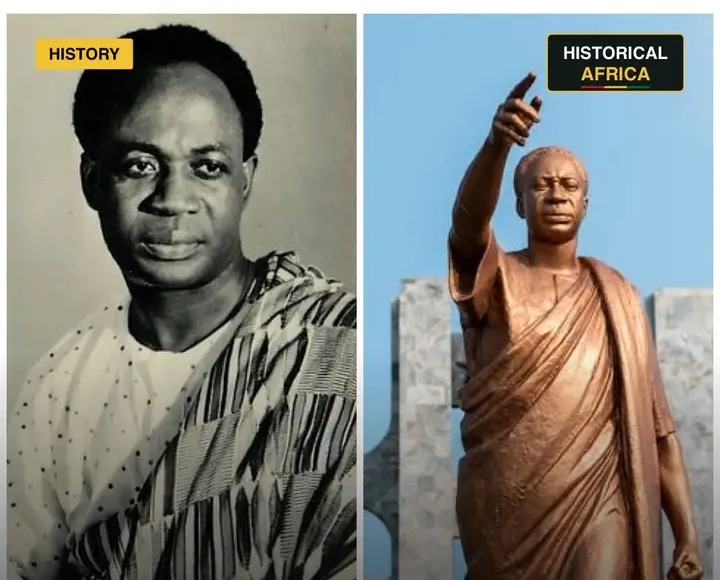
Everything Kwame Nkrumah warned Africa about in 1965 has already happened
In 1965, Kwame Nkrumah published a book called Neo-Colonialism, the Last Stage of Imperialism. In it he explained something the world had no name for yet. He said the empires were not leaving Africa. They were changing their method.
The soldiers and the governors would go home, the flags would come down, and Africans would be handed independence on paper. But the control would remain, exercised now through currency, through debt, through foreign companies, through investment that looked like generosity and functioned like ownership. He wrote that a state in this position would appear sovereign and possess all the outward trappings of independence, while its economic system and its political policy were directed from outside.
Read that again, then look around the continent today.
Fourteen African nations still use the CFA franc, a currency guaranteed by the French Treasury, printed in France, with African reserves held abroad. Congo’s cobalt is dug by Congolese children and controlled overwhelmingly by foreign companies. African nations still export raw ore and buy back the finished product at a price set somewhere else. The IMF and World Bank still shape national budgets from Washington. Foreign militaries still hold bases across the continent. Africans still need visas to visit their own neighbours while goods flow freely to Europe. Nkrumah described all of it, in advance, six decades ago.
He also told Africa exactly what would save it, and Africa said no. At the founding of the Organisation of African Unity in 1963, he argued for immediate political union, a single continental government with one army, one currency and one foreign policy. He was not being romantic. His argument was cold and strategic. He said that divided, African nations would be picked off one at a time and forced to negotiate alone against powers far larger than any of them.
Most leaders refused, unwilling to surrender the sovereignty they had just won. Six decades later, that fear of losing a little sovereignty has cost Africa an enormous amount of real power. We negotiate with the world in fifty four separate pieces, exactly as he warned.
He named the Congo as the test of African freedom and warned that if Congo’s independence was broken, all of Africa would be exposed. Lumumba was murdered. Congo has never been allowed to stand upright since. He was right about that too.
And he did not only theorise. He built. The Akosombo Dam to power industry, the port at Tema, a national airline, factories, schools, because he insisted that a nation which only exports raw materials will always be poor. Every gold refinery being built in Africa today, every argument about adding value at home, is Nkrumah’s argument arriving sixty years late.
They removed him in a coup in 1966, welcomed by the West, and he died in exile in 1972 without ever seeing Ghana again.
Here is the tragedy in one sentence. Africa did not fail to understand Nkrumah. Africa understood him perfectly and decided the price of listening was too high. We are still paying the price of not listening, and it is far higher.