

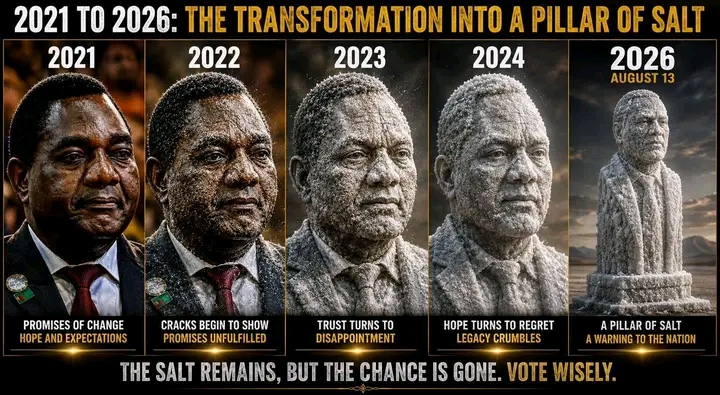
FIVE YEARS ON: HH MUST ACCOUNT FOR HIS OWN RECORD
By Dr Brian Malama
Five years after President Hakainde Hichilema and the UPND came to power on a platform of change, accountability and economic transformation, Zambia has reached a point where the administration must increasingly be judged by its own record rather than by the failures it inherited.
The central question is no longer what the previous government did wrong. The question is: What has the Hichilema administration delivered with the mandate, institutions and five years it has had at its disposal?
RULE OF LAW AND THE JUDICIARY
One of the most serious areas requiring scrutiny is the state of the rule of law and public confidence in Zambia’s institutions. The UPND entered government promising stronger democratic institutions, respect for constitutionalism and equal treatment before the law. Yet critics increasingly question whether those aspirations have translated into practice.
“no one is above the Law”
Whenever citizens perceive that political opponents, critics or activists are treated differently from those associated with those in power, confidence in the justice system suffers. The independence of the judiciary, law-enforcement agencies and other institutions of governance must therefore remain beyond political suspicion.
A democracy cannot thrive merely because elections are held. It requires independent courts, professional law enforcement, respect for civil liberties and institutions capable of acting without fear, favour or political interference.
FROM PROMISES TO ACCOUNTABILITY
The UPND campaigned on an ambitious programme of reform and repeatedly presented its priorities as a pathway towards a better Zambia. Five years later, those commitments deserve a comprehensive audit.
Zambians have every right to ask which promises have been fully delivered, which have been partially implemented and which have failed to materialise. Political promises cannot remain permanent works in progress while citizens continue confronting unemployment, the high cost of living, economic uncertainty and inadequate public services.
The administration should therefore be prepared to account, point by point, for the programme on which it sought office.
GOVERNING CANNOT MEAN PERMANENTLY BLAMING THE PAST
Perhaps the greatest political weakness facing the Hichilema administration is its continued tendency to explain present difficulties by referring to the government it replaced.
There is no doubt that governments inherit both assets and liabilities from their predecessors. The condition of the economy, public debt and institutional weaknesses inherited in 2021 formed part of the environment in which the UPND assumed office.
But an inheritance cannot become a permanent explanation for shortcomings.
After five years in government, responsibility inevitably shifts to those currently exercising power. Leadership means confronting inherited problems, correcting them and producing measurable results. A government elected because the previous administration had supposedly failed cannot indefinitely use that previous administration as the principal explanation for its own difficulties.
At some point, the question must change from “What did we inherit?” to “What have we done with what we inherited?”
WHERE IS THE NEXT BIG IDEA?
Zambia also needs clarity about what comes next.
The country requires more than explanations of yesterday’s problems. It needs a convincing vision for employment, industrialisation, agriculture, mining, energy security, affordable living, healthcare, education and opportunities for young people.
Leadership is ultimately about the future.
A government approaching the electorate after five years should be able to demonstrate not only what it believes its predecessor did wrong, but what it has accomplished itself and, crucially, where it intends to take the country next.
THE RECORD MUST NOW SPEAK
President Hichilema sought office promising change. Five years later, the standard against which his administration should be measured is therefore the change it has actually produced.
The debate should not be reduced to personalities or political slogans. It should revolve around evidence: promises versus delivery, institutions versus political influence, economic commitments versus household realities, and rhetoric versus measurable results.
Zambians deserve a government capable of defending its record without constantly returning to the failures of five years ago.
The previous administration has already faced its political judgment. The administration currently in office must now face judgment on its own record.
That is the essence of democratic accountability.