

FOURTEEN YEARS AFTER MARIKANA, THE GUNS FELL SILENT BUT JUSTICE NEVER ARRIVED
By Gabriel Manyati
Fourteen years after police bullets tore through a crowd of striking mineworkers at Marikana, the most haunting question is no longer what happened on that August afternoon. South Africa has spent years documenting the tragedy, investigating it and compensating some of those who survived. The harder question is why, after all this time, the state has still failed to deliver the accountability that its own constitutional order demands.
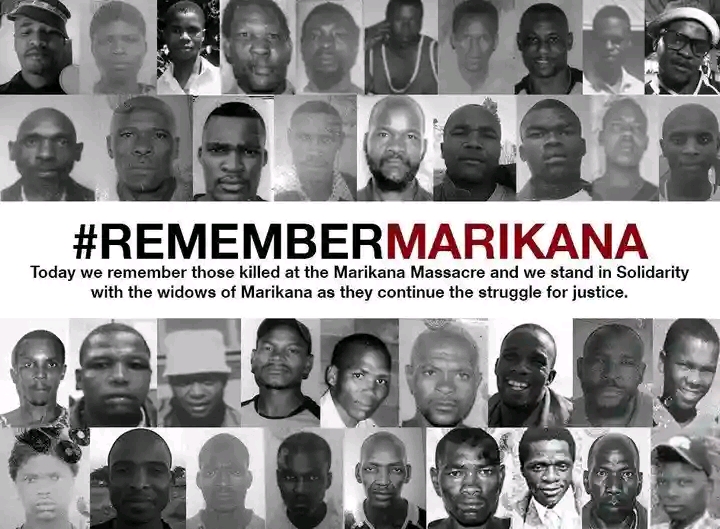
On 16 August 2012, 34 mineworkers were killed when police opened fire at Lonmin’s Marikana platinum mine in North West. Seventy-eight others were wounded and about 250 were arrested. The killings followed a week of violence in which 10 people had already died, including six mineworkers, two police officers and two security guards.
The events of those days remain one of the darkest chapters in post-apartheid South Africa.
The significance of Marikana extends far beyond the mineworkers, their families and the platinum belt. It goes to the heart of a promise made when apartheid ended: that the state would no longer use its power against black South Africans with impunity, and that constitutional democracy would place human dignity, equality and accountability at the centre of public life.
That promise is precisely why Marikana remains so difficult to put to rest.
The massacre was not an aberration from an authoritarian past. It happened under a democratic Constitution, with institutions specifically established to prevent the arbitrary exercise of state power. That makes the absence of criminal accountability particularly troubling.
The Socio-Economic Rights Institute of South Africa, which represents a number of Marikana families, says the families and survivors are still waiting for justice. Its argument is difficult to dismiss. The passage of time has not erased the crime. It has merely made the pursuit of accountability harder.
The National Prosecuting Authority has yet to secure a conviction for the killings of 16 August 2012. Several police officers were prosecuted in connection with other incidents surrounding the massacre, but those cases also ended in acquittals.
In March 2021, the Mahikeng High Court acquitted four police officers charged in connection with the death of mineworker Modisaotsile van Wyk Sagalala. He had been shot and wounded at what became known as Scene 2 on 16 August, before dying in a police vehicle while being transported with other arrested mineworkers.
Two years later, the NPA cited personnel and resource constraints as among the reasons for its failure to advance the Marikana prosecutions.
In September 2024, six police officers were acquitted over the events of 13 August 2012, when three mineworkers and two police officers were killed.
After those acquittals, the NPA said it would revive the matter and conduct a formal inquest. Yet, according to SERI, there has been little clarity about what has happened since.
That uncertainty is itself part of the problem.
Justice delayed is often described as a procedural failure. Marikana shows why that description is inadequate. Every year that passes makes witnesses harder to trace, memories less reliable and evidence more difficult to test. Delay does not merely postpone justice. It can gradually make justice harder to achieve.
There is another uncomfortable reality. The state has paid substantial sums in civil settlements arising from the massacre. SERI says approximately R352 million has been paid in settlements involving some of the 36 civil claims brought by injured survivors, unlawfully arrested miners and families.
Among the families represented by SERI, 34 received about R71 million in loss-of-support claims, benefiting more than 300 dependants. Yet more than 120 people from those families received nothing, according to the organisation.
Compensation matters. Families who lost breadwinners and survivors who suffered life-changing injuries cannot be expected to live on principles alone.
But money cannot answer the central question that has haunted Marikana for 14 years: who should be held criminally responsible for the unlawful use of deadly force? A settlement can acknowledge financial harm. It cannot establish accountability.
That distinction matters because Marikana was not simply an industrial dispute that went catastrophically wrong. It was a confrontation between citizens and the state in which the state’s coercive machinery ended 34 lives in a matter of minutes.
The anniversary therefore forces South Africa to confront something larger than the tragedy itself.
What does constitutional democracy mean when citizens can die at the hands of the state and spend more than a decade waiting to see whether anyone will face criminal consequences?
The comparison with the Soweto uprising of 1976 is unavoidable. Marikana was the deadliest use of force by South African police since the killings of students protesting against apartheid’s education policies. In both cases, young black people demanding their rights encountered the overwhelming force of the state.
The historical circumstances are profoundly different. Soweto took place under apartheid. Marikana occurred under constitutional democracy. Yet that difference makes Marikana’s unresolved legacy even more disturbing.
South Africa changed its laws, its institutions and its political system after apartheid. The Constitution promised that government would be accountable and that every person would enjoy equal protection under the law. Marikana tests whether those principles still have meaning when the accused are members of the state security apparatus.
The arrival of Advocate Jan Lekgoa Mothibi as the new National Director of Public Prosecutions offers an opportunity to confront that question directly. SERI has called on the NPA to publish a comprehensive account of every outstanding Marikana prosecution, explain what remains to be done and provide a concrete timetable.
It has also called for non-prosecution certificates where the NPA is unwilling or unable to proceed, allowing families to consider private prosecutions.
Those demands should not be treated as another anniversary ritual.
The families deserve clarity. If prosecutions can proceed, they should proceed. If they cannot, the NPA should explain why. If evidence has deteriorated beyond recovery, that reality should be confronted honestly rather than concealed behind administrative silence.
SERI has also called on President Cyril Ramaphosa to issue a formal apology to the Marikana families, noting that such an apology had previously been promised but never delivered. That, too, would not amount to justice. But an apology would at least acknowledge the magnitude of what happened and the continuing pain carried by those left behind.
Fourteen years on, Marikana is not merely a memorial to 34 dead mineworkers. It is a test of South Africa’s democratic conscience.
The guns fell silent long ago. The questions did not.
A constitutional democracy cannot ask grieving families to accept compensation as a substitute for truth, nor can it expect the passage of time to extinguish the state’s responsibility.
Marikana will remain unfinished business until South Africa can answer a basic democratic question: when the state uses lethal force against its own citizens, who holds the state to account?