

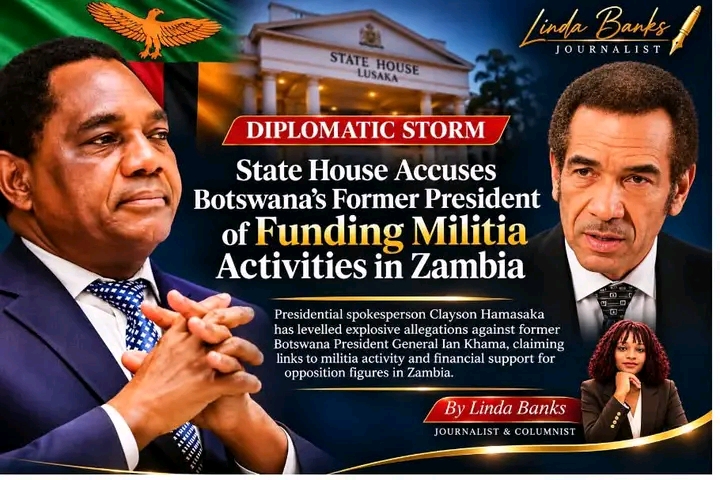
WHEN STATE HOUSE BECOMES A DIPLOMATIC AND CONSTITUTIONAL LIABILITY, THE NATION MUST WORRY.
By Linda Banks
HAMASAKA’S CREDIBILITY IS FINISHED. BUT THE DAMAGE MAY EXTEND FAR BEYOND HIS OWN CREDIBILITY.
Before the President assembled his team, some of us offered sincere guidance on whom to retain and whom to leave out. Not because we hated those individuals, but because we recognised that certain personalities lacked the judgement, restraint and political maturity required to advance his agenda.
Today, some of those very individuals appear to have become the greatest liabilities to the presidency they were appointed to protect.
Clayson Hamasaka appears to be perpetually auditioning for a job he already holds. One wonders whether the relentless urge to demonstrate loyalty has overtaken the elementary obligation to exercise judgement.
Previously, he questioned the motives and funding of civil society organisations, both locally and across Africa, when they raised concerns about Emmanuel Jay Jay Banda and other human rights issues.
Now, we have something potentially far more consequential.
https://www.facebook.com/share/p/1EbPVXxsK5/?mibextid=wwXIfr
A FORMER FOREIGN HEAD OF STATE ACCUSED OF FINANCING AN ALLEGED MILITIA IN ZAMBIA!
Does State House appreciate the diplomatic gravity of allegations reportedly made against Botswana’s former President, General Ian Khama?
We are not discussing an ordinary political disagreement. We are discussing an allegation potentially associating a former Commander-in-Chief of a neighbouring sovereign nation with activities alleged to threaten Zambia’s national security.
Where is the evidence? Who authorised the accusation? Was the Ministry of Foreign Affairs consulted? And does the President endorse these extraordinary claims?
A deleted social media post does not necessarily erase the legal, diplomatic or reputational consequences of its publication.
And this brings me to a far more disturbing constitutional question.
HAVE BRIAN MUNDUBILE, MAKEBI ZULU AND THEIR CO-ACCUSED ALREADY BEEN CONVICTED IN THE COURT OF STATE HOUSE?
If the reported statements are authentic, I am deeply concerned about their implications for the presumption of innocence and the right to a fair trial.
Article 18 of the Zambian Constitution guarantees an accused person a fair hearing before an independent and impartial court. It also guarantees the presumption of innocence until guilt is established according to law.
These are not privileges granted at the discretion of the President. They are constitutional protections.
When a presidential spokesperson publicly discusses allegations of treason, militia activity and supposed financiers, he risks creating the appearance that the Executive has already reached conclusions on matters that properly belong before the courts.
How can the State demand that citizens respect the judicial process while an official speaking from the presidency appears to pronounce upon the substance of allegations that remain to be proved?
Was Hamasaka communicating verified investigative findings? Was he authorised to disclose sensitive information? Or was he expressing political speculation under the authority of State House?
Each possibility raises serious questions.
I THEREFORE STRONGLY IMPLORE THE LAW ASSOCIATION OF ZAMBIA AND MULENGA MUNDASHI & CO. ADVOCATES TO EXAMINE THESE DEVELOPMENTS WITH THE UTMOST URGENCY.
My concern is not merely that political opponents have been accused of serious offences. It is whether they can enjoy the full protection of the law when public statements emanating from the presidency risk portraying them as guilty before a court has determined their guilt.
Their legal representatives should consider whether these pronouncements create grounds for challenging prejudicial executive commentary, seeking appropriate judicial safeguards and requiring clarification of the evidential basis for such extraordinary allegations.
The Director of Public Prosecutions must also be allowed to exercise prosecutorial independence without political pressure, real or perceived.
If sufficient admissible evidence exists, let it be presented before an independent court and tested through due process.
If it does not, the accused must not be punished through prolonged uncertainty, public condemnation or detention unsupported by law.
The burden of proof rests upon the prosecution. It does not rest upon the accused to disprove political pronouncements from State House.
And there is another dimension that deserves serious consideration.
GENERAL IAN KHAMA HAS LEGAL RIGHTS TOO.
A former President does not surrender his reputation merely because he has left office.
If General Khama has indeed been publicly accused of financing an alleged militia, he is entitled to seek independent legal advice on whether the publication gives rise to an actionable defamation claim against Hamasaka or any other legally responsible party.
Whether such proceedings could succeed would depend on the precise words published, their meaning, applicable jurisdiction, available defences and any relevant immunities.
But the underlying principle remains: public office is not a licence to make potentially reputation-destroying allegations without accountability.
The irony would be extraordinary. A presidential spokesperson purporting to defend his government could instead expose it to diplomatic embarrassment, constitutional scrutiny and potentially avoidable litigation.
But perhaps the fundamental problem confronting some presidential appointees is their failure to understand one elementary principle of democratic governance.
The moment Hakainde Hichilema declared himself President of the Republic of Zambia, he ceased to belong exclusively to his political friends, former colleagues, party loyalists and presidential appointees.
He became President of ALL Zambians, including those who oppose him, question him and profoundly disagree with his leadership.
That distinction is not negotiable.
Journalists have the right to scrutinise and criticise the President. Citizens have the right to question his decisions, challenge his policies and express dissatisfaction with his government without automatically being accused of treason, bitterness or harbouring sinister political motives.
The President’s former close friends and current government officials must understand that criticism of Hakainde Hichilema is not a personal attack on their friend. It is democratic scrutiny of a public officeholder.
Their emotional attachment to the man does not confer upon him immunity from criticism, nor does it impose upon the nation an obligation to admire him.
A presidency is a constitutional institution, not a private friendship circle.
Zambia is a republic, not an exclusive social club whose members must approve every opinion expressed about its chairman.
Since the disputed declaration of victory in this year’s elections, Zambia has appeared to stumble from one controversy into another.
Even when I apply the coldest intellectual reasoning, I struggle to reconcile this extraordinary pattern of events.
As a person of faith, I cannot ignore the moral and spiritual dimensions of leadership. A nation cannot indefinitely endure fear, division, bitterness and the erosion of institutional dignity without consequences.
ZAMBIA NEEDS A RESET. URGENTLY. BEFORE THE POLITICAL TEMPERATURE REACHES BOILING POINT.
Not because we wish the President to fail, but because we cannot afford for Zambia to fail.
The presidency is bigger than its occupants. The Constitution is bigger than political loyalty. And the administration of justice must never become collateral damage in someone’s desperate pursuit of presidential approval.
Mr President, some of those defending you most loudly may be doing your presidency the greatest harm.
And if your spokesperson’s public pronouncements create the impression that political opponents have already been judged guilty, the question is no longer merely whether he has embarrassed State House.
The question is whether State House itself is undermining public confidence in the independence of the justice system.
That is a far more serious matter than an ill-advised Facebook post.
Hamasaka may delete his words. But he cannot simply delete the constitutional questions they raise.