

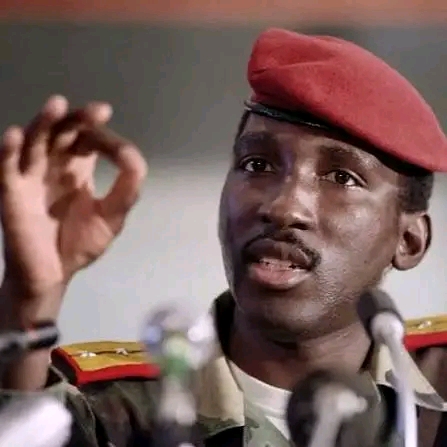
He heard the gunmen coming and told his colleagues it’s me they want, stay here
On 15 October 1987, Thomas Sankara went to a meeting of the National Revolutionary Council at the Conseil de l’Entente building in Ouagadougou. He was 33 years old and he was the president of Burkina Faso. According to witnesses, when the shooting started outside, Sankara understood immediately what was happening. He told the men in the room with him, it’s me they want, stay here. Then he walked out to face them alone. He was shot multiple times. Twelve of his colleagues were killed anyway.
The prosecution at his trial put it simply. As Sankara headed to the meeting, his executioners were already there.
The man who took power that day was Blaise Compaoré. He was not a rival or a stranger. He was Sankara’s closest comrade, his friend, the man who had helped bring him to power in 1983. It was the deepest betrayal in modern African politics.
Understand what Sankara was in the four years he had. He renamed the country from Upper Volta to Burkina Faso, the land of upright people. He vaccinated 2.5 million children in a matter of weeks. He planted 10 million trees against the advancing desert. He banned forced marriage, polygamy and female genital mutilation, and put women in his government when almost no African leader would. He sold off the government’s fleet of Mercedes and made the Renault 5 the official state car. He cut his own salary to about 450 dollars a month, and when he died his personal possessions amounted to a car, four bikes, three guitars, a fridge and a broken freezer. He refused foreign aid on principle and told the world that he who feeds you controls you. He stood before the Organisation of African Unity in 1987 and called on the whole continent to refuse to pay its debt, warning that if Burkina Faso stood alone he would not be there for the next conference. Three months later he was dead.
Then came the 27 years. Compaoré ruled Burkina Faso until 2014. He reversed Sankara’s policies, restored the relationship with Paris, and kept a tight lid on the circumstances of the killing for nearly three decades. No investigation was possible while he held power. Sankara was buried in a hurried, unmarked grave, and his family fought for decades just to have the body exhumed.
Justice came only after the people threw Compaoré out. A popular uprising forced him to flee to Côte d’Ivoire in 2014, which then granted him citizenship. The trial finally opened in October 2021, more than 34 years after the murder. On 6 April 2022 a military court convicted Compaoré of attacking state security, complicity in murder and concealing a corpse, and sentenced him to life imprisonment. His security chief Hyacinthe Kafando, suspected of leading the hit squad, got life too. General Gilbert Diendéré got twenty years. The court also confirmed that French agents were present in Ouagadougou on 16 October 1987, the day after the killing. France has never declassified its files.
And here is the ending that should make every African angry. Compaoré was tried in absentia. He was never arrested, never extradited, never spent a night in a cell. He is alive in Côte d’Ivoire, a convicted murderer of a head of state, living freely with a life sentence hanging over him that no one has enforced.
Sankara asked his colleagues to stay behind so they would not be killed with him. They were killed anyway. And the man who ordered it has still not answered for it.