

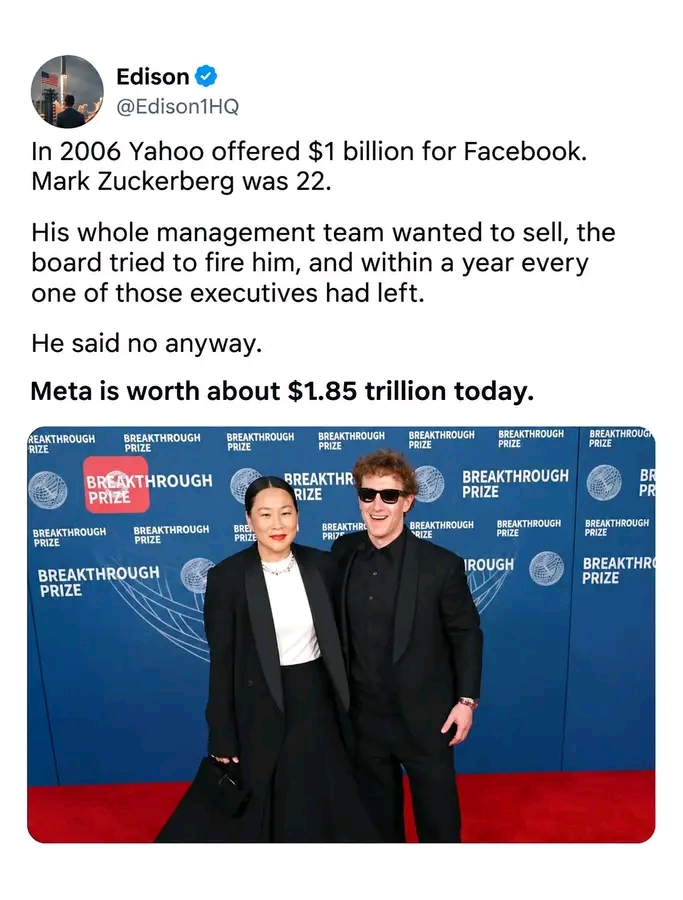
HE TURNED DOWN $1 BILLION AT 22.
TODAY, META IS WORTH $1.58 TRILLION.
In 2006, Yahoo reportedly offered to buy Facebook for $1 billion.
Mark Zuckerberg was just 22 years old.
Most of his management team believed selling was the right decision.
Zuckerberg disagreed.
He later said the board was so upset that it tried to remove him, while the management team eventually left over the following 18 months.
At the time, Facebook had around 10 million users.
But Zuckerberg saw something beyond those numbers: a platform that could connect people at a scale traditional media companies could not easily replicate.
That decision gave Facebook the opportunity to grow into something much bigger.
It expanded beyond college networks, built a powerful advertising business, acquired Instagram and WhatsApp, and eventually became Meta Platforms.
As of November 18, 2026, Meta’s stock-market value is approximately $1.58 trillion.
Put that beside the original $1 billion offer, and the scale of what the company became is extraordinary.
But here’s the financial lesson I find more interesting:
A business should not always be valued by what someone is willing to pay for it today. Its future earning power, competitive advantage, customer network, and ability to generate cash can matter far more.
Facebook’s growing user network became a major advantage.
More people attracted more businesses and advertisers, while advertising revenue helped fund further expansion.
That is how a platform can turn its audience into a long-term economic engine.
There is another lesson here, too.
Rejecting a billion-dollar offer was not automatically the smart choice. Facebook could have failed, competitors could have won, and the future was far from guaranteed.
The decision only looks extraordinary because the business eventually delivered on a potential that was difficult to see in 2006.
For entrepreneurs and investors, the takeaway is not to reject every offer or hold every investment forever.
It is to understand what you own, what could make it more valuable, and what risks you are accepting by waiting.
Sometimes the biggest financial decision is knowing what you are giving up when you cash out.