

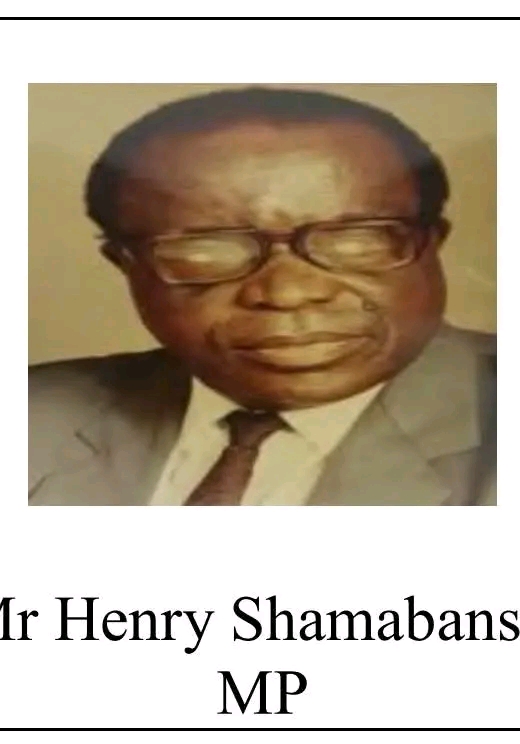
HENRY SHAMABANSE: THE TEACHER, NATIONALIST, FREEDOM FIGHTER AND POLITICAL VETERAN WHOSE NAME OUTLIVED HIS TIME IN POLITICS
From the classroom to the liberation struggle, from the corridors of power to the quiet life of farming the story of a man who helped build a nation and left behind a name that the people of Kabwe still call out to this day.
Shamabanse was born on 15 March 1929 in Broken Hill, present-day Kabwe, to William Shamabanse and Idah Kubala. He came from a generation in which politics was not merely a career choice but, for many, a calling that demanded courage, sacrifice and, occasionally, a willingness to exchange the comfort of ordinary life for the uncertainties of the liberation struggle.
Raised in a devout Catholic household, Shamabanse served as an altar boy. Little could anyone have imagined that the young man who once served at the altar would grow up to challenge the colonial establishment. From the church to the political battlefield, his journey was anything but ordinary.
Shamabanse received his early education at St Mary’s School in Broken Hill before proceeding to St Canisius, where he completed his education.
He subsequently pursued a career in teaching, working at Kapandwe School before moving to Chipepo School, where he rose through the ranks to become headmaster. He was later transferred to Mkushi.
But while some teachers were content with chalk, blackboards and the occasional stubborn pupil, Shamabanse had his eyes on a much bigger classroom, the political education of an entire nation.
By 1956, he had resigned from the teaching service. A year later, in 1957, he became actively involved in politics in Broken Hill, participating in civil disobedience against colonial rule.
When the United National Independence Party (UNIP) was formed, Shamabanse became actively involved in mobilising support for the party.
His commitment to the nationalist movement saw him entrusted with greater responsibilities, including an appointment as UNIP regional secretary in the Feira area, following his transfer to Lusaka and the surrounding region.
By 1964 when Zambia attained her independence, Shamabanse had also won the Lukanga constituency in Kapiri Mposhi on the UNIP ticket.
His victory opened the door to national leadership. Kenneth Kaunda appointed him Resident Minister for Central Province.
He subsequently served in different provincial assignments, including Southern and Western provinces, and later held the position of Minister of State for Labour and Social Services. In 1969, he was transferred to North-Western Province in the same capacity.
In 1973, Shamabanse did not seek re-election for the Lukanga parliamentary seat.
He withdrew from active public office and ventured into private business, establishing Lukanga Blocks Works Limited, a construction company in Solwezi. He later returned to his farm in Kabwe.
For nearly a decade, he remained largely absent from public life.
He went farming.
In 1983, President Kaunda brought Shamabanse back into public service, appointing him District Governor for the newly established Chibombo District in Central Province.
In 1988, he was appointed a member of the UNIP Central Committee for Central Province.
In 1990, he received another appointment as a member of the Central Committee and Deputy Administrative Secretary at Freedom House, UNIP’s headquarters.
During the 1990–1991 period, he was also assigned to North-Western Province as a Central Committee chairman.
It appeared that, even after years away from the political limelight, Shamabanse’s experience remained valuable to the old guard.
The return to multiparty politics in 1991 brought an end to UNIP’s long hold on power. Shamabanse subsequently retired from active politics and concentrated on farming.
Despite the political transition, he remained loyal to UNIP.
Individuals associated with the new Movement for Multiparty Democracy (MMD) government reportedly continued consulting him on national matters, with prominent figures visiting him and attempting to persuade him to join the new political establishment.
However, Shamabanse remained attached to the party with which he had fought for independence, UNIP.
Shamabanse died on 9 March 1997, just six days before his 68th birthday. He was laid to rest at the old St Mary’s cemetery in Kabwe.
His passing marked the end of a life that had traversed several chapters of Zambia’s political history: colonial resistance, independence, the consolidation of UNIP rule, the one-party state and the return to multiparty democracy.
In Kabwe, his name lives on through a residential area popularly known as Kwa Shams or Shamabanse Compound.
The name is a reminder that history is not always preserved through monuments, grand buildings or carefully worded government statements. Sometimes, it survives through the names people give to the places they inhabit
And perhaps that is one of the most interesting aspects of Shamabanse’s legacy.
Governments may confer titles, parties may bestow appointments, and political careers may eventually fade into archival documents. But when ordinary people name a neighbourhood after someone, they create a form of remembrance that no political reshuffle can easily erase.
The people of Kabwe did not need a campaign committee or a party convention to keep his name alive. They simply called the place after him.
No election campaign required. No manifesto necessary. No political rally to remind anyone who he was.
In recognition of his contribution to Zambia, late President Levy Mwanawasa honoured Shamabanse posthumously at an investiture ceremony, conferring upon him the Order of the Eagle of Zambia, Second Division.