

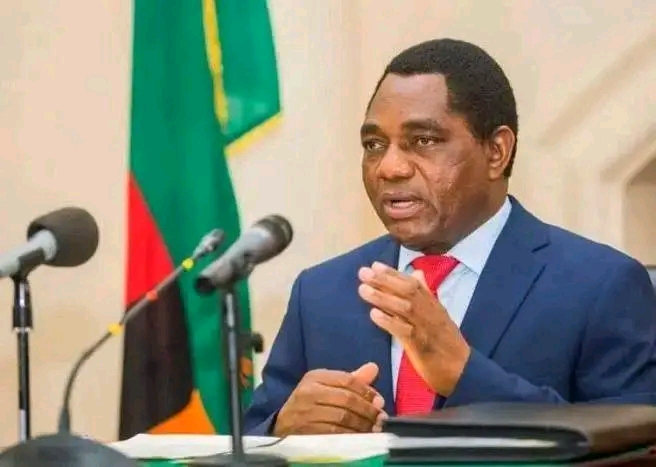
HH Wins by a landslide. But the Real Story Is Why.
The election is over. President Hakainde Hichilema has another 5-year mandate, and Zambia must now move beyond the campaign noise and ask a more important question:
Why did the election produce this result?
For me, the signs were there. I believed this election would ultimately be decided by three groups: new voters, neutral voters and the ability to retain the political arithmetic that had previously placed the governing side at roughly 2.8 million votes against the opposition’s 1.8 million. The UPND did the latter very well with Southern, Western and North Western all delivering astounding numbers, while gaining significantly in places like Luapula, Eastern, Lusaka, Copperbelt, and Central provinces.
The opposition needed more than enthusiasm. It needed to fundamentally change that equation. It didn’t. Makebi was always going to be a difficult choice and I felt Makebi Zulu was a problematic running mate from the beginning. His close association with the late President Edgar Lungu and the controversy surrounding the former President’s burial created an immediate political dilemma.
Those who strongly identified with the ECL family were likely to gravitate towards him. But those who believed the government had been right in the burial dispute were unlikely to suddenly embrace a ticket so closely associated with that political camp. Whether fair or unfair, politics is about perception. And the perception around Makebi was simply too complicated.
There were even allegations and political theories suggesting that he had played a central role in the events surrounding the burial impasse for political advantage. Regardless of whether one accepts those claims, the controversy itself was politically expensive.
Then came the promise to release jailed PF officials
This, for me, was one of the biggest political miscalculations.
Telling voters that people convicted by competent courts would simply be released may have sounded politically attractive to sections of the PF constituency. But it also created a different reaction among neutral voters. Many Zambians did not see those convictions merely as political persecution. They saw them as the consequence of alleged wrongdoing that had gone through the judicial process. The opposition therefore needed to convince voters that the justice system had failed.
Further, economic messaging needed more than criticism. The economy was always going to be the biggest battlefield with inflation, the Kwacha, foreign reserves, fuel, food prices, production costs, and Jobs all at the center of the cost of living for an average Zambian. These are the issues that determine whether people vote with their hearts or their stomachs.
But the opposition’s economic messaging often appeared stronger on criticism than on a convincing alternative.
At times, statements about foreign reserves and economic management raised more questions than answers. If you want to take over government, voters need to know what you will do differently, how you will finance it and what the consequences will be. Saying the incumbent has failed is easy. Convincing the country that you can do better is the real election.
The campaign became a catalogue of political miscalculations including the halabaloo about excavators for marketeers, attempts to discredit free education which is benefiting masses in rural and marginalized communities, and ill arguments around the Constituency Development Fund (CDF).
The problem was not necessarily that every idea was bad. The problem was credibility. Voters have become much more sophisticated. They don’t simply ask, “What are you promising me?”
They increasingly ask: “Can you actually deliver this?”
And perhaps even more damaging was the impression that some of the opposition’s own leaders did not appear prepared for the momentum their campaign generated. Brian Mundubile himself seemed at times almost surprised by the attention the campaign attracted. That is dangerous in an election. Momentum without strategy is not enough.
Then came the Mundubile’s defence of Binwell Mpundu over the controversial “ready to be killed or kill” remarks, which I felt was another unnecessary political headache. Politics requires knowing when to defend your colleague and when to distance yourself from a statement. Sometimes, the strongest political response is: “That was wrong. We don’t support it.”
Instead, the opposition repeatedly found itself explaining statements that should never have needed explanation. And every explanation consumed political oxygen.
But perhaps the biggest mistake was the statement that Mundubile would govern Zambia the way Edgar Lungu did. That, in my view, was the clearest political error.
With respect to the late President, Zambia had already answered that question in 2021. The electorate rejected the continuation of the Lungu administration and handed power to Hakainde Hichilema.
You could disagree with that decision. You could argue that ECL’s record deserved another chance. But you could not ignore the political reality that the 2021 election was a rejection of that model of governance.
Therefore, promising voters a return to it was unlikely to unseat the very president who benefited from that rejection. You could not defeat HH by telling voters you will become another version of the government they previously voted out.
.
The opposition underestimated the centre. The UPND did not necessarily need every Zambian to love it. It just needed enough voters who were undecided, neutral or unconvinced by the alternative to stay within its electoral coalition. And that appears to have happened. The new voters mattered. The neutral voters mattered. The voters who had moved away from PF but were not necessarily UPND loyalists mattered. And most importantly, the opposition did not build a compelling enough bridge between its traditional support base and the political centre.
Now, with the final results announced, President Hakainde Hichilema won 2.97 million votes or 60.7 percent of the poll against Brian Mundubile’s 1.86 million votes or 38 percent of the poll. There will be prize for remaining permanently angry about the result. There is no wisdom in spending the next five years explaining why everyone who voted differently was foolish. The opposition must now undertake an honest post-mortem. They must interrogate what they got wrong as opposed to wasting time on who may have betrayed them, or assertions of a rigged election. This result means President Hichilema has not only consolidated his victory but has also surpassed his previous tally of 2.8 million votes recorded in 2021, by more than hundreds of thousands votes.
And for the government, victory must also come with humility. A second mandate will not be a blank cheque. Zambians voted and will expect results including cheaper food, a stronger Kwacha, reliable electricity, and Jobs. Further inevitable investment in better healthcare,better education, functional public institutions, and more importantly, a government that remembers that political victory comes from citizens who vote and eventually expires.
The opposition has five years to rebuild. The government has five years to deliver. And for every politician, there is one lesson from this election that should never be forgotten: “The voter is watching.”
By Michael Kaluba