

CAMPAIGN WATCH | Hichilema Revisits Central as UPND Fine-Tunes Electoral Map
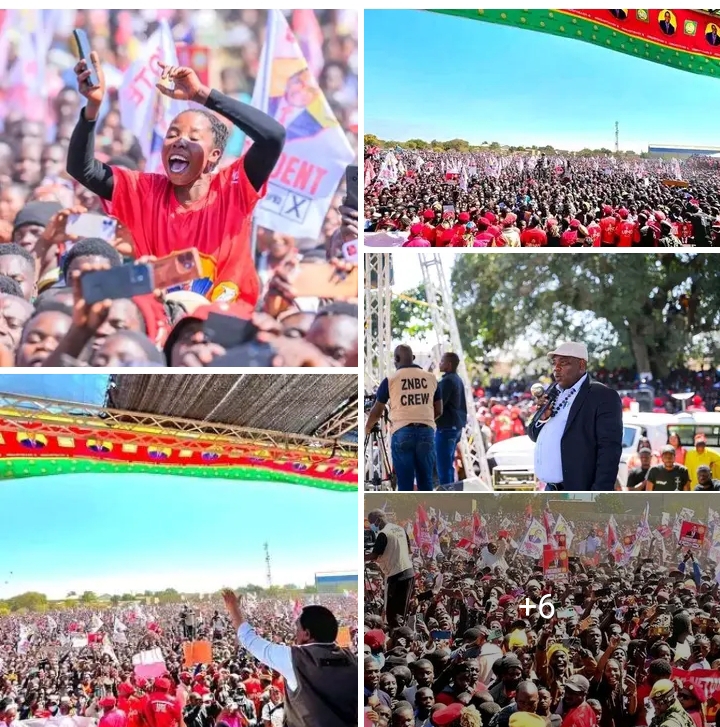
President Hakainde Hichilema took his campaign back to Luano District in Central Province on Tuesday, a day after completing his Southern Province programme. The visit was notable not because it introduced a new campaign message, but because it returned the UPND campaign caravan to a province it had already traversed earlier in the campaign.
Addressing supporters, Mr Hichilema stayed with the themes that have defined his re-election bid.
“We shall continue delivering for you. More jobs. More agriculture support. More business opportunities,” he said, before promising additional roads, schools and health facilities for Luano.
He urged residents to “go in large numbers and vote for us this August,” framing the election as a choice between continuing existing programmes and changing direction.
The revisit to Central Province offers insight into the campaign’s priorities. Modern campaigns rarely retrace their steps unless they believe additional mobilisation is worthwhile. With only days remaining before voting, every journey competes for the campaign’s most limited resource: time. Returning to a province suggests the UPND believes there are votes to consolidate, not simply rallies to hold.
Central Province has become an increasingly favourable province for the ruling party. In 2021, Mr Hichilema won the province decisively, extending UPND support beyond its traditional bases in Southern, Western and North-Western provinces. Revisiting districts within Central points to a strategy focused on strengthening existing support rather than assuming previous gains will automatically translate into turnout.
This strategy also reflects the arithmetic of Zambia’s presidential election. The national conversation often centres on Lusaka and the Copperbelt because they are the country’s largest urban centres and generate the greatest volume of political debate. They are also the provinces where both the UPND and the Tonse Alliance are investing heavily, suggesting each expects a closely contested race rather than an outright sweep.
But presidential elections are decided by a national majority, not by victories in a handful of cities. A candidate must assemble support across provinces and secure more than 50 percent plus one of valid votes cast. That reality makes turnout in rural constituencies just as important as margins in urban centres.
Many of the government’s flagship programmes have their greatest visibility outside the major cities. Free education, teacher recruitment, additional health workers, Social Cash Transfer expansion, agricultural support and Constituency Development Fund projects are policies that reach communities where public services often have a direct impact on daily life.
Whether those programmes ultimately influence voting behaviour will only be known after polling day, but the campaign’s itinerary suggests the UPND believes they provide a strong basis for mobilisation in rural Zambia.
There is another pattern emerging. While some campaigns have concentrated much of their energy on the headline battlegrounds of Lusaka and the Copperbelt, the President’s itinerary points to a broader electoral map. Rather than relying solely on urban contests, the UPND appears to be investing in provinces where it believes high turnout can reinforce its national position while remaining competitive in the country’s largest electoral blocs.
Campaign routes are rarely accidental. They reflect calculations about organisation, turnout and where additional votes are most likely to be found. As the August 13 election approaches, the UPND campaign appears to be making one calculation above all others: in a presidential election decided by national arithmetic, consolidating favourable ground can be as important as competing for new territory.
© The People’s Brief | Goran Handya