

🇿🇲 EXCLUSIVE | Hichilema’s Copperbelt Gamble
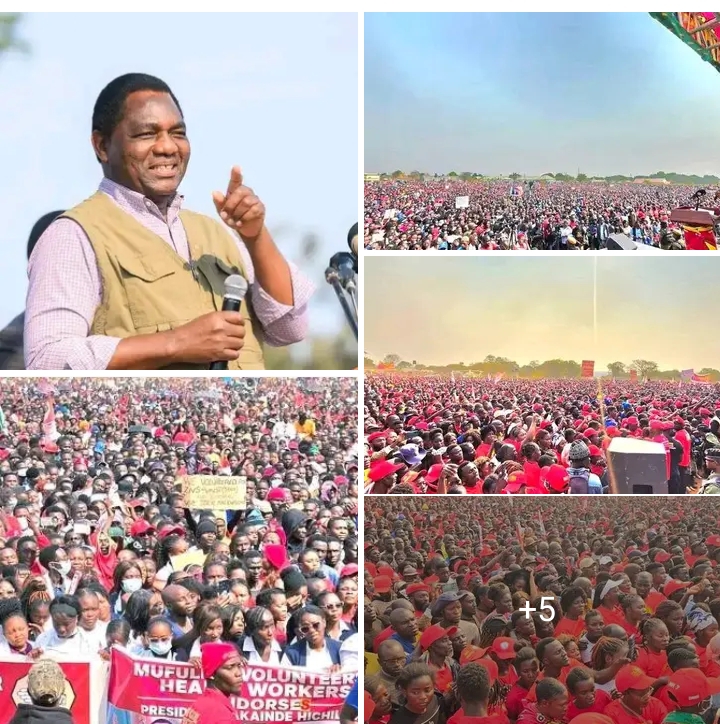
President Hakainde Hichilema has returned to the Copperbelt at one of the most decisive moments of his re-election campaign, not because he failed to win the province in 2021, but because winning it again may not be enough. With only days remaining before Zambians vote on August 13, the President appears to be pursuing something more ambitious: expanding his margin in one of Zambia’s most competitive electoral battlegrounds as part of the UPND’s stated objective of securing five million votes nationwide.
The Copperbelt enters this election with 1,296,446 registered voters, making it Zambia’s second-largest voting province after Lusaka. In 2021, it delivered one of the victories that helped propel Mr Hichilema into State House. He polled 420,443 votes, representing 56.4 percent of the ballots cast, while then president Edgar Lungu secured 300,413 votes, or 40.3 percent. The UPND’s advantage of approximately 120,000 votes proved significant nationally, but unlike Southern, Western and North-Western provinces, where the party recorded overwhelming victories, the Copperbelt remained a province won through persuasion rather than dominance.
That distinction explains why the President is back.
Since the restoration of multi-party democracy, the Copperbelt has rarely produced overwhelming presidential victories. It is an industrial province, but it is also home to extensive farming communities, expanding rural districts and rapidly growing townships. Mining towns, commercial agriculture and rural livelihoods coexist within the same electoral map, producing voting patterns that are often more competitive than those found in traditional party strongholds. Political history suggests the province rewards broad coalitions, not electoral monopolies.
President Hichilema’s latest itinerary reflects that reality. His campaign has deliberately combined mining centres with predominantly rural districts, taking him through Mufulira, Lufwanyama, Kalulushi and Chambishi. The message has remained remarkably consistent. Rather than unveiling a catalogue of new promises, the President has asked voters to judge his administration on continuity.
“We have done so much for the Copperbelt but we still have a lot of work. More jobs. More business opportunities. More health facilities. More schools. More agriculture support. Free education. And opening up of more mines will have to continue.”
The emphasis is equally visible in the campaign’s engagement with rural communities. Addressing supporters in Lufwanyama, a district where farming is as politically significant as mining, the President connected government programmes directly to the election.
“Your show of gratitude towards free education, increased CDF, employment opportunities and many others is highly acknowledged. In order for these and many more developments to continue trickling down to Lufwanyama and Zambia, we call on you to go and vote for us this August.”
That message illustrates a broader electoral calculation. Public debate often treats the Copperbelt as one large urban voting bloc driven almost entirely by mining and the cost of living. The electoral map tells a more complex story. Districts such as Lufwanyama, Masaiti and other rural parts of the province are shaped by agriculture, feeder roads, farming support and access to public services.
Issues such as free education, Social Cash Transfers, teacher recruitment, health workers and the Constituency Development Fund resonate differently there than they do in densely populated mining townships. The campaign appears designed to speak to both realities simultaneously.
The President’s return also forms part of a broader national strategy that has become increasingly visible during the closing stages of the campaign. After becoming the first presidential candidate to physically campaign in all ten provinces, Mr Hichilema has begun using the remaining Electoral Commission campaign days to revisit strategically selected districts.
Southern Province was followed by Central Province, then Western Province, Eastern Province and now another Copperbelt swing. Reports indicate the Northern circuit could also receive renewed attention before polling day. Rather than repeating the campaign, the UPND appears to be reinforcing areas where additional votes remain attainable.
Opposition leaders argue these return visits demonstrate an incumbent under pressure. The governing party offers a different explanation, describing them as part of a disciplined electoral strategy aimed at broadening support beyond its traditional strongholds. Neither interpretation can be verified through rallies alone. Elections are decided by ballots, not campaign narratives.
The arithmetic, however, is easier to measure. The UPND secured 2,852,348 presidential votes in 2021. If its publicly stated ambition is to approach five million votes, defending its previous support will not be sufficient. The campaign must increase its margins in provinces already won while simultaneously making inroads into provinces historically associated with the opposition.
The Copperbelt occupies a central place in that calculation because every additional percentage point represents thousands of votes added to the national tally.
Whether the strategy succeeds remains one of the defining questions of the 2026 election. The Copperbelt continues to wrestle with familiar concerns over employment, mining investment, municipal services and household living costs, providing fertile political ground for both the governing party and the opposition.
At the same time, the UPND is asking voters to weigh those concerns against visible investments in education, mining revival, infrastructure, health services and local development financed through increased CDF allocations.
The outcome will not be determined by the size of campaign crowds or the volume of political slogans. It will be determined by how the province’s diverse electorate: miners, farmers, traders, civil servants, young voters and rural households interprets the competing messages placed before them. This is why President Hichilema is back on the Copperbelt. Not simply to defend a province he won in 2021, but to test whether one of Zambia’s most influential electoral battlegrounds is prepared to widen that victory.
© The People’s Brief | Ollus R. Ndomu