

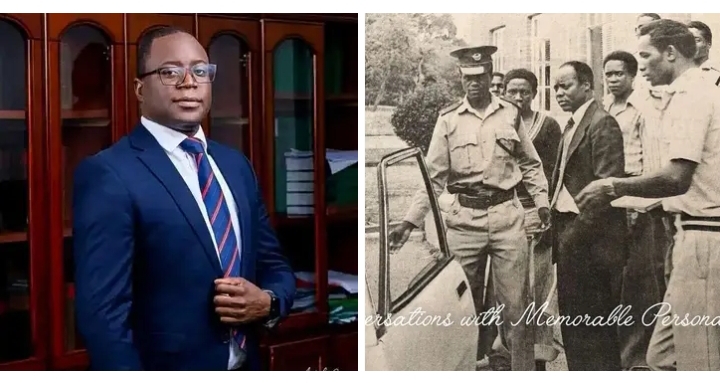
Echoes Of Shamwana: How 45-Year-Old Makebi Zulu Has Taken The Reins In Modern-Day Treason Trial
Hey Folks,
In October 1980, Makebi Zulu was still unborn when one of Zambia’s towering legal minds of the era—Edward Jack Shamwana—was arrested for treason in a state sweep that shook the country.
That arrest set the stage for a legendary courtroom showdown where Shamwana elected to reject outside counsel, stood alone, and fought a mandatory death sentence.
A year after that historic treason arrest, Makebi Zulu was born on December 25, 1981, on Christmas Day!
Fourty-five (45) years later, history has awoken its ghosts in the very same Lusaka High Court. This week, Makebi—now a prominent opposition leader and a formidable legal mind himself, arrested on treason charges—elected to walk that exact same lonely and precarious Shamwana path.
In Zambia’s legal history, few maneuvers carry as much weight, risk, and inherent drama as an accused person choosing to stand alone before the High Court bench in a capital offense case.
By stepping out from behind a defence team, Makebi did more than just assume control of his own fate—he channeled a precedent of defiance set over four decades ago by Shamwana.
The parallels are striking.
Nearly 46 years ago, a 47-year-old Shamwana stood in a similar dock for his alleged role in the 1980 coup attempt against President Kenneth Kaunda. Facing the gallows, Shamwana relied entirely on his own sharp intellect to cross-examine state witnesses, expose gaps in the prosecution’s timeline, and aggressively challenge confessions obtained under duress.
Today, Makebi at 45 finds himself at the center of a modern treason storm, accused of possessing high-grade military weapons and allegedly operating an illicit post-August 2026 election militia group.
While the eras and political landscapes have shifted, the fundamental strategy remains identical. Where Shamwana focused on tearing down coerced confessions, Makebi has immediately used his own legal expertise to strike at the state’s procedural conduct.
Representing himself, Makebi is directly arguing his own Constitutional Bail Application, fiercely asserting that his prolonged detention—now exceeding 50 days—is a clear violation of constitutional limits on trial delays.
It remains to be seen whether this modern-day gamble will mirror the complex legal legacy left behind by Shamwana.
That notwithstanding, Makebi’s move has undoubtedly set the stage for one of the most compelling courtroom battles in Zambia’s contemporary history.
Having watched this precedent unfold so far, I am keenly waiting to see if Makebi will go full circle—by growing out his beard in protest, and representing his fellow treason-accused co-defendants whenever their human rights are trampled upon behind those high walls of Mukobeko Maximum Prison in Kabwe.
This is exactly what Shamwana did. He grew his beard—a protest tactic later mirrored by Dr. Kenneth Kaunda when he was arrested for treason on Christmas Day in 1997—and mounted a fierce court action on behalf of his fellow inmates, successfully challenging the state over deplorable prison conditions.
I share a vivid window into this experience in the excerpt below from my book, Conversations with Memorable Personalities, Part 1 (2022), as narrated by one of the 1980 treason masterminds—Yoram Godwin Mumba (pages 410–411).
Enjoy the excerpt!
Amos Malupenga
Author
Amos Malupenga: Now tell me how you were spending your time in prison.
Yoram Mumba: We were kept in the cells 24 hours, no coming out. You come out for only 30 minutes per day. In the morning 30 minutes and you get back.
Food was served right by the door. And the food was not that good. We had protested and we were lucky, we had Shamwana in our midst as a lawyer.
Shamwana instituted some court proceedings to complain to the court for better
conditions and we won the case. So, we just found that apart from the beddings, they were opening up 7 o’clock in the morning and then put us back after 5 o’clock. So, conditions were a bit better.
That was after a three months’ struggle in court.
Shamwana argued the case on our behalf, he would even lead us into giving evidence.
The case was before judge Florence Mumba. She gave us the verdict and things were a bit better.
The uniform when we were condemned was a pair of shorts. And instead of being given
two pairs, we were given four pairs so we could afford to change almost every day.
Then the sentence was commuted to life so were given trousers and warm clothing inside and socks. Shoes they said you can buy if you have got money. We could afford and helped our friends from Congo to buy. We were then given a cook and some two boys to wash for us, those were regular prisoners serving sentences. They cooked, washed and ironed for us.
So, on the food side, it was a bit better than it was in the condemned section.
And a year later they said government cannot afford to give you what you are supposed
to have so if you have relatives who can bring you, bring it here and we keep it here for you.
Picture caption: Edward Jack Shamwana (in a dark suit), on Thursday, November 20, 1980, being led by police officers and prison warders into a car outside the Lusaka High Court to be driven back to Mukobeko Prison in Kabwe after a court appearance.