

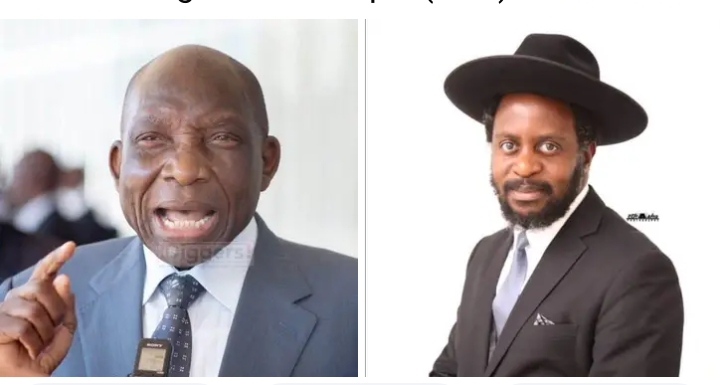
Saviour Chishimba, president writes
POLITICAL ALLIANCES CANNOT FLOURISH WHERE CONSULTATION IS ABSENT AND SACRIFICE IS MET WITH INSINUATION
I have read with considerable consternation the report published by News Diggers on 7 November 2026, attributing to Hon. Charles Milupi, Chairperson of the UPND Alliance Council of Presidents, the assertion that anyone who withdraws from the Alliance following the conclusion of ministerial appointments must have joined in anticipation of public office. If these remarks have indeed been accurately attributed to Hon. Milupi, I register my strongest objection to their tenor, implications and apparent disregard for the sacrifices of fellow political leaders.
Such an indiscriminate imputation of motives is particularly disheartening when associated with a gentleman of his political seniority, entrepreneurial distinction and longstanding acquaintance with many of us. The responsibilities of political leadership demand discernment, circumspection and an appreciation of the dignity of colleagues whose convictions and contributions cannot be summarily adjudicated through public insinuation.
I speak from an intimate knowledge of the circumstances surrounding the conception of this political undertaking. I was among the six participants at the inaugural meeting of the UPND Alliance held at Community House in 2017. The meeting was attended by President Hakainde Hichilema, Geoffrey Bwalya Mwamba, the late Hon. Mike Mulongoti, Hon. Charles Milupi, Dr Nevers Mumba and myself, Saviour Chishimba.
Our deliberations were animated by a shared aspiration to establish a durable political partnership founded upon mutual confidence, collective responsibility and a common commitment to Zambia’s advancement. We envisaged an association of independent political parties capable of sustaining principled cooperation beyond the exigencies of electoral competition. The experience of longstanding political alliances like the African National Congress (ANC) of South Africa informed our discussions. Those formative engagements were undertaken in the conviction that political solidarity derives its enduring strength from fidelity to shared objectives and the conscientious discharge of reciprocal obligations.
The 2026 electoral campaign demanded sacrifices whose magnitude cannot be adequately conveyed through casual political commentary. Some of us remained continuously deployed in the Northern Corridor until after the elections, confronting formidable logistical impediments, financial constraints and operational exigencies. We committed substantial personal and party resources to sustain mobilisation, frequently improvising solutions under exceptionally demanding circumstances. Even now, some of us remain encumbered by considerable financial obligations incurred in the prosecution of that electoral undertaking, with the arduous process of recovering our financial position still unresolved.
These commitments were made voluntarily, without contractual assurances of ministerial appointments or expectations that public office would constitute reimbursement for political expenditure. When difficulties arose, repeated attempts to communicate with the Alliance Chairperson and solicit collective interventions were unsuccessful. We consequently consulted our internal structures, marshalled the resources at our disposal and persevered because we regarded the electoral objective as a responsibility transcending individual convenience. There are many UPND members on the ground who can attest to this.
It is in this context that I must address a matter of considerable institutional concern. Speaking exclusively from my own experience, Hon. Milupi has remained persistently inaccessible to me in his capacity as Alliance Chairperson. Telephone calls have gone unanswered, messages have elicited little or no response, and our interactions have been largely restricted to ceremonial occasions and official functions. I personally brought this difficulty to his attention when we encountered one another during the official opening of Parliament.
I make no presumption about the experiences of other constituent leaders, but my own experience raises serious questions about the effectiveness of communication within the Alliance. Hon. Milupi is an eminent entrepreneur, an accomplished industrialist and a seasoned public figure. His extensive exposure to corporate governance and institutional administration should have cultivated an acute appreciation of the indispensable relationship between accessibility, consultation and effective leadership. An alliance chairmanship carries obligations of continuous engagement that cannot be satisfactorily fulfilled through sporadic encounters at public gatherings.
The constitutional responsibilities of President Hakainde Hichilema as Head of State, Head of Government and Commander in Chief of the Defence Force are exceptionally extensive. The President must attend to the multifarious demands of national administration, economic management, public security and international relations. It consequently behoves those of us participating in the Alliance to maintain effective mechanisms of consultation among ourselves, principally through the designated Chairperson, so that the President may benefit from coherent proposals, carefully examined policy interventions and collectively developed solutions.
The Chairperson ought to serve as the indispensable conduit through which constituent leaders exchange perspectives, reconcile differences and formulate proposals requiring presidential attention. Many questions arising within the Alliance should be deliberated upon and resolved without unnecessarily encumbering the President with matters properly belonging to its internal administration. Where communication between the Chairperson and a fellow party president becomes so attenuated that even ordinary telephone calls and messages remain unanswered, the efficacy of that coordinating responsibility is materially compromised. That is the institutional deficiency to which I draw attention.
My disappointment is compounded by a personal association with Hon. Milupi extending over many years. We served together in the National Assembly, and he is acquainted with consequential episodes in my political life. When I resigned my parliamentary seat in 2009, approximately three weeks before the disbursement of midterm gratuities, I approached Hon. Milupi to second my final motion in the House.
I relinquished parliamentary office and the attendant financial benefits at a moment when continued occupancy would have served my material interests. That decision arose from convictions which I was prepared to uphold irrespective of their personal cost. Hon. Milupi therefore has reason to appreciate that my political conduct has, on consequential occasions, involved the voluntary surrender of public office and its privileges. It is particularly regrettable that a leader with whom I share such a history should reportedly advance a sweeping proposition that invites the public to speculations.
The President’s constitutional prerogative to appoint Ministers is beyond dispute. Equally deserving of recognition is the distinct responsibility of Alliance leadership to sustain consultation, cultivate cohesion and preserve confidence among constituent political parties. An alliance cannot subsist indefinitely upon ceremonial association, intermittent encounters and declarations of solidarity while the ordinary disciplines of collective engagement remain neglected. Its vitality depends upon reciprocal accessibility, institutional responsiveness, intellectual exchange and the willingness of its leaders to accommodate divergent perspectives without imputing dishonourable motives.
The Chairperson’s responsibilities extend beyond the formalities of presiding over meetings. They encompass the patient cultivation of relationships, the anticipation of emerging difficulties, the reconciliation of competing viewpoints and the continuous coordination of constituent leaders. These are obligations inherent in the office itself, irrespective of whether its occupant simultaneously exercises ministerial responsibilities.
I have spent a considerable part of my public life defending convictions that have sometimes demanded substantial personal sacrifice. My decision to relinquish parliamentary office before the payment of gratuities remains one illustration of that record. My participation in the electoral campaign, including the commitment of resources whose financial consequences continue to be felt, constitutes another. I will therefore neither acquiesce in the indiscriminate disparagement of the motives of Alliance partners nor accept the proposition that fidelity to political cooperation must be demonstrated through unquestioning permanence of membership.
Every constituent party retains its independent identity, political conscience and obligations to the Zambian people. Hon. Milupi and I have traversed a long political journey, and I would have expected from a gentleman of his distinction a more judicious appreciation of these realities. The Alliance deserves a Chairperson whose accessibility facilitates confidence, whose deliberations encourage candour and whose public pronouncements reinforce the dignity of its constituent members.
Our collective responsibility is to preserve the gains of political cooperation through conscientious leadership and sustained consultation. The sacrifices of political colleagues deserve acknowledgement. Their convictions deserve understanding. Their integrity must never become collateral damage in public commentary about ministerial appointments.
Saviour Chishimba
President
United Progressive People (UPP)