

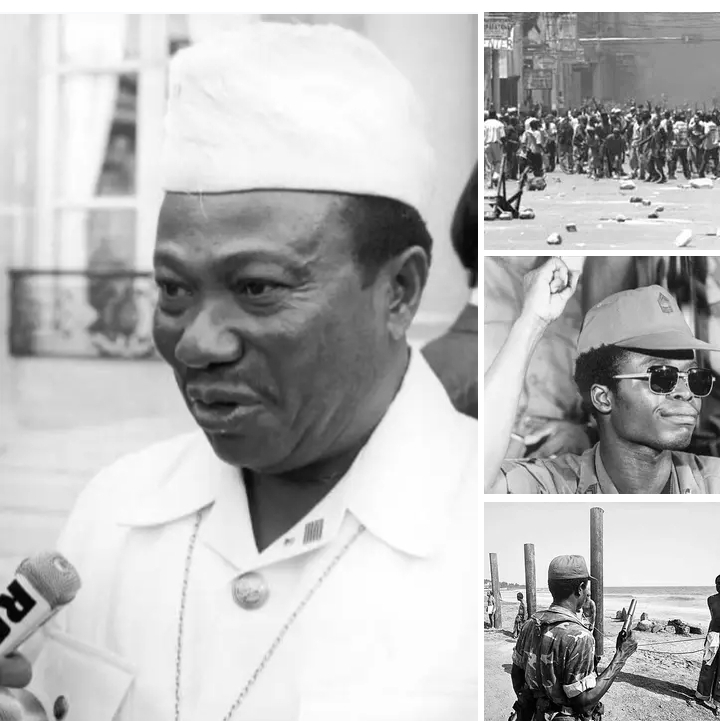
“How Rice Protest Contributed To The Assassination Of Liberia’s President William Tolbert and Execution Of His 13 Cabinet Officials”
On 12 April 1980, Liberia’s 20th president, William Richard Tolbert Jr., was overthrown and assassinated in a bloody military coup, following months of public anger sparked by his government’s proposal to increase the price of rice.
Tolbert came from the Americo-Liberian community, descendants of freed American slaves who had dominated Liberia’s political system since independence in 1847. He served as vice president under William Tubman before taking over the presidency following Tubman’s death on 23 July 1971.
His downfall began in 1979 when his government proposed raising the price of subsidised rice, the staple food for many poor Liberians, from $22 to $26 for a 45 kg bag. Many suspected that Tolbert’s family, which had extensive interests in rice farming, would benefit from the increase. On 14 April 1979, protests erupted in Monrovia, and security forces opened fire, killing dozens of demonstrators
However, the rice crisis was only part of a deeper problem. Indigenous Liberians had faced decades of political exclusion, discrimination and limited economic opportunities, while the Americo-Liberian elite enjoyed considerable wealth. Rising inflation and unemployment further angered ordinary citizens. Public resentment also grew over the substantial cost of hosting the 1979 Organisation of African Unity (OAU) summit in Monrovia, estimated at $100 million.
Rather than calming the situation, Tolbert’s government cracked down on opposition groups, restricted critical newspapers and arrested prominent political figures. Although the rice riots took place in April 1979, tensions continued to grow over the following months, leaving Tolbert’s government increasingly vulnerable to opposition.
On 12 April 1980, a military coup led by 28-year-old army staff sergeant Samuel K. Doe brought Tolbert’s government to a violent end. Doe and a group of soldiers stormed the presidential Executive Mansion in Monrovia, found Tolbert in his bedroom and killed him. His body was later buried in a mass grave.
Tolbert was not the only senior government figure killed. On 22 April 1980, thirteen members of his cabinet were publicly executed by firing squad at a beach near the Barclay Training Center in Monrovia. A military tribunal had accused them of crimes including treason, corruption and abuses of power.
Tolbert’s assassination ended more than a century of Americo-Liberian political dominance under the True Whig Party. Doe established the People’s Redemption Council, suspended the constitution and became Liberia’s first indigenous head of state.-Victo Adundo