

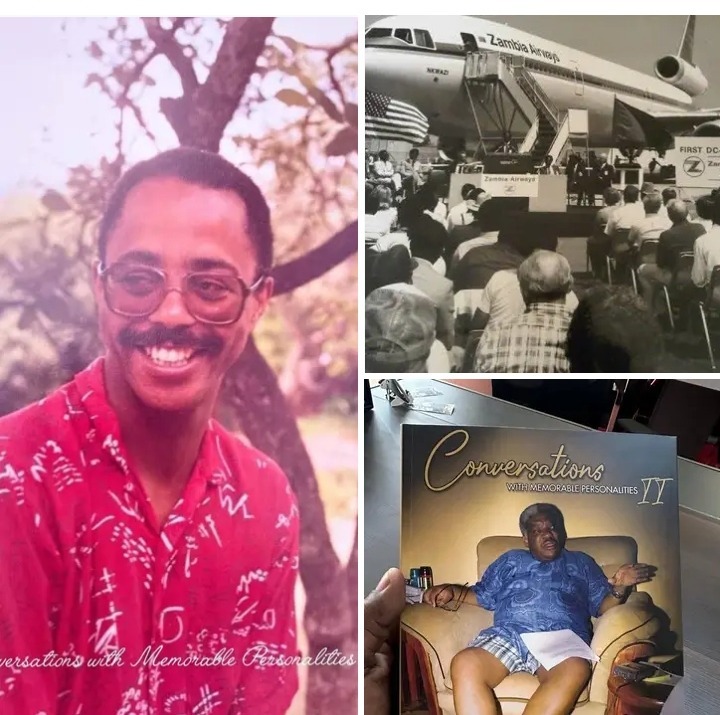
“I COULD HAVE SAVED ZAMBIA AIRWAYS FROM COLLAPSING.” — GEORGE LEWISBut then Finance Minister Ronald Penza f
But then Finance Minister Ronald Penza frustrated the plan.
This is one of those stories from Zambia’s economic history that deserves to be remembered—not simply as a story about an airline, but as a story about how institutions make decisions when a company is in crisis.
When the MMD came into power in 1991, George Lewis left his senior management position at Zambia Airways in 1992 and later became Managing Director of the Zambia National Tourist Board (ZNTB).
By early 1994, however, Zambia Airways was in serious financial trouble.
Through ZIMCO—the Zambia Industrial and Mining Corporation—Lewis was seconded back to Zambia Airways as Managing Director.
What he found was an airline that had been badly run down.
Lewis developed a rescue plan.
The first option was straightforward: recapitalise Zambia Airways.
The World Bank reviewed the business plan and asked Lewis to develop different scenarios, including a worst-case scenario. According to his account, the plan was considered viable, but the final decision rested with the Zambian government.
Government, however, was reluctant to inject more money into an airline that had already consumed significant public resources.
So Lewis developed a second option.
And this is where the story gets particularly interesting.
THE US$3 MILLION PLAN 💰✈️
Some of Zambia Airways’ aircraft were being acquired through lease-purchase arrangements.
Lewis says an ATR 42 was worth approximately US$11 million on the open market, while Zambia Airways owed only about US$3 million to complete its acquisition.
His proposal?
👉 Government provides a US$3 million bridging loan.
👉 Zambia Airways pays off the outstanding aircraft financing.
👉 The aircraft becomes fully owned by Zambia Airways.
👉 The airline sells at least one aircraft for approximately US$11 million.
👉 The proceeds are then used to restructure and stabilise the airline.
In other words, Lewis wasn’t simply asking government to throw another US$3 million into a failing company.
He was proposing to use government financing to unlock an asset whose market value, according to his account, was substantially higher.
Government initially appeared receptive.
Then the money didn’t arrive.
Lewis was eventually called to a Cabinet meeting where Finance Minister Ronald Penza reportedly said:
«“I told you gentlemen that I can’t print money, I don’t have this US$3 million to give Zambia Airways.”»
Lewis says that was when he realised the airline’s future was becoming increasingly bleak.
Vice-President Godfrey Miyanda reportedly argued strongly in support of Zambia Airways during the meeting.
But the rescue effort ultimately failed.
Six months after Lewis returned to ZNTB, Zambia Airways collapsed.
Lewis subsequently went on to establish Zambian Express, backed by financiers including Dr Rajan Mathani and Enoch Kavindele.
THE BIGGER LESSON 🇿🇲
Whether Lewis’s proposed rescue would actually have saved Zambia Airways is something history can no longer test.
We should also remember that this is Lewis’s retrospective account, published in Conversations with Memorable Personalities, Part 2 (2026) by Amos Malupenga. The financial assumptions and Cabinet discussions would need to be independently verified against contemporary government, airline and World Bank records before treating every detail as established fact.
But the story raises a very important question:
When a strategic national company is in distress, what exactly should government be evaluating?
Is it:
“How much money have we already put into this company?”
Or:
“What is the economic value of the assets we already own, and is there a credible path to restructuring the institution?”
Those are two very different decision frameworks.
And there is an even deeper question.
If an institution has failed because of poor management, weak governance, political interference or an unsustainable business model, throwing more money at it may simply create more losses.
But equally, refusing every form of restructuring capital because money was previously wasted can also destroy potentially valuable assets.
The real issue is therefore not simply “government funding versus no government funding.”
It is capital allocation + governance + management + accountability + execution.
That is the lesson worth extracting from the Zambia Airways story.
Because Zambia will continue to face difficult decisions involving ZESCO, ZAMTEL, ZCCM-related assets, public transport, hospitals, universities and other strategic institutions.
We cannot afford to make those decisions purely through political instinct.
We need better institutional decision systems.
Sometimes the question isn’t:
“How much has this institution already cost us?”
It is:
“What is this institution worth today, what went wrong, what can realistically be fixed, and what evidence justifies the next kwacha we put into it?”
That is how nations preserve value.
That is how institutions are rebuilt.
And that is how we avoid repeating history.
📖 Source: Conversations with Memorable Personalities, Part 2 (2026) by Amos Malupenga, pp. 192–193.