

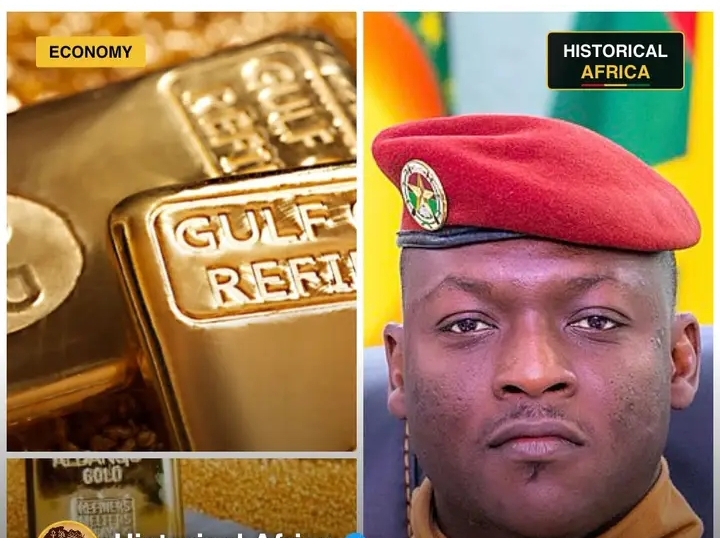
In 2022, foreign companies owned 14 of Burkina Faso’s 15 industrial gold mines.
In 2026, the country made $6 billion from gold in six months.
This is not luck. This is policy.
Captain Ibrahim Traoré took power and rewrote the mining code. He created SOPAMIB, a state company that now controls three major mines. He forced foreign companies to cut stakes. Canadian firm Iamgold went from 90% to 85% at Essakane. The government wants 50% at Kiaka, the country’s largest mine.
He created SONASP. A state buyer for artisanal gold. Before SONASP, artisanal miners sold to smugglers. The gold left through Mali. Through Togo. Through Ivory Coast. The state saw nothing.
In 2024, artisanal production was 8.1 tonnes.
In 2025, it was 42 tonnes.
SONASP set up buying counters across the country. Nine new mining cooperatives. Designated mining corridors. Tougher oversight. The gold now flows through official channels.
The result? Over $6 billion in the first half of 2026 alone.
This is more than revenue. This is sovereignty.
For decades, Burkina Faso’s gold flew to Switzerland. To London. To Dubai. The country borrowed money from the West to pave its own roads. Traoré calls this the old system. He is dismantling it piece by piece.
A national gold refinery is under construction. A national gold reserve is being built for the first time in history. A sovereign fund, Siniyan Sigui, will capture future windfalls for infrastructure.
But the picture is not simple.
Industrial production has struggled. Essakane output dropped 29% in 2025. Foreign investors are nervous. Resource nationalism scares capital. The security crisis continues. Jihadists control territory near some mines.
And artisanal mining has a human cost. Over 430,000 people work in it. Many are children. Mercury poisons the water. Tunnels collapse. The formalization helps the state. It does not yet help the miner enough.
So is this a revolution or a rebalancing?
The answer is both. And neither.
Because $6 billion in six months is real. But so is the fact that Burkina Faso still needs foreign technology, foreign markets, and foreign buyers. Nationalization does not mean independence. It means negotiation from a stronger position.
Thomas Sankara nationalized mines in 1986. He was killed in 1987. The mines were privatized within two years.
Traoré knows this history. He is moving carefully. But he is moving.
The question is not whether Burkina Faso can keep the gold. The question is whether it can keep the will.
Comment GOD BLESS TRAORE if you believe he’s the kind of leader Africa needs.