

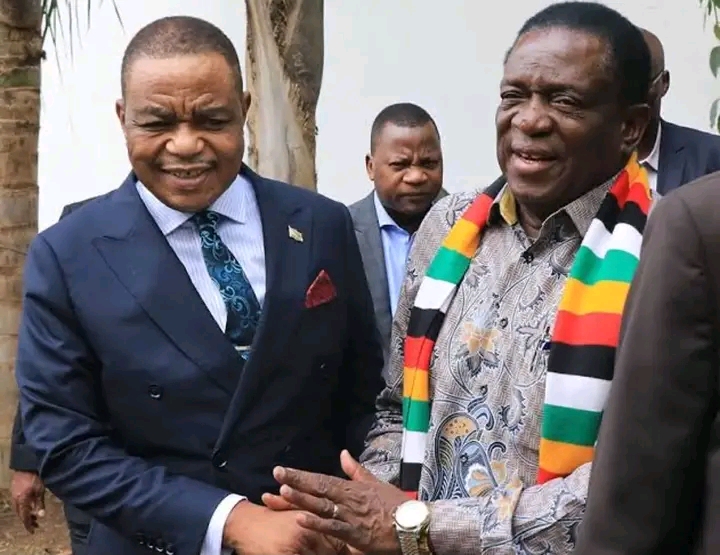
INSIDE THE EXPLOSIVE MNANGAGWA-CHIWENGA POWER STRUGGLE THAT HAS PLUNGED ZANU PF INTO CRISIS
By Gabriel Manyati
The ZANU PF Politburo meeting scheduled for 2pm on Friday 9 October 2026 never took place. Members had already begun assembling at the party headquarters in Harare when the session was abruptly cancelled. The reason was not administrative. It was the direct collision between President Emmerson Mnangagwa and Vice President Constantino Chiwenga over proposals to rewrite the party’s constitution so that it matches the far-reaching changes introduced by the Constitution of Zimbabwe Amendment (No. 3) Act, 2026.
An investigation by The NewsHawks established that the postponement followed fierce disagreement over the alignment exercise.
Official statements sought to downplay the episode. ZANU PF spokesperson Chris Mutsvangwa said: “There was a clash or an overflow of programmes, and the meeting was postponed.” Director for Information and Publicity Farai Marapira described it as a “clash of programmes; but nothing serious.”
Those explanations sit uneasily against the political context. The meeting had been called to prepare constitutional changes for the party’s 23rd National People’s Conference, due to open at Chinhoyi University of Technology from 12 to 17 October. The subject was the rules that will govern leadership succession. The timing, only days before that conference, and the identity of the two principals made the cancellation a public signal that the succession contest had moved from private corridors into the party’s highest decision-making body.
Constitutional Amendment Act No. 3, signed into law by Mnangagwa on 7 July 2026, fundamentally altered Zimbabwe’s political architecture. It extended the terms of the president, parliament and local authorities from five to seven years and applied the new tenure to the sitting president, pushing Mnangagwa’s current term from 2028 to 2030. It replaced the direct popular election of the president with election by a joint sitting of the Senate and National Assembly. It expanded the Senate and transferred voter registration functions.
The national changes created an immediate requirement for ZANU PF to revise its own constitution. Party legal affairs secretary and Justice Minister Ziyambi Ziyambi confirmed in late September that the Legal Standing Committee had been instructed to align the party document with the national amendments so that the changes could be considered at Chinhoyi.
The alignment is not a technical housekeeping exercise. The ZANU PF constitution governs how the party nominates its presidential candidate, how congresses and conferences are timed, and how internal power is distributed among the Politburo, Central Committee and provincial structures. Changing those rules while the national timetable has already been extended would lock in Mnangagwa’s longer tenure inside the party itself and alter the pathway any successor must follow.
Mnangagwa’s allies frame the reforms as necessary for continuity, the completion of infrastructure projects and the realisation of Vision 2030. Chiwenga’s camp views them as a calculated effort to postpone the succession transition, consolidate the president’s authority and restrict the vice president’s route to the highest office.
The present confrontation is the latest chapter in a succession struggle that began with the military-assisted transfer of power in November 2017. Then-commander of the Zimbabwe Defence Forces Constantino Chiwenga played a decisive role in the events that ended Robert Mugabe’s 37-year rule and elevated Mnangagwa to the presidency. The alliance that removed Mugabe contained competing interests from the outset. Chiwenga’s military and war-veteran networks expected a structured transition. Mnangagwa’s political and business networks sought to consolidate control. No settled succession arrangement acceptable to both sides ever emerged.
After the 2018 and 2023 elections, the five-year presidential term pointed towards a 2028 transition. That horizon mattered to Chiwenga and those who regarded him as the natural successor rooted in the liberation struggle. The campaign to extend Mnangagwa’s tenure gained organised momentum through provincial resolutions and public advocacy, culminating in the parliamentary passage of Amendment No. 3. Once the national constitution changed, the party constitution became the next instrument of power. Control of candidate selection, the timing of congresses and the criteria for leadership positions would determine whether the 2028 timetable survived or was replaced by a longer horizon favourable to the incumbent.
Businessman Kudakwashe Tagwirei’s rapid advancement has intensified the rivalry. Co-opted into the Central Committee amid sharp internal resistance, Tagwirei later received a Senate seat under the new presidential appointment powers and was appointed Minister of Economic Development and Investment Promotion this week. Chiwenga and his allies have long viewed the rise of wealthy businessmen with close ties to the presidency as a threat to the party’s liberation character. The term “zvigananda” – popularised by Chiwenga – has been used to attack such figures, reflecting deeper disputes over political financing, patronage and access to influence.
Tagwirei’s elevation is widely read inside the party as part of a broader effort to reshape the networks surrounding the succession.
The death of businessman Wicknell Chivayo on 30 September 2026 in a helicopter crash near Marondera added a personal dimension. Chivayo, a flamboyant philanthropist closely associated with Mnangagwa, was declared a provincial hero. His funeral on 8 October drew senior party and government figures. Reports that Chiwenga boycotted the ceremony were interpreted within political circles as a deliberate signal of distance from the patronage networks surrounding the president. In a system where public displays of loyalty and access to influential business figures often mark factional boundaries, the absence carried political weight.
For Mnangagwa the stakes are clear. Remaining in office beyond 2028 preserves control over party decision-making, the security services and the patronage relationships that sustain authority. Constitutional changes that shift presidential selection to parliament and extend the term reshape the succession environment in favour of continuity under his leadership. For Chiwenga the implications run in the opposite direction. A delayed transition weakens the leverage that comes with being the recognised military and liberation successor. His formal position as vice president, his residual influence among war veterans and the organisational networks built since 2017 all depend on a timetable that still offers a credible path to the presidency.
ZANU PF’s internal organs will now decide the next moves. The Politburo is the highest decision-making body outside congress. The Central Committee follows. Provincial structures feed into the annual conference. The Chinhoyi gathering was expected to formalise the party’s constitutional amendments. Whether those amendments proceed, are watered down or are deferred will determine the practical rules of succession for the remainder of Mnangagwa’s extended term.
The comparison with the period before November 2017 is unavoidable. Then, as now, ruling class divisions, unresolved succession, competing centres of authority and the interaction between party institutions and the security establishment created systemic strain.
Mugabe’s efforts to manage succession through constitutional and party manoeuvres ultimately failed when the military and key factions withdrew support. The current conflict has grown directly from the unresolved tensions within the coalition that brought Mnangagwa to power. The central question is whether ZANU PF can manage succession through its established institutions when the two most powerful figures in the governing establishment are divided over the very rules that will determine the outcome.
The postponed Politburo meeting has not resolved that question. It has merely deferred it to the Chinhoyi conference and beyond. The party constitutional dispute will shape the succession timetable, the relationship between Mnangagwa and Chiwenga, and the internal balance of power within ZANU PF.
Whether the party’s institutions can contain the confrontation or whether the rules themselves become the battlefield remains the decisive political dilemma facing Zimbabwe’s ruling establishment.