

Lusaka, Zambia – 12TH November 2026
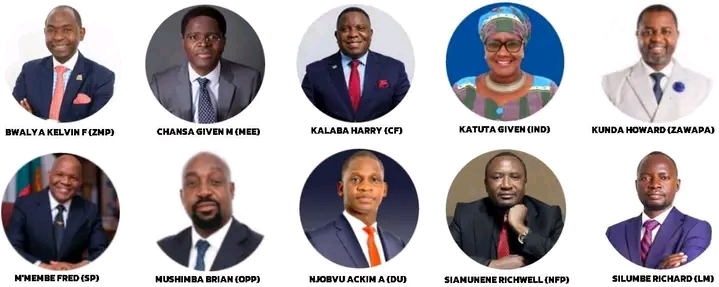
JOINT PRESS STATEMENT BY THE TEN PRESIDENTIAL CANDIDATES WHO PARTICIPATED IN THE 13TH AUGUST 2026 GENERAL ELECTIONS ON THE PROPOSED REMOVAL OF PRESIDENTIAL TERM LIMITS (ZAMBIA MUST NOT SACRIFICE DEMOCRACY AT THE ALTAR OF POLITICAL EXPEDIENCY)
We, the ten Presidential candidates who participated in the 13TH August 2026 General Elections, having demonstrated our collective faith in Zambia’s multiparty democratic process, and recognizing that our participation was founded upon the strength of our democratic institutions and the constitutional provisions governing the electoral process and eligibility of all participating candidates, hereby issue this joint statement in defence of Article 106 of the Constitution of Zambia.
Acting together in full agreement and recognizing our rights and duties as citizens under Article 2(a) of the Constitution of Zambia, we wish to reaffirm that our Constitution is not a personal possession of those who occupy public office. It is a solemn social contract between the people and the State, designed to protect the freedoms, rights and democratic aspirations of present and future generations.
We respectfully disagree with those advancing the view that Zambia is short of the human resources with the requisite competence to lead the country, as our nation’s history has demonstrated otherwise.
We are aware that at Independence in 1964, we had only 3 Black Lawyers, 1 Black Engineer, 3 Black Doctors and in total less than 100 Black University graduates. We had only 884 men with only 77 women holding Secondary School qualifications, complemented by about 4,000 holding Junior Secondary School (Form II) certification. We had only a few thousands junior teachers, clerks, policemen and semi-skilled workers with only Primary School Education to complete our entire national human resource to run the nation.
Yet from that, we were able to run the country and implement the greatest school enrolment in the nation’s history and superintended over a country that worked, where schools worked, hospitals worked, sewer and water systems worked at least far better than what we currently have under Mr Hichilema.
Having now produced thousands of engineers, lawyers, doctors, economists, professionals from various fields and countless school leavers, the claim that we can find no single person from all those to run the country better than Mr Hichilema is plainly without basis.
We also recognise that our young democracy remains fragile, given the weaknesses in our democratic institutions, requiring comprehensive reforms to strengthen the independence of relevant State institutions and thus demonstrating the absolute necessity to maintain constitutional checks and limits on the role of individual actors.
We have followed with grave concern the debate surrounding the reported proposal by Hon. Mwato Kabaso, a nominated Youth Member of Parliament under the proportional representation system, regarding the removal of presidential term limits.
As citizens who believe in constitutionalism, democratic accountability and the preservation of our country’s political heritage, we wish to express our firm collective opposition to any proposal aimed at abolishing presidential term limits.
NOTE THAT: Zambia does not belong to an individual, a political party or an administration. Zambia belongs to its people.
The question before us is not whether a particular President deserves another opportunity to govern. It is whether we are prepared to weaken one of the most important constitutional safeguards that protects our democracy from excessive concentration of power.
We believe that the answer must be an emphatic NO.
REALIZING THAT: Democracy is a legacy, not a temporary political convenience.
Zambia’s democratic journey was not handed to us on a silver platter. It was shaped by political struggles, difficult decisions, sacrifices and the collective determination of citizens who believed that no individual should have a permanent claim to national leadership.
Our founding political generation understood that independence without political freedom would be an incomplete achievement. The return to multiparty democracy in 1991 was therefore a defining moment in our national history.
We must never forget that between 1973 and 1991, Zambia operated under a one-party political system in which UNIP was the only legally recognized political party. The United Progressive Party (UPP) and the African National Congress (ANC), among other opposition political formations, were prohibited under that system.
This was a period in which political competition was severely restricted, alternative political voices were excluded from formal party politics, and the concentration of authority in the presidency became a defining feature of governance.
We must understand that democracy is not simply the act of conducting elections. It is the protection of political pluralism, the freedom to organise, the right to challenge authority, the independence of institutions and the peaceful transfer of power.
The right to elect a President must be accompanied by the constitutional right to elect another President when the incumbent’s lawful mandate comes to an end.
Democracy is not merely about the freedom to choose who governs us; it is equally about ensuring that no one becomes too powerful to be replaced.
THE LESSONS OF THE ONE-PARTY STATE: Economic decline and institutional concentration. There is an important historical and economic dimension that must inform this debate.
At independence in 1964, Zambia had considerable economic potential. Copper revenues supported an ambitious development agenda, and the country invested in education, infrastructure and public institutions.
However, from the mid-1970s onwards, Zambia experienced a prolonged economic downturn. The oil shocks, falling copper prices, increasing external debt, weak and unchallenged economic policies alongside unchallenged political decisions and the limitations of state-led industrialisation contributed to the country’s economic difficulties.
Inflation accelerated significantly, economic growth weakened and living standards deteriorated. By the 1990s, Zambia was experiencing severe macroeconomic instability, with inflation exceeding 100 per cent in some years.
It would be intellectually dishonest to attribute every economic failure of that era exclusively to the one-party system. International commodity shocks and economic policy decisions also played significant roles.
Notwithstanding all this international economic turmoil, the concentration of power at the top turning State house into a business deals brokerage as well as too many political cadres heading up major businesses in our economy left us terribly ill-prepared to weather the economic shocks that swept through the 70s.
Having acquired 51 per cent of all mining companies, following the Matero reforms of 1969, through the issuance of a ZIMCO government-guaranteed bond, Kenneth Kaunda would, in 1973, go on to make one of the most shocking economic policy blunders by announcing the full redemption of ZIMCO bonds at par or face-value of K1.00 when the same bonds were then trading on the capital markets at 29 Ngwee (a third of their face value).
This early and fraudulent redemption of the ZIMCO bonds depleted our foreign reserves at the most critical period when the copper prices were falling and there had been an explosion in the price of crude oil. We began limping as a nation economically and we limped on through 1973 to 1975 when the copper prices reached bottom levels and beyond through the 80s. Suffering from a severe combination of low copper prices, high crude oil prices, shortages of hard currency and the crippling effects of the Exchange Control Regulations as well as a bulging national debt burden, our economy was on its knees and the Exchange Control Regulations were choking the life out of our mines as they couldn’t acquire enough hard currency to meet both their operational needs and the importation of critical components for equipment maintenance.
This experience shows the dangers of weak accountability, limited political competition and insufficient institutional checks on government when a small group of people surrounded the president and effectively hijacked and appropriated all government functions and operations, making it all about serving the narrow interests of the UNIP political elite to the exclusion of the masses. UNIP, the party had become the government, and the government had become the party. The party’s central committee had become more powerful than parliament whose role had been reduced to rubber stamping the decisions of the UNIP central committee.
In failing to reflect on these historic lessons, we are choosing to ignore and indeed even defend these same events as they take shape right before us as we watch, once again, state house increasingly turning into a business deal brokerage especially dedicated to foreign interest and capital.
The question we must ask ourselves is this: when political authority becomes excessively concentrated, what mechanisms remain available to correct policy failures, challenge poor decisions and hold those in power accountable?
A country cannot build sustainable development by weakening the institutions that are supposed to protect its citizens.
LEARNING FROM: The Chiluba third-term debate and Edgar Chagwa Lungu’s eligibility case defining lessons for Zambia.
Perhaps one of the most important historical references in this debate is the attempt by the late Second Republican President, Dr Frederick Titus Chiluba, to secure a third presidential term in 2001.
Zambia was confronted with a significant constitutional and political test.
Those who supported the proposed third term argued for continuity and the opportunity to allow an experienced leader to continue implementing his development agenda.
However, opposition political parties, civil society organisations, churches, prominent citizens and even members of the ruling Movement for Multiparty Democracy (MMD) resisted the proposal.
The resistance was not simply about opposing Dr Chiluba as an individual. It was about defending a constitutional principle that must apply equally to every President, regardless of political affiliation or popularity.
Ultimately, Dr Chiluba announced on 4 May 2001 that he would not seek a third term.
That decision remains one of the most important moments in Zambia’s democratic history.
We must appreciate the courage of those who stood against the proposed constitutional alteration, including individuals within the ruling establishment who placed national constitutional principles above political loyalty.
Similarly, the eligibility proceedings involving former President Edgar Chagwa Lungu, which were controversial towards 2021, saw the courts rule that he was eligible to contest despite having been elected and sworn in twice. The case was revisited after he left power, and the Court’s judgment of 10 December 2024 declared that he was not eligible. This demonstrated the importance of enforcing constitutional term limits and transitional provisions through the courts, regardless of an individual’s political standing.
Although the two cases arose under different circumstances, they reinforce one fundamental principle: the Constitution must remain supreme, and presidential eligibility must be determined by law rather than political convenience.
Now imagine an alternative historical outcome.
If Zambians had accepted the third-term proposal in 2001, what would have become of our democratic institutions and political future?
In our considered political opinion, had the third-term project succeeded, Zambia could have entered a very different political trajectory. The country might have witnessed a much deeper entrenchment of incumbent political influence, weakened opposition competition and a political succession increasingly shaped by those already holding power.
It is even reasonable to question whether the political environment that eventually enabled subsequent administrations to emerge, including the current administration, would have developed in the same way.
We cannot state with certainty that opposition parties would have been banned or that a particular political outcome was inevitable. However, the history of our one-party state demonstrates precisely why citizens must remain vigilant whenever constitutional arrangements threaten to reduce political competition.
The lesson of 2001 is simple: constitutional safeguards must be defended before they are lost, not after their removal has become politically convenient.
FURTHER LEARNING FROM: The danger of entrusting excessive power in one individual.
One of the fundamental principles of constitutional democracy is the separation and limitation of power.
A President is elected to serve within a constitutionally defined mandate. The presidency is an institution of the Republic, not a personal inheritance or lifetime appointment.
When constitutional term limits are removed, the country risks creating an environment in which political survival becomes more important than national service delivery.
There are several dangers associated with such a development:
a) Weakening institutional independence
Institutions such as the Electoral Commission, the Judiciary, Parliament, law enforcement agencies and other constitutional bodies must operate independently and without undue political interference.
When one political establishment dominates the political landscape for an extended period, the independence of these institutions can come under pressure. Their ability to scrutinise government, investigate wrongdoing and enforce constitutional provisions may become compromised.
b) Unequal political competition
An incumbent President enjoys considerable advantages arising from the visibility and influence of the office. Without effective constitutional safeguards, prolonged incumbency can create an uneven political environment in which opposition parties struggle to compete on equal terms.
c) The weakening of democratic succession
Democracy must provide opportunities for new leadership, fresh ideas and alternative approaches to national development. A political system that revolves around one individual risks weakening internal party democracy, discouraging emerging leaders and creating uncertainty over succession.
d) The possibility of political instability
History across the African continent demonstrates that prolonged political exclusion, contested elections and the absence of credible avenues for peaceful political change can contribute to political unrest.
When citizens begin to believe that the ballot box no longer provides a meaningful opportunity for political change, frustration can escalate into demonstrations, civil disobedience and, in extreme circumstances, violent confrontation or insurgent movements.
We must never encourage or normalise such outcomes.
Zambia has enjoyed relative political stability despite its political differences. That stability must be protected through constitutional safeguards, dialogue, accountability and peaceful democratic competition.
A peaceful transfer of power is not a weakness of democracy; it is one of its greatest achievements.
ALSO NOTING THAT: The argument that elections are expensive development cannot be an excuse for weakening democracy.
We have also observed arguments suggesting that Zambia spends considerable financial resources conducting elections and that longer presidential tenure could provide greater continuity for national development.
This argument deserves serious intellectual examination.
Yes, elections require substantial financial resources. Yes, national development requires policy continuity. Yes, frequent political transitions can present administrative and economic challenges.
However, the solution to the cost of elections is not to abolish presidential term limits.
The solution is to improve electoral administration, strengthen public financial management, reduce unnecessary expenditure, promote economic productivity and ensure that public resources are utilised efficiently.
We must not create a false choice between democracy and development. A country can have both. As we have previously demonstrated, in this statement, economic progress cannot be entirely divorced from political competition.
Indeed, development without accountability can become an instrument of political patronage, while economic growth without institutional safeguards may fail to translate into meaningful prosperity for ordinary citizens.
We must also challenge the notion that only one individual can deliver national development.
If a President has a successful development programme, the responsibility of building sustainable institutions is to ensure that those programmes can survive beyond that President’s tenure.
A nation that cannot function without one individual has an institutional problem, not a leadership advantage.
REALIZING THAT: Our young people may not know our history in full.
It is particularly concerning that this discussion has been raised by a young legislator.
Young people must be at the forefront of defending constitutionalism, democratic accountability and the political renewal and freedoms inherited from previous generations.
The youth must not confuse political ambition with democratic progress.
Our responsibility is not merely to inherit public office. It is to inherit a country whose institutions are stronger, whose democratic values are respected and whose citizens enjoy equal opportunities to participate in governance.
The younger generation must understand that the same constitutional amendment being entertained today could become a dangerous precedent tomorrow.
The question is not whether the current President or any future President is popular.
The question is whether we are prepared to establish a political culture in which the Constitution remains superior to every individual who occupies State House.
We must never mortgage the democratic future of our children for the political convenience of the present generation.
NOW THEREFORE: Our collective declaration and position.
In view of the foregoing, we, the ten Presidential candidates who participated in the 13TH August 2026 General Election, wish to state our collective position unequivocally:
1. We reject any proposal aimed at abolishing presidential term limits in Zambia.
2. We call upon Members of Parliament, irrespective of political affiliation, to defend the constitutional principles that protect democratic succession.
3. We urge young people, churches, civil society organizations, traditional leaders, professional associations and all patriotic citizens to participate in this debate with knowledge, responsibility and a commitment to constitutional democracy.
4. We call for the strengthening of the independence of the Electoral Commission, the Judiciary, Parliament and other constitutional institutions.
5. We urge the government and Parliament to prioritise economic development, job creation, education, healthcare, infrastructure and poverty reduction rather than entertaining constitutional changes that could weaken democratic accountability.
6. We encourage constructive national dialogue, peaceful engagement and respect for divergent political opinions.
We must also emphasize that opposing the removal of presidential term limits is not an act of hostility towards any President or political party. It is an expression of our commitment to the constitutional order and the long-term interests of the Republic.
OUR FINAL REFLECTION: Zambia is bigger than any President.
We must never forget that Presidents come and go, political parties rise and fall, governments change, but the Republic of Zambia must endure.
The Constitution must remain the supreme instrument through which the people exercise their sovereignty and regulate the conduct of public affairs.
We cannot afford to return to a political environment where the ambitions of individuals take precedence over the aspirations of millions of citizens.
The sacrifices made by previous generations to secure multiparty democracy must not be rendered meaningless by a generation that has benefited from those very freedoms.
The late President Dr Kenneth David Kaunda’s acceptance of the return to multiparty democracy in 1991, the sacrifices of opposition political formations, and the national resistance to the third-term proposal in 2001 are important chapters in our democratic history.
Let us learn from them.
We do not need a President who stays in office indefinitely to demonstrate national leadership. We need institutions that work, a constitution that is respected, a Parliament that exercises oversight, an independent Judiciary, credible elections and a political environment where leadership is earned through the confidence of the people.
The presidency is an office of service, not an inheritance. Leadership is a constitutional responsibility, not a lifetime entitlement.
Let us defend the constitution today so that tomorrow’s generation will inherit a Zambia where the power to choose its leaders remains firmly in the hands of the people with sufficient constitutional guardrails to safeguard against the concentration of power.
ZAMBIA MUST REMAIN A DEMOCRATIC REPUBLIC, NOT A PERSONAL POLITICAL PROJECT.
ISSUED JOINTLY BY THE TEN PRESIDENTIAL CANDIDATES WHO PARTICIPATED IN THE 13TH AUGUST 2026 GENERAL ELECTIONS
Issued On 12TH November 2026 END
Original Signed by:
BWALYA KELVIN F, President, Zambia Must Prosper
CHANSA GIVEN M, President, Movement for Economic Emancipation
KALABA HARRY, President, Citizens First
KATUTA GIVEN, Independent
KUNDA HOWARD, President, Zambia Wake Up Party
M’MEMBE FRED, President, Socialist Party
MUSHIMBA BRIAN, President, Organised Peoples Party
NJOBVU ACKIM A, President, Democratic Union
SIAMUNENE RICHWELL, President, New Focus Party
SILUMBE RICHARD, President, Leadership Movement
Page 10 of 10