

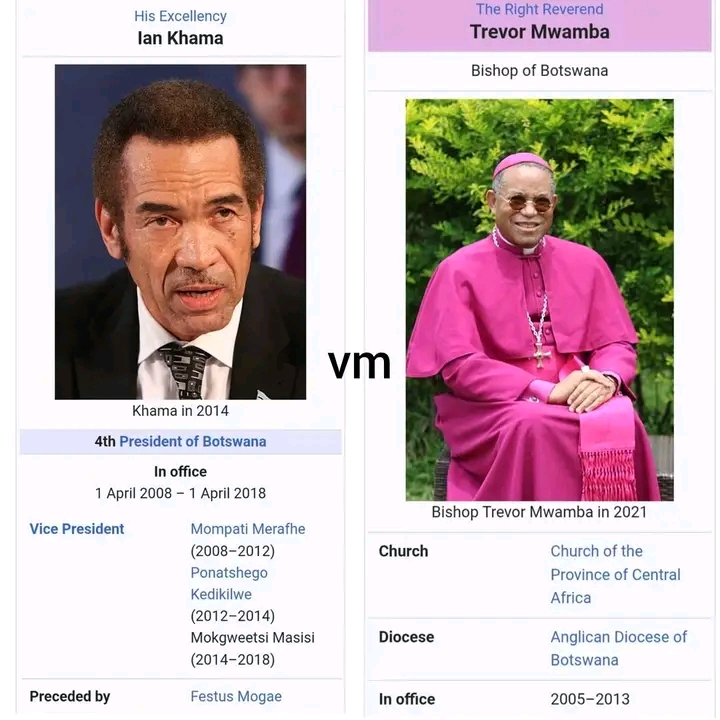
KHAMA’S ZAMBIA INTEREST: THE MWAMBA CONNECTION BEHIND THE POLITICAL CONTROVERSY
Family connections and Botswana’s political history provide context—but do not establish the former president’s motives.
Former Botswana President Ian Khama’s outspoken criticism of Zambia’s leadership has brought renewed attention to Bishop Trevor Mwamba’s connections to Botswana’s presidential families.
On October 30, Zambian Eye reported that Khama had questioned Botswana’s attendance at President Hakainde Hichilema’s inauguration, describing the Zambian leader as “Africa’s newest dictator”. The reported remarks triggered criticism from ruling-party figures and debate over Khama’s involvement in Zambia’s affairs.
Behind that controversy lies a documented connection: Mwamba, the former Anglican Bishop of Botswana and a Zambian opposition politician, is married to Mmasekgoa Masire-Mwamba, daughter of Botswana’s second president, Sir Ketumile “Quett” Masire. Botswana’s government-owned DailyNews confirmed the marriage and her parentage in a September 2015 profile. She is Mwamba’s wife, not Ian Khama’s.
The historical link reaches back to Botswana’s independence. Quett Masire became vice-president under founding president Sir Seretse Khama, Ian Khama’s father, in 1966. Mwamba’s marriage therefore connects him to the family of the elder Khama’s governing partner. This establishes a connection through Botswana’s political history; it does not establish that Mwamba and Ian Khama are blood relatives.
Mwamba also publicly acknowledged Ian Khama’s influence years before the present controversy. In a 2021 Mail & Guardian interview, he named Seretse and Ian Khama among the figures who had influenced him. That account provides evidence of longstanding regard rather than an association emerging only after Zambia’s recent elections.
His involvement in preserving Botswana’s presidential history is also documented. A University of London record lists Mwamba as a participant in a November 2016 discussion following a screening of A United Kingdom, the film about Seretse and Ruth Khama.
Mwamba’s detention in Zambia has since attracted international attention. In September, the British government acknowledged parliamentary questions concerning his detention and treason charge, saying the case was before Zambia’s courts and emphasising transparency and due process. The Anglican Church of Southern Africa separately appealed for humane treatment and access to basic necessities for detained opposition figures. The allegations against Mwamba remain allegations, subject to determination by the courts.
These connections provide relevant background when assessing Khama’s interventions. They do not, by themselves, prove that personal loyalty motivates his criticism, that he acts as an opposition spokesperson, or that his statements form part of a coordinated propaganda campaign.
The sources reviewed also provide no substantiation for a promised Zambian citizenship arrangement. Presenting that suggestion as a revelation would go beyond the available evidence.
The documented story is consequential enough: a former Botswana president is commenting on developments in a neighbouring country where an opposition figure with longstanding connections to Botswana’s political establishment faces serious charges. Whether those relationships explain Khama’s position remains a question requiring his own account and further evidence.
By George Mtonga
Khama and Pastor Mwamba are in-laws.
Their children are husband and wife.
That is the connection.
As a result, dont expect praises from Khama on this one. As an elder and former head of state, Khama should know that he can not give an unbiased opinion on this matter.
It is simple conflict of interest.
Now, what this George Mtonga has written doesn’t even make sense.