

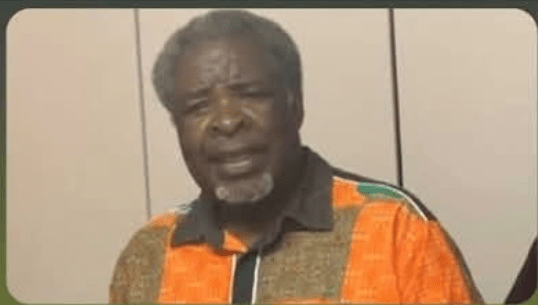
LEVISON MUMBA—THE MINISTER WHO TESTIFIED AGAINST HIS APPOINTING AUTHORITY
In Zambian politics, sometimes the most interesting courtroom dramas are not about lawyers.
They are about ministers, presidents, government vehicles and the small inconvenience of telling the truth under oath.
Meet Mumba, the minister who found himself testifying in the Supreme Court against the very man who had appointed him to Cabinet.
Following the 2001 general elections, which saw Levy Mwanawasa emerge victorious by a slim margin, losing opposition parties challenged the presidential election and sought its nullification.
In November 2002, Mumba, then serving as Minister of Sport, Youth and Child Development, testified before the full bench of the Supreme Court.
And the testimony was rather uncomfortable.
Mumba admitted that he had given a government motor vehicle to President Mwanawasa for use during the 2001 election campaign.
Apparently, Cabinet appointments came with many responsibilities. Keeping quiet was seemingly not one of them.
Mumba was also dealing with his own electoral problems. His election as MP for Msanzala had been challenged, and while testifying, he disclosed that he had given 10 rural health-centre drug kits to First Lady Maureen Mwanawasa in 2001 after she requested them from him, then Minister of Health, saying she wanted to donate them to Keembe, where she was planning to visit.
Politics, elections, government vehicles, drug kits and the Supreme Court all in one testimony.
One can only imagine the Cabinet meeting afterwards.
Following Mumba’s testimony against Mwanawasa, the President wasted little time and fired him as Sports Minister.
The appointment letter had apparently developed an expiry date.
Mumba’s political journey, however, had started long before the Mwanawasa episode.
He was first elected Member of Parliament for Msanzala under the United National Independence Party (UNIP) in 1988.
He reclaimed the seat in the 1991 general elections on the UNIP ticket, polling 3,395 votes against his closest rival, MMD’s Edward Banda, who received 1,782 votes.
In 1996, Mumba switched camps and joined the MMD, on whose ticket he was again elected MP for Msanzala.
In 2001, President Frederick Chiluba appointed him Eastern Province Minister before later redeploying him to the Ministry of Health.
Then came the 2001 parliamentary election.
And this one came with more drama than the average constituency could reasonably be expected to handle.
Chief Nyampande said the results were unacceptable, alleging corruption and vote buying in Msanzala by the MMD, the party on whose ticket Mumba had contested.
After Mumba was declared winner, Chief Nyampande declared Msanzala a no-go area for the newly elected MP.
The traditional leader said his position followed petitions from his subjects, who had raised allegations of electoral irregularities and intimidation of voters.
The election itself was unusually competitive.
Four candidates crossed the 2,000-vote mark:
Mumba — 2,942
FDD’s Peter Njobvu — 2,249
UNIP’s Jonathan Banda — 2,131
Heritage Party’s Peter Daka — 2,017
With numbers like those, Msanzala was clearly not interested in making anyone’s political life easy.
The election was subsequently challenged, and in 2002 the High Court nullified Mumba’s victory. The Supreme Court record states that the trial court found the election characterized by corrupt and illegal practices, violence, threats and intimidation.
And then came the Supreme Court testimony that would make Mumba’s relationship with the MMD even more complicated.
After testifying against Mwanawasa, Mumba faced disciplinary proceedings within the MMD, where he was accused of destabilising the party in Eastern Province.
The MMD’s National Executive Committee eventually expelled him from the party.
To add salt to the political wound, Mumba was also slapped with a K700 million bill from lawyers representing a petitioner.
J.B. Sakala and Company, who represented losing Heritage Party candidate Peter Daka in the Msanzala election petition, demanded K700 million in costs from Mumba following the nullification of his parliamentary victory.
Because apparently losing an election petition was not expensive enough without adding a seven-hundred-million-kwacha footnote.
Following the nullification of Mumba’s election, a by-election was held in October 2003.
Peter Daka returned, this time on the MMD ticket.
Mumba returned too, this time under the UPND.
Daka won with 3,474 votes, while Mumba managed 1,759.
But Mumba was not prepared to let the matter rest.
He petitioned Daka’s election, filing the petition in the Lusaka High Court registry on November 14, 2003, alleging that the election had been marred by corrupt practices and rigging.
In February 2006, the UPND in Northern Province nominated Mumba’s name for the position of UPND Secretary General.
Around the same period, Mumba confessed that he had participated in the rigging of the 2001 elections.
Then came the 2006 general elections.
And, once again, it was Daka versus Mumba.
Daka, now standing on the MMD ticket, won with 5,917 votes.
Mumba, contesting under the United Democratic Alliance (UDA), came second with 3,380 votes.
At this point, the political rivalry between the two men had developed the longevity of a Zambian political party.
Fast-forward to November 2022.
Mumba joined Harry Kalaba’s Citizens First Party and eventually became National Chairperson.
During his tenure, he openly criticised the economic policies and cost-of-living handling of the current administration.
Then came July 2026.
Mumba resigned as National Chairperson of Citizens First and crossed over to the ruling United Party for National Development (UPND).
He made the announcement during a press briefing in Petauke District, citing personal reasons and a desire to contribute his long-standing experience to national development.
And so, after decades of changing political jerseys, courtrooms, election petitions, Cabinet appointments, expulsions, defeats, comebacks and political realignments, Mumba remains a fascinating character in Zambia’s political archive.
A man who once testified against the president who appointed him, lost an election he had won, challenged the man who replaced him, lost to the same man again, changed parties, returned to opposition politics and eventually crossed back into government.
In Zambian politics, the journey from Cabinet to courtroom to opposition and back to government is apparently not a career detour.
It’s just another route on the political GPS.