

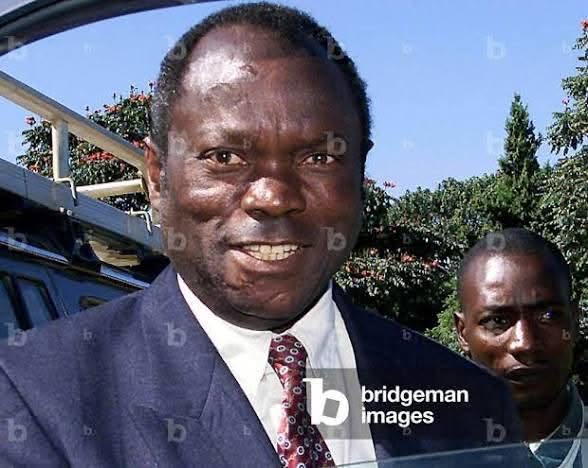
LT GEN CHRISTON TEMBO: THE GENERAL WHO MOBILISED 22 MINISTERS TO STOP CHILUBA’S THIRD TERM!
When President Frederick Chiluba began entertaining the idea of a third presidential term, many in the MMD discovered a sudden talent for silence.
Others perfected the art of political gymnastics, twisting constitutional arguments to accommodate their leader’s appetite for power. But one man decided that enough was enough.
His name was Lieutenant General Christon Tembo.
And he did not come alone.
The former Army Commander, then serving as Republican Vice-President, reportedly mobilised 22 cabinet and junior ministers to stand against President Chiluba’s controversial third-term ambitions.
In a government where political survival often depended on knowing when to clap, Lt Gen Tembo assembled a rebellion from within the very Cabinet that was supposed to support the President.
President Chiluba had apparently mistaken loyalty for obedience and the Constitution for a document that could be negotiated whenever presidential ambition demanded an extension. Unfortunately for him, Lt Gen Tembo and his colleagues were not prepared to salute that particular command.
The General had once commanded soldiers. Now he was commanding a political rebellion.
Lt Gen Tembo would eventually pay the political price, losing his position and being expelled from the MMD. But by then, the third-term project had suffered a devastating political setback.
This is the story of the soldier who helped turn a presidential succession question into a national constitutional battle; the Vice-President who refused to become a cheerleader for an unconstitutional ambition; and the General who demonstrated that sometimes the most important word in politics is not YES, but NO.
And this is where the General’s political legacy becomes particularly interesting.
President Chiluba eventually dissolved his Cabinet and engineered the expulsion of Lt Gen Tembo and other rebellious figures from the MMD.
There was something particularly ironic about the whole affair: a former army commander who had once faced allegations of plotting against a president was now at the centre of a political rebellion against another president’s ambitions.
Born on May 24, 1944 in Kasempa District of North-Western Province, Lt Gen Tembo was a career soldier who rose through the military ranks to become Army Commander. He received his military training in the United Kingdom, including at the prestigious Staff College at Camberley, earning the coveted Passed Staff College (PSC) qualification.
He served as a platoon commander, company commander, battalion commander and eventually Lieutenant General. In 1985, he rose to the position of Army Commander, a position he held until 1987, before being appointed Zambia’s Ambassador to West Germany.
His military career was, however, interrupted by allegations of involvement in a failed coup plot against President Kenneth Kaunda.
He was arrested on his arrival at Lusaka’s international airport on October 6, 1988 and charged with treason in the politically turbulent period preceding the return to multiparty democracy.
The other officers that were arrested together with Lt Gen Tembo included Lt Col Bizwayo Nkunika, Lt. Col. Chongo Shula, 37, and Maj. Epyrious Mulenga, 36.
Lt Gen Tembo’s defence team included Levy Mwanawasa, who would later become one of his political opponents.
In 1989, President Kaunda decided to pardon all coup plotters.
When the MMD came into power in 1991, Lt Gen Tembo became part of the new political establishment. He was elected Member of Parliament for Chawama, defeating UNIP’s Donald Chilufya by 13,396 votes to 3,601. He retained the seat in the 1996 general elections.
During his 10 year tenure in parliament, Lt Gen Tembo served as Minister of Tourism and Foreign Affairs before being elevated to Vice-President of the Republic of Zambia in 1997.
He served as Republican Vice President until 2001, when he had a fallout with President Chiluba over the third bid.
Lt Gen Tembo also made headlines during the 2001 campaign when he publicly made allegations about President Chiluba’s drinking habits. State House strongly denied the claims, insisting that the President had stopped drinking alcohol in 1981.
The political fallout extended into personal territory, with President Chiluba accusing his former vice-president of betraying his confidence by revealing details of a confidential discussion concerning his matrimonial problems.
Following his expulsion from the MMD, Lt Gen Tembo went on to establish the Forum for Democracy and Development (FDD) in 2001, becoming its founding president.
His new political home attracted several prominent figures, including former Finance Minister Edith Nawakwi, who became his vice-president.
Following his election as FDD president, Lt Gen Tembo’s nationality came under scrutiny with Enoch Kavindele alleging that the General’s parents were from Malawi and as such, he was ineligible to contest the 2001 presidential elections.
Lt Gen Tembo subsequently contested the 2001 presidential election but failed to make a significant electoral breakthrough. He came out third in the race with the FDD winning about 12 parliamentary seats.
Despite his impressive military credentials and his role in the anti-third-term campaign, he struggled to translate his political popularity into a convincing presidential mandate.
He was often described as reserved, media-shy and lacking the charisma expected of a presidential candidate. Some critics questioned his ability to articulate a compelling economic vision for the country.
Perhaps the General was more comfortable giving orders in a military formation than delivering political speeches to television audiences!
In April 2005, at the FDD’s mid-term convention held at Kabwe’s Masiye Motel, Lt Gen Tembo shocked delegates when he announced his retirement from active politics.
He died on March 6, 2009 aged 64, leaving behind a political legacy that deserves recognition beyond his unsuccessful presidential ambitions.
Lt Gen Tembo may not have become President of Zambia, but his contribution to the country’s constitutional history should not be overlooked.
He was among the senior figures who stood up against Chiluba’s attempt to secure a controversial third term. More importantly, he demonstrated that loyalty to a political party should never supersede loyalty to the Constitution.
There is a lesson here for contemporary Zambian politicians: sometimes the greatest act of political courage is knowing when to tell your own leader NO!
Lt Gen Tembo and his 22 colleagues understood something that some politicians still struggle to comprehend: a president is elected to occupy State House, not to inherit it.
Zambia Political Archive, preserving the personalities, politics and events that shaped our nation’s history.