

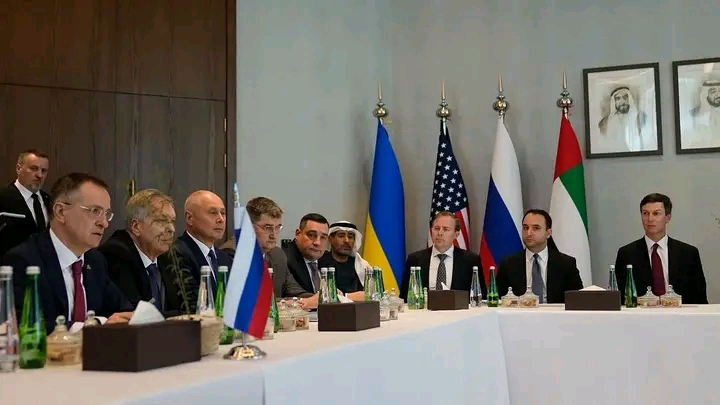
Vladimir Medinsky, Putin’s aide and head of Russia’s delegation in Abu Dhabi, has openly stated what Moscow considers an acceptable peace.
“I will be satisfied only when we win and sign a peace agreement on our terms,” Medinsky said after the negotiations.
Asked about exchanging occupied territories, he repeated an earlier declaration by Putin: “Wherever the foot of our Russian soldier has stepped—that is ours.”
This was not an anonymous leak or an emotional remark from a military blogger. It came from the man Putin appointed to negotiate on Russia’s behalf immediately after Washington described the talks as productive and spoke again of momentum toward peace.
The message is unmistakable. Moscow still defines peace as Ukrainian submission, territorial expansion and international acceptance of whatever Russian soldiers can temporarily occupy. That is not compromise—it is annexation by bootprint.
These remarks also expose the diplomatic loop we have seen repeatedly: Russia enters negotiations, Western officials announce progress, and the Kremlin publicly repeats demands Ukraine could never accept.
A Russian soldier stepping onto Ukrainian soil does not transform that land into Russia. Around Lyman, Ukrainian forces are already pressing Russian units eastward toward the Zherebets River, demonstrating how quickly supposedly “Russian” territory can return to Ukrainian control. The Russian soldier who crosses onto Ukrainian land does not acquire it—he becomes an occupier whose time there may be limited.
If Moscow insists that peace can exist only after a Russian victory, then pressure—not optimism—remains essential. Ukraine must continue receiving the weapons, financing and political support required to ensure that Putin never obtains the victory Medinsky is demanding at the negotiating table.
MEDINSKY: RUSSIA WILL ACCEPT PEACE ONLY AFTER “VICTORY” ON ITS OWN TERMS
Vladimir Medinsky, Putin’s aide and head of Russia’s delegation in Abu Dhabi, has openly stated what Moscow considers an acceptable peace.
“I will be satisfied only when we win and sign a peace agreement on our terms,” Medinsky said after the negotiations.
Asked about exchanging occupied territories, he repeated an earlier declaration by Putin: “Wherever the foot of our Russian soldier has stepped—that is ours.”
This was not an anonymous leak or an emotional remark from a military blogger. It came from the man Putin appointed to negotiate on Russia’s behalf immediately after Washington described the talks as productive and spoke again of momentum toward peace.
The message is unmistakable. Moscow still defines peace as Ukrainian submission, territorial expansion and international acceptance of whatever Russian soldiers can temporarily occupy. That is not compromise—it is annexation by bootprint.
These remarks also expose the diplomatic loop we have seen repeatedly: Russia enters negotiations, Western officials announce progress, and the Kremlin publicly repeats demands Ukraine could never accept.
A Russian soldier stepping onto Ukrainian soil does not transform that land into Russia. Around Lyman, Ukrainian forces are already pressing Russian units eastward toward the Zherebets River, demonstrating how quickly supposedly “Russian” territory can return to Ukrainian control. The Russian soldier who crosses onto Ukrainian land does not acquire it—he becomes an occupier whose time there may be limited.
If Moscow insists that peace can exist only after a Russian victory, then pressure—not optimism—remains essential. Ukraine must continue receiving the weapons, financing and political support required to ensure that Putin never obtains the victory Medinsky is demanding at the negotiating table.