

🇿🇲 VOTE INSIGHT | Mundubile Wins Ground, Hichilema Builds the Margin
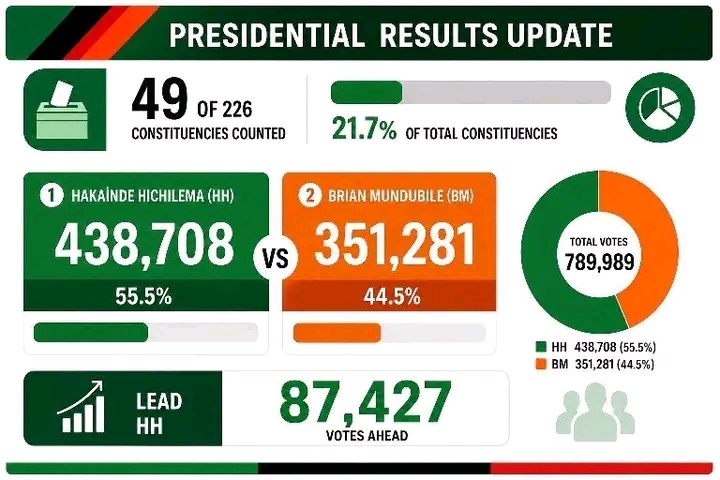
The presidential count is beginning to reveal an election where geography and arithmetic are telling different stories. With 49 of 226 constituencies in the consolidated tally, Hakainde Hichilema has 438,708 votes against Brian Mundubile’s 351,281, an advantage of 87,427. Between the two leading candidates, this translates to roughly 55.5% for Hichilema and 44.5% for Mundubile. It remains too early to project the final outcome, but there is now enough material to examine how each candidate is building his vote.
The latest 22 constituencies did not dramatically expand Hichilema’s lead. From the earlier tally of 27 constituencies, Hichilema added 195,199 votes, while Mundubile added 189,398. The difference was only 5,801 votes. Mundubile is therefore keeping pace as more results from Northern, Muchinga, Luapula and Eastern enter the count.
His strength across the old PF belt is becoming visible. Mundubile won Kasama Central 20,689 to 8,178, Senga Hill 14,163 to 8,341, Chinsali Central 15,606 to 3,986 and Chipata North 16,345 to 7,172. Luapula has also delivered consistent advantages, including Mwansabombwe 11,812 to 4,456, Chifunabuli North 11,950 to 4,108, Milenge 9,733 to 4,108, Pambashe 9,155 to 3,467 and Chipili 9,379 to 5,411. The numbers support an emerging conclusion: Mundubile has consolidated a substantial part of the former PF presidential vote.
But consolidation is only half of his task. The size of the victories matters. Mundubile can win several constituencies across Northern, Muchinga and Luapula and still surrender those accumulated advantages when one large Hichilema stronghold reports. This is already happening.
Only a small part of Southern Province has entered the figures under review. Dundumwezi returned 22,043 for Hichilema against 46 for Mundubile. Kalomo South produced 23,802 to 83, Magoye East 19,738 to 148, Monze East 22,523 to 429, Chikankata 38,739 to 475, and Sinazongwe 29,098 to 382. Those six constituencies alone give Hichilema 155,943 votes against Mundubile’s 1,563, a net advantage of about 154,380 votes.
The significance becomes clearer when Southern is temporarily removed from the arithmetic. Take those six results out of the consolidated total and Mundubile would be ahead among the remaining reported results, with roughly 349,718 votes against Hichilema’s 282,765. Restore those Southern constituencies and Hichilema returns to an overall lead of 87,427. Southern has 29 constituencies, meaning most of the province remains outside this particular sample.
This is why counting constituencies won can mislead. Mundubile may eventually carry more constituencies, and it remains possible for him to carry more provinces. Zambia does not elect its president by provinces or constituencies. The votes are aggregated nationally. A Mundubile victory of 7,489 to 7,180 in Mafinga North produces an advantage of 309 votes. Hichilema’s 38,739 to 475 in Chikankata produces an advantage of 38,264. One overwhelming constituency can therefore cancel numerous narrow victories elsewhere.
Hichilema is also doing something important outside Southern. Mwomboshi in Central gave him 11,586 against 3,627, while Mumbwa Central earlier returned 18,225 against 1,923. Chongwe East in Lusaka produced 17,114 to 8,807, and Rufunsa has come in at 8,716 to 7,672. He also won Nkombwa in Muchinga 7,199 to 3,493, Lusangazi Central in Eastern 7,847 to 7,054, and Kalalangabo on the Copperbelt 6,994 to 3,618. These are strategically valuable results because Hichilema does not need to dominate Mundubile’s territory. He needs enough votes there to prevent large opposition surpluses.
Turnout could become another part of the story. Returns and field observations so far suggest relatively modest raw totals in several Mundubile-leaning constituencies, alongside much heavier voting in some Hichilema strongholds. Rejected ballots also need watching. We should not draw a firm conclusion before constituency-level registered-voter and votes-cast figures are fully reconciled, but lower turnout in a candidate’s strongest regions can materially reduce the value of carrying those regions.
The remaining electoral map is therefore more important than the current headline lead. Southern still has most of its constituencies outstanding, while Western and North-Western will test whether Hichilema can reproduce the large margins associated with his traditional western bloc. At the same time, more of the Copperbelt, Lusaka, Northern, Muchinga, Luapula and Eastern will show whether Mundubile can generate margins large enough to counter those numbers.
The Copperbelt is especially important. Winning it narrowly will help Mundubile politically, but may not be sufficient mathematically. The same applies to Lusaka. If those populous and relatively competitive provinces split closely, Mundubile will require much larger surpluses from the northern and eastern belt. If he begins winning major urban constituencies by wide margins, the equation changes considerably.
At 49 of 226 constituencies, 177 remain outside the consolidated tally. No responsible call can be made. But the structure of the contest is taking shape. Mundubile is winning considerable territory across the former PF belt. Hichilema is absorbing some of those losses while accumulating enormous surpluses in his strongest areas.
It is therefore entirely possible for one candidate to finish with more constituencies, perhaps even more provinces, and still lose the presidential election. The map tells us where each candidate is strong. The margins will determine who goes to State House.
© The People’s Brief | Ollus R. Ndomu