

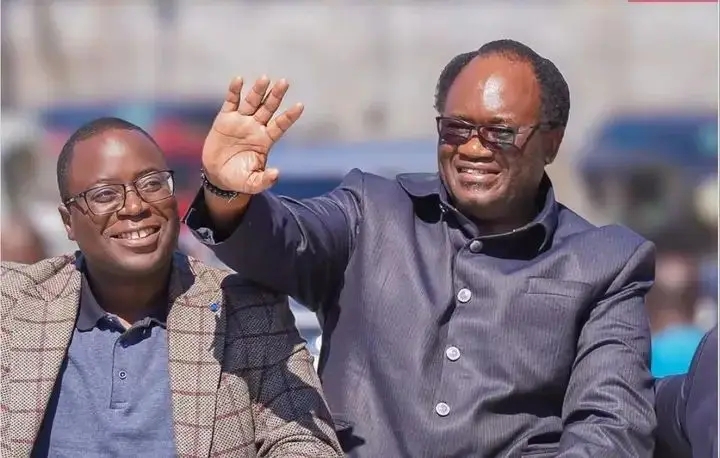
🇿🇲 MONITOR | Mundubile’s Campaign Promises: What is Being Offered to Voters?
As election campaign gathers pace, Tonse Alliance presidential candidate Brian Mundubile continues to unveil a growing list of promises aimed at different constituencies across the country. From miners on the Copperbelt to students, farmers, civil servants and content creators, the opposition candidate has increasingly used rallies and media appearances to outline what a Mundubile presidency would look like.
The challenge for voters is separating campaign rhetoric from policy, and distinguishing between promises contained in the official manifesto and commitments made during campaign engagements.
The People’s Brief has therefore begun tracking major promises being made by candidates as part of our election monitoring project.
One of the most publicised promises has been directed at small-scale miners, commonly known as Jerabos. Speaking in Kitwe and other Copperbelt towns, Mundubile pledged to return mining dumpsites, including Senseli and Kikonge, to local miners if elected.
“Without beating about the bush, when we are elected, we’ll give you back Senseli Mine, Kikonge and all the dumpsites,” Mundubile told supporters.
The proposal speaks directly to unemployment and economic exclusion on the Copperbelt. However, it also raises questions about mining regulation, environmental compliance, investor confidence and the government’s ongoing efforts to formalise mining activities following crackdowns on illegal mining operations in several provinces.
Students have emerged as another major target group. Mundubile has promised to increase meal allowances to K5,000 and has further pledged to cancel outstanding student loans.
“We will maintain meal allowances and increase them in line with the cost of living,” he said during a recent media appearance.
The promise has generated significant interest among students. Yet questions remain regarding financing. Zambia currently supports thousands of students under higher education financing programmes, and any cancellation of existing loans would require substantial fiscal resources. Notably, some critics have pointed out that the K5,000 allowance proposal is not prominently featured in the manifesto itself.
Civil servants have also been promised relief measures. Mundubile says his administration would revive debt-swap schemes and improve remuneration for public workers who upgrade their qualifications.
Supporters argue that such measures would ease financial pressure on workers. Critics question the budgetary implications, particularly at a time when government finances remain constrained despite debt restructuring progress.
Agriculture occupies a central position in the Tonse campaign message. During rallies in Eastern Province, Mundubile proposed accelerated mechanisation, expanded irrigation, access to tractors and combine harvesters, and the introduction of commercial grain drying systems.
One proposal that generated extensive debate involved introducing industrial maize drying technologies to reduce post-harvest delays.
Mundubile argued that farmers should not have to wait months for natural drying before selling maize to the Food Reserve Agency. Agricultural experts note that commercial grain dryers are widely used across advanced farming economies and can significantly reduce moisture content while protecting grain quality. The policy debate therefore shifts from whether the technology exists to whether it can be deployed at scale and financed sustainably across Zambia’s farming communities.
Another notable promise involves restructuring the Zambia National Service (ZNS). Mundubile says ZNS should move away from gold mining operations and focus on infrastructure projects such as roads and dam construction.
“ZNS should be building roads and digging dams instead of stopping young people from mining,” he said in Petauke.
The proposal reflects a broader opposition argument that state institutions should focus more heavily on productive economic activities. Whether such a shift is operationally feasible would depend on security, resource allocation and government priorities.
Mundubile has also promised the creation of new government structures, including a Ministry of Chiefs, a Ministry of Digital Economy, and a youth employment desk at State House. The digital economy proposal includes support for content creators and online entrepreneurs.
Questions remain over how monetisation mechanisms would operate given that major digital platforms are owned and regulated outside Zambia. Nevertheless, the proposal reflects the growing political importance of digital employment among younger voters.
Several additional commitments have attracted attention, including promises to provide state security to opposition leaders, complete stalled infrastructure projects, and facilitate the repatriation and burial of former president Edgar Lungu’s remains.
As campaigns intensify, the central question facing voters is no longer whether promises are being made. Every election produces promises. The more important question is which promises are costed, which are contained in official policy documents, which can realistically be implemented within five years, and how they would be financed.
We will continue monitoring campaign commitments from all major candidates and comparing them against official manifestos, fiscal realities and implementation feasibility.
Because elections are not simply contests of popularity. They are contests of ideas, priorities and credibility.
For corrections, partnerships, advertising inquiries, opinion submissions and story tips, contact the People’s Brief editorial team at editor.peoplesbrief@gmail.com.
C© The People’s Brief | Goran Handya & Mendoi Liteta
Isn’t he also now making promises? Shame.
Brian Mundubile has been a member of Parliament for mporokoso , what has he done to his constituency in regards the welfare of the voters.How many students is he sponsoring at primary, secondary and tertiary level ? Promises should result instead of political cheating…it is wise not to promise a lot of things that are not achievable because those promises will result in the voters take you as a joker. Bwana Mundubile should be careful especially with promises he is laying down at each rally he holds,l remember of an aspiring Presidential candidate in DRC telling people that once elected as president No more DEATH ! Because l will wipe out hanger because food will be on people’s tables.Well , it’s campaign time and the voters have a say on the 13th August 2026 .
Mr. Mundubile is promising heaven on earth. His promises all bank on spending, spending and more spending. I have not heard him talk about how he is going to raise the money that will be required to realise his spending.
Either he will print more money (which will rapidly increase the cost of goods and services) or drastically raise taxes (which will leave people with less money to spend). It reminds me of how PF got so desparate to tax citizens that they introduced the borehole tax at K250(?) when they had failed to supply potable water.
Yes, Mr. Mundubile is making some pretty wild promises which, clearly he will fail to keep even of he is given 15 years to rule.
He doesnot fool me.
He can only fool the fools!
All his promises are EMPTY. The maize dryer is USED IN IN COUNTRIES WHERE there’s little or no sun at all. Here in AFRICA WE HAVE ALOT OF SUNSHINE.
These guys and Mwambazi are dreamers. HH PROMOTED irrigation which the PF were ignoring and today they wake up that THEY WANT TO SCALE AGRICULTURE??
They don’t have any manifesto of their own. ONLY GUESS WORK.
The other week E.Mwamba was busy accusing UPND that they STOLE HIS MANIFESTO. Guys grow up