

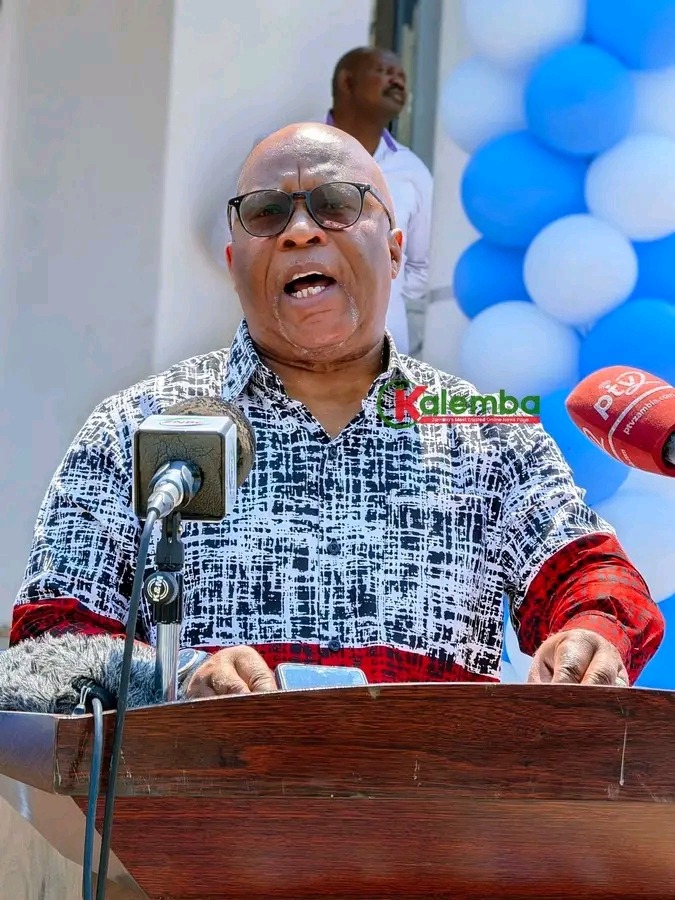
NEVERS SEKWILA MUMBA—FROM THE PULPIT TO POLITICS, GOVERNMENT HOUSE, DIPLOMACY, POLITICS… AND NOW THE EXIT DOOR.
From Zambia’s pioneering televangelists to Republican Vice-President, diplomat, party president, election observer and now a man stepping away from active politics Pastor Mumba’s political journey has had more plot twists than a Zambian political party convention.
Born on 18 May 1960 at Chitambo Mission, in present-day Chitambo District, Pastor Mumba grew up in a deeply religious family in Chinsali.
His father was both a teacher and Reverend in the United Church of Zambia, so religion was not exactly something Pastor Mumba discovered later in life, it was part of the family furniture.
He was baptised in the UCZ by Rev. Paul Mushindo, the clergyman after whom Paul Mushindo University in Chinsali would later be named.
Pastor Mumba attended Hillcrest Technical School in Livingstone, where he joined the Zambia Combined Cadet Force and rose to become Provincial Commandant for Southern Province.
He subsequently underwent compulsory military training under the Zambia National Service before heading to the Copperbelt in search of employment in the mines.
But the mines apparently failed to convince him that copper was his calling.
At just 19, he joined Maranatha Church, where he became a church elder under Bishop Sky Banda.
A year later, at the tender age of 20, Pastor Mumba founded Victory Bible Church and Victory Ministries International.
And that was the beginning of a ministry that would eventually make him one of Zambia’s most recognisable Pentecostal preachers.
His television programme, “Zambia Shall Be Saved,” turned him into a household name. For many Zambians, Pastor Mumba was the man on television preaching salvation.
But somewhere along the way, salvation acquired a political manifesto.
In 1997, Pastor Mumba founded the National Christian Coalition, a Christian political movement which was later registered as the National Citizens Coalition (NCC) in 1998.
He entered the 2001 presidential election as the NCC candidate.
The results were, to put it politely, not exactly televangelist numbers.
Out of 1,771,335 valid votes, Pastor Mumba received 38,860, finishing eighth among the contestants.
But Zambian politics has always had a fascinating habit of giving people second acts.
And Pastor Mumba’s second act arrived rather dramatically.
In May 2003, President Levy Mwanawasa appointed the 43-year-old Pastor Mumba as Republican Vice-President, replacing Enock Kavindele.
Just like that, the preacher who had been asking Zambia to be saved was now accommodated at Government House.
The NCC was subsequently dissolved and Pastor Mumba joined the ruling MMD.
Naturally, the appointment generated controversy.
Some within the MMD reportedly questioned the wisdom of bringing a former presidential candidate into the vice-presidency.
Former Legal Affairs Minister Roger Chongwe also challenged the constitutionality of the appointment, citing Article 68(3).
But Mwanawasa went ahead.
And for approximately 16 months, Zambia had a former televangelist occupying the second-highest office in the land.
In September 2004, Mwanawasa was attending the United Nations General Assembly in New York when Pastor Mumba became Acting President.
This is where the story took another turn.
Pastor Mumba made remarks alleging that the Democratic Republic of Congo (DRC) was harbouring criminal elements who had fled prosecution in Zambia.
The comments caused diplomatic discomfort, particularly concerning former intelligence chief Xavier Chungu, who had fled Zambia while facing corruption-related allegations.
Mwanawasa reportedly asked Pastor Mumba to retract and apologise.
Pastor Mumba declined.
And Mwanawasa, apparently deciding that the Vice-President had tested the boundaries of “acting president” a little too enthusiastically, dismissed him in October 2004 for insubordination.
Mwanawasa later apologised personally to then DRC President Joseph Kabila, describing Pastor Mumba’s remarks as embarrassing.
And just like that, the journey from Vice-President to former Vice-President took considerably less time than most Zambians would have expected.
Pastor Mumba returned to the pulpit.
But politics, as we know, has a habit of calling people back.
Following Mwanawasa’s death and the election of Rupiah Banda in 2008, Pastor Mumba was appointed Zambia’s High Commissioner to Canada in 2009.
So the man who had once preached to Zambians through a television screen was now representing Zambia thousands of kilometres away in Ottawa.
Unfortunately, even Canada could not completely escape the Pastor Mumba political sequel.
His diplomatic tenure later became the subject of criminal proceedings.
In 2018, the Lusaka Magistrates’ Court convicted him on two counts of abuse of authority of office, while he had also faced a charge relating to failure to follow procedure under the Anti-Corruption Act.
The cases involved, among other things, the handling of CAD$122,000 received from Barrick Gold for a cultural exchange programme and contracts involving electrical works and carpeting.
Despite the convictions, Magistrate Joshua Banda granted him an absolute discharge, after considering the mitigating factors presented before the court.
In May 2012, Pastor Mumba returned to party politics and was elected MMD president, defeating Felix Mutati in a re-run.
Pastor Mumba polled 870 votes, against Mutati’s 422, with Situmbeko Musokotwane finishing third on 280.
For a man whose first political party had struggled electorally, the MMD presidency offered another opportunity to rebuild his political fortunes.
Then came the 2015 presidential by-election following the death of President Michael Sata.
Pastor Mumba contested.
He finished fourth, receiving 14,609 votes out of 1,671,662 votes cast.
By now, Zambia had begun discovering an intriguing feature of Pastor Mumba’s political career:
The man could command a congregation. Mobilising a country at the ballot box was another sermon altogether.
Ahead of the 2016 election, Pastor Mumba entered into a Memorandum of Understanding with Hakainde Hichilema and the UPND.
After the election, however, Pastor Mumba later announced that the agreement had expired.
Politics had once again done what politics does best, create an agreement, hold an election, and then hold another meeting to explain what the agreement actually meant.
In 2018, Pastor Mumba was sentenced to three months’ imprisonment with hard labour after being convicted of providing false information to a public officer.
He was acquitted on a separate criminal trespass charge connected to protests over ZNBC’s coverage of the 2016 elections.
Then came another chapter.
In 2021, Pastor Mumba contested the presidential election under the MMD New Hope banner.
This time he polled 4,968 votes, finishing tenth among 16 presidential candidates.
The man who had once stood behind a pulpit before thousands of worshippers was now receiving votes in numbers that could probably fit inside a reasonably sized church.
But Pastor Mumba was not finished.
In October 2021, MMD New Hope entered into a partnership with the governing UPND based on seven principles, including rule of law, fighting corruption, national unity, economic recovery, human rights and foreign-policy renewal.
Perhaps one of the more interesting chapters came in 2023.
President Hakainde Hichilema appointed Pastor Mumba to lead the SADC Electoral Observation Mission to Zimbabwe.
For a man who had spent decades contesting elections, Pastor Mumba was now being sent to another country to observe one.
The irony was almost too perfect.
This time, he wasn’t asking Zambians for votes.
He was watching Zimbabweans cast theirs.
The SADC mission’s preliminary statement identified several aspects of Zimbabwe’s 2023 election that it said fell short of relevant constitutional, electoral and SADC standards. Pastor Mumba defended the report, insisting that the mission had acted on behalf of SADC rather than as individuals.
In other words, the former candidate had temporarily changed jobs:
from contestant to referee.
In November 2025, Mumba announced the rebranding of the former MMD into the New Nation Party (NNP).
Because apparently after decades of MMD politics, another name change was the one thing Zambian politics had been waiting for.
And then came 15 September 2026.
After 29 years in politics, Pastor Mumba announced that he was stepping aside from active partisan politics, resigning as NNP president and handing interim leadership to Vice-President Reuben Sambo until the next party convention.
He also announced his withdrawal from the UPND Alliance Council of Presidents.
This comes barely a few days after some stakeholders raised concerns about Pastor Mumba’s continued participation in active politics as NNP president while receiving benefits as a former vice president, following the enactment of the Benefits of Former Presidents and Former Vice-Presidents Act, 2026, into law in June.
Pastor Mumba stressed that this was not a retirement from public service but a “redefinition of service.”
He said he intended to continue contributing through counsel and guidance based on his experience in Scripture, diplomacy and politics.
And so, after nearly three decades, the preacher has stepped away from the political pulpit.
Few Zambian political careers have travelled through quite so many lanes.
Perhaps the most amusing chapter is that after spending years trying to get Zambians to vote for him, Pastor Mumba eventually found himself travelling around the region watching other people vote.
Politics may not have delivered the electoral victories he once sought, but it certainly delivered a career with enough chapters to fill several political archives.
And as he steps away from active partisan politics, one thing is certain:
Pastor Mumba has never had a boring career.
The preacher preached.
The politician contested.
The Vice-President governed.
The diplomat represented.
The candidate campaigned.
The observer observed.
And now the politician has apparently decided to observe politics from the sidelines.
Pastor Mumba holds:
A Master’s Degree in Public Policy from Regent University, Virginia, USA.
A Practical Theology Degree from Christ for the Nations Institute, Dallas, Texas.
A Diploma in Instrumentation from Copperbelt Energy Institute in Kitwe.
An Honorary Doctorate in Theology from Full Gospel Christian Theological Seminary in Flint, Michigan.