

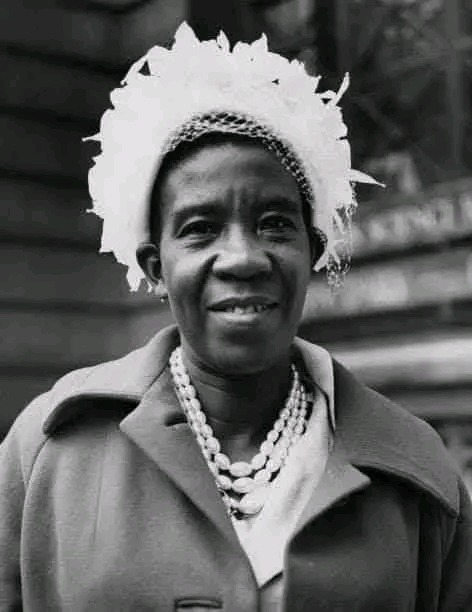
PRINCESS NAKATINDI NGANGA YETA (1922–1972)
Long before “women in leadership” became a slogan, Princess Nakatindi was already doing the work.
Born in 1922 at Lealui, daughter of Yeta III, the Litunga of Barotseland, Nakatindi could have comfortably remained within royal circles.
Instead, she entered politics at a time when Zambian politics was basically a men’s club.
She became the first well-known woman in Barotseland to join UNIP and the first director of the UNIP Women’s Brigade.
She even accompanied Kenneth Kaunda to Limulunga to meet the Litunga, Sir Mwanawina, helping build the political alliance that supported the independence struggle.
In 1962, she contested the Zambezi constituency. She lost to Job Michello of the Northern Rhodesian African National Congress.
Did she retire?
Please.
In 1964, she contested Nalikwanda and won.
She was among the first women elected to Zambia’s legislature, alongside Margret Mbeba (Kazimuli) and Ester Banda (Roan).
And then came independence.
On 24 October 1964, Zambia became independent and Nakatindi was already part of the political class shaping the new nation.
After independence, Nakatindi continued breaking political ground. In 1966, she became Parliamentary Secretary to the Minister of Labour and Social Development the first woman to hold a junior ministerial position.
That same year, the Barotse Royal Establishment installed her as Chieftainess of Sesheke.
So Nakatindi was simultaneously:
Princess. Politician. MP. Junior minister. Traditional ruler. A mother of 11 children.
Apparently, one career was not enough.
She lost her parliamentary seat in 1968, but politics did not lose her. She went on to serve in the House of Chiefs and as governor of Sesheke District until her death in 1972.
Her daughter, Nakatindi Wina, later followed in her footsteps as an MP and minister.
Nakatindi was one of the women who entered Zambian politics before there was a comfortable place for women in it.
There were no hashtags.
No “women empowerment” conferences.
No diversity panels.
There was simply the political struggle and Nakatindi showed up
While others were waiting for permission, she was contesting elections.
She didn’t wait for the political door to open.
She helped push it open.
Today, Nakatindi Hall at the Lusaka Civic Centre carries her name, a fitting reminder of a woman who helped make space for generations of Zambian women who came after her.
A princess by birth.
A political pioneer by choice.
And one of the women who helped prove that Zambia’s political history was never meant to be written by men alone.