

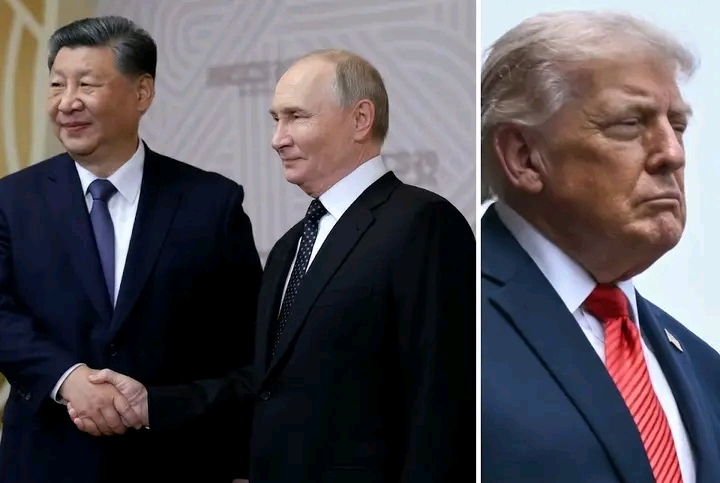
Putin, Trump and Xi Jinping: A Proposed Three-Power Deal to Reshape the World Order
Russian President Vladimir Putin has reportedly proposed a new international arrangement involving himself, U.S. President Donald Trump, and Chinese President Xi Jinping, aimed at reshaping the global order and strengthening the influence of their respective countries.
According to the proposal, the three leaders would discuss major international conflicts and strategic interests, potentially establishing a framework in which the world’s three leading powers play a greater role in determining the future of global affairs.
Ukraine Could Be the First Test
One of the first issues expected to feature prominently in the discussions is the war in Ukraine. Putin has reportedly proposed holding a meeting in November to discuss the conflict, potentially without Ukrainian President Volodymyr Zelensky or any other Ukrainian representative.
Instead, the proposal would place Russia, the United States, and China at the center of negotiations over the future of the war, raising concerns that decisions affecting Ukraine could be made without Ukraine’s direct participation.
A report published by The Wall Street Journal on October 19, 2026, said Putin raised the idea during a telephone conversation with Trump on October 9. The proposal reportedly included holding a trilateral summit in China on the sidelines of the Asia-Pacific Economic Cooperation (APEC) summit, scheduled for November 18–19.
A U.S. official reportedly said Trump had not yet accepted the proposal. China, meanwhile, was said to be open to the idea in principle if Washington agreed. The Kremlin confirmed that discussions were taking place, although the date and agenda had not been finalized.
Putin’s Vision of a New Global Order
Putin reportedly hopes to persuade Trump to pursue a broader strategic arrangement in which the three powers strengthen their international positions while reducing obstacles to their geopolitical ambitions.
From Moscow’s perspective, Ukraine and European opposition to Russia’s policies remain significant barriers to its regional and international objectives.
A former Russian intelligence official reportedly compared Putin’s ambitions to the Yalta Conference of 1945, when the leaders of the United States, the Soviet Union, and Britain discussed the postwar international order and the distribution of influence in Europe.
However, a modern arrangement involving Washington, Moscow, and Beijing would represent a different geopolitical landscape, with China playing a much more prominent role than it did in the final stages of World War II.
China’s Opportunity and the Risks for Europe
Such a summit could provide Beijing with an opportunity to strengthen its position as a diplomatic intermediary between Washington and Moscow while expanding its influence over major international decisions.
However, the initiative could also strain China’s relations with Europe if European governments interpret it as an attempt by the three powers to determine Ukraine’s future without Ukrainian participation.
For Ukraine, the central concern would be whether its sovereignty, territorial integrity, and security guarantees could become subjects of negotiations conducted primarily by outside powers.
For European governments, the broader question would be whether a new global arrangement could weaken the principle that countries have the right to determine their own political and security futures.
Could the Model Extend to Africa and Strategic Maritime Routes?
If a three-power arrangement were ever established, its implications could extend beyond Ukraine. Strategic territories, mineral resources, military access, energy infrastructure, and international shipping routes could become increasingly important elements of negotiations among major powers.
Under this potential scenario, Russia could seek to consolidate its influence in areas it considers strategically important, while the United States could prioritize its military, economic, and maritime interests. China, meanwhile, could seek access to critical minerals, infrastructure, and new economic opportunities.
Ukraine’s natural resources and strategic location illustrate why territorial conflicts and great-power competition can become intertwined with economic interests. However, claims that the three leaders intend to divide Ukraine’s territory or formally allocate other countries to one another remain speculative and should not be treated as established facts.
The same concerns could arise in the Horn of Africa, where access to the Red Sea, the Gulf of Aden, the Bab el-Mandeb Strait, and the wider Indian Ocean gives the region considerable strategic importance.
Countries in the region could face growing pressure as external powers compete for port access, military facilities, mineral resources, energy corridors, and influence over maritime trade.
If major powers increasingly rely on bilateral deals to settle regional disputes, smaller countries could find themselves negotiating from a weaker position, particularly where their institutions, economies, or security arrangements depend heavily on external support.
The Strategic Question
The central question is whether a potential Putin Trump Xi initiative would produce a more stable international order or encourage a system in which the world’s strongest countries exercise disproportionate influence over the affairs of smaller nations.
For the Horn of Africa, the lesson would be significant: strategic geography can create economic opportunities, but it can also expose countries to intense competition among outside powers.
The region’s long-term interests would depend on strengthening national institutions, protecting sovereignty, negotiating transparent agreements, and avoiding excessive dependence on any single foreign power.
Ultimately, any proposed three-power arrangement would need to be assessed not only by what Russia, the United States, and China stand to gain, but also by whether the countries directly affected by their decisions have a meaningful voice in determining their own futures.