

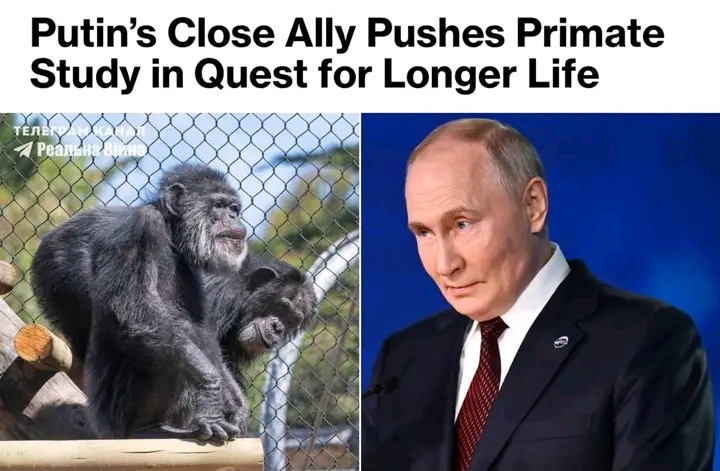
PUTIN’S INNER CIRCLE BUILDS MONKEY BLOOD BANK IN SEARCH FOR LONGER LIFE
Russia is expanding an unusual state-backed effort to slow human aging—an effort closely connected to Vladimir Putin’s inner circle and his increasingly public fascination with extreme longevity.
The Kurchatov Institute, headed by Putin’s longtime friend and informal scientific adviser Mikhail Kovalchuk, is studying elderly primates to understand how their bodies change with age. Its breeding facilities reportedly contain more than 7,000 monkeys from 22 species, although that is the total colony—not the number participating in the aging study.
Researchers are conducting biochemical and structural examinations of monkeys between 18 and more than 30 years old. They are studying their brains, blood vessels, organs and genetic changes while building a biobank containing blood samples from particularly long-lived animals.
The objective is to identify biological markers connected to slower aging and eventually develop what Kovalchuk described as a “regulatory system” for extending human life. There is no evidence that scientists have created an actual longevity elixir or discovered a treatment capable of allowing people to live anywhere near 150 years.
The monkey study is only one part of Russia’s wider longevity program. Other projects reportedly involve gene therapy intended to slow cellular aging, three-dimensional printing of human tissue and attempts to grow transplantable organs inside genetically modified miniature pigs. Russia’s 2027–2029 budget allocates nearly 18 billion rubles—around $217 million—to “new health-preservation technologies.”
Putin’s eldest daughter, endocrinologist Maria Vorontsova, is also connected to state-supported research involving genetics, cellular regeneration and healthy aging.
Ukraine:News reported on Putin’s obsession with longevity when it first became public during the 2025 military parade in Beijing. Putin, Chinese leader Xi Jinping and North Korean dictator Kim Jong Un were walking together when a live microphone captured an almost surreal conversation about replacing human organs and extending life to 150 years. While the world watched three aging authoritarian leaders display military power, they casually contemplated whether biotechnology might allow them to remain alive for generations.
Putin has since described reaching such an age as potentially realistic.
The science itself is not fictional: researchers worldwide study aging, regenerative medicine and organ replacement. What makes Russia’s program unusual is the concentration of projects around people personally connected to its 74-year-old ruler.
The mystery is not whether Russia is studying how to prolong life—it openly is. The unanswered question is whether this is primarily a public-health program or an aging authoritarian elite investing state resources in the hope that science might eventually allow it to outrun mortality.