

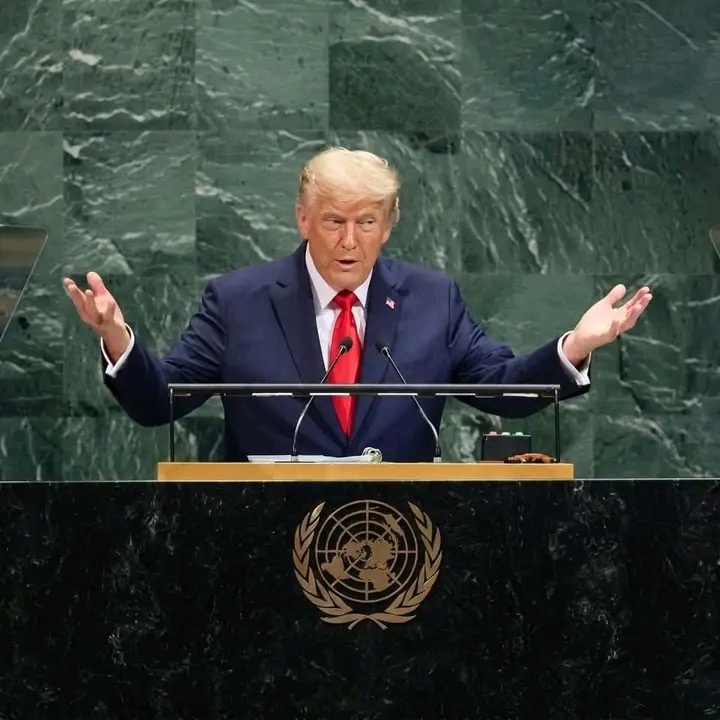
🌍 RECAP OF THE UN GENERAL ASSEMBLY: WHAT TRUMP ACTUALLY SAID
Donald Trump addressed the 81st United Nations General Assembly in New York on September 22, 2026.
His 37-minute speech covered Iran, Russia and Ukraine, Gaza, artificial intelligence, Venezuela, Cuba, Greenland, NATO, immigration, energy, the United Nations and the future of global security.
But beyond the headlines, there is something more important to understand:
This was a speech about power, leverage and decision-making.
Let me break it down.
🇮🇷 1. IRAN
Trump said he now faces a major decision over Iran: pursue a deal that would allow Iran to rebuild, or, in his words, potentially “annihilate” the Islamic Republic.
At the same time, he called on other countries to support complete economic isolation of Iran.
He also suggested that a deal could eventually be reached after the U.S. midterm elections.
This is not simply about Iran.
It is about how economic pressure, military power and diplomacy are being used together as instruments of statecraft.
🇺🇦 2. RUSSIA & UKRAINE
Trump said he believes the Russia-Ukraine war can be brought to an end.
He expressed frustration that the conflict continues and referred to sanctions targeting Russia while saying the United States is working with both sides toward a resolution.
The important question is not only what is being said about peace, but what diplomatic mechanisms, concessions and enforcement arrangements could actually produce it.
🇵🇸 3. GAZA
Trump presented his administration’s efforts around Gaza as part of a broader attempt to end major conflicts.
The bigger issue here is whether diplomatic statements translate into an actual framework capable of producing a durable settlement and addressing the humanitarian and security dimensions of the conflict.
That distinction matters:
Announcement ≠ implementation.
🤖 4. ARTIFICIAL INTELLIGENCE
This was one of the most interesting parts of the speech.
Trump said the United States should not slow the development of AI and rejected warnings about catastrophic AI risks as a “hoax.”
He also said the U.S. government would begin using the term “superintelligence” rather than “artificial intelligence” in official language.
He framed technological leadership as a strategic competition and argued that the United States should remain ahead.
For Africa, this deserves serious attention.
AI is no longer simply a technology discussion.
It is becoming a discussion about national capability, economic competitiveness, education, infrastructure and geopolitical power.
🇻🇪 5. VENEZUELA
Trump defended U.S. military action involving Venezuela and presented American intervention as necessary to protect U.S. interests in the Western Hemisphere.
He also discussed Venezuela’s oil resources and the role the United States intends to play in the country’s future.
This is another example of how security, energy and geopolitical influence are increasingly interconnected.
🇨🇺 6. CUBA
Trump strongly criticized Cuba’s communist government and predicted that the system would eventually fall.
Again, the important thing to watch is not only the rhetoric.
Watch the policy instruments:
Sanctions.
Diplomacy.
Economic pressure.
Security policy.
Those are the mechanisms through which political statements become actual outcomes.
🇬🇱 7. GREENLAND
Trump announced a new security arrangement involving the United States, Denmark and Greenland.
He said the United States would build two major military bases as part of strengthening security in the Arctic and NATO’s northern frontier.
This matters because Greenland sits at the intersection of:
Arctic security + NATO + energy + geography + great-power competition.
🇺🇸 8. NATO & AMERICA’S ALLIES
Trump again argued that America’s allies should contribute more to collective security.
His broader message was consistent with his approach to alliances:
Security commitments must be matched by resources, capability and burden-sharing.
That has implications far beyond Europe because NATO’s security architecture increasingly intersects with energy, Arctic security and the wider global balance of power.
🏛️ 9. THE UNITED NATIONS
Trump also criticized the United Nations for bureaucracy and what he sees as inefficient use of resources.
This creates an interesting institutional question:
Can the UN remain effective in a world where major powers increasingly prefer bilateral deals, coalitions and direct negotiations?
That question is bigger than Trump.
It concerns the future of multilateralism itself.
🧠 NOW STEP BACK AND LOOK AT THE SYSTEM
This is where Decision Infrastructure™ becomes useful.
Don’t just ask:
“What did Trump say?”
Ask:
What decisions are being signalled?
Who has the authority to make them?
What resources support them?
Which institutions will implement them?
What countries will be affected?
What economic sectors will move as a result?
What happens if the decisions fail?
Because these decisions do not stay inside the UN building.
They move through:
🌍 Geopolitics
⛽ Energy markets
💰 Investment
📈 Trade
🤖 AI
🚢 Supply chains
🛡️ Security
🎓 Education
🏢 Business
🌾 Development
💱 Currencies
And eventually, they reach ordinary people.
That is why you should pay attention to what happens at the United Nations.
The UN is not simply a room where presidents give speeches.
It is one of the places where the world’s political, economic and security systems are being negotiated.
And for Africa, the question should not simply be:
“What did America decide?”
It should be:
“What does this changing global decision environment mean for Africa?”
That is the conversation we should be having.
This is only the beginning of UNGA 81.
🌍 Stay informed.
Because the decisions being made in these rooms can eventually affect your country, your business, your investments, your opportunities — and your future.
Better information. Better decisions. Stronger futures.