

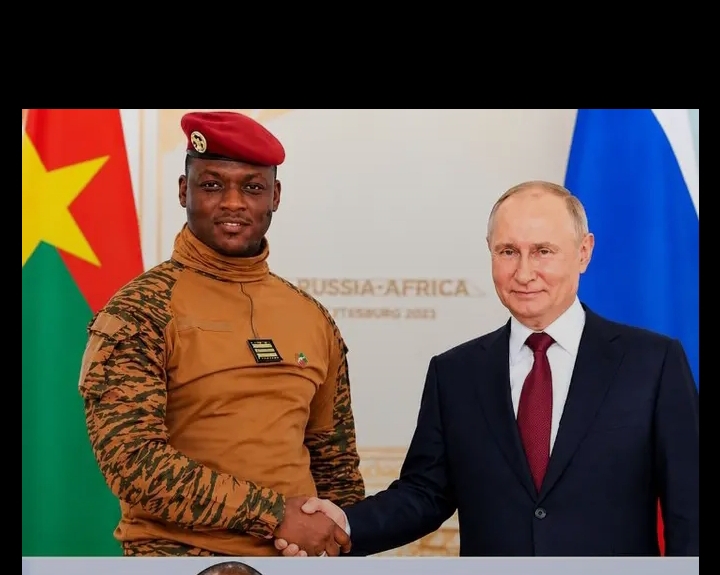
RUSSIA-AFRICA SUMMIT: TRAORÉ’S ABSENCE IN MOSCOW AND THE FRANCE OUT, RUSSIA IN FALLACY.
There have been rumours and unfounded claims circulating across Francophone Africa about Captain Ibrahim Traoré’s absence from the ongoing Russia-Africa Summit in Moscow.
Traoré’s presence at last year’s event attracted enormous attention, drawing the eyes of the world to both the summit and the young Burkinabè leader, who became one of its most talked-about figures.
Perhaps he simply has no desire to generate that same level of attention this time around, hence his decision to send his Prime Minister, Rimtalba Jean Emmanuel Ouédraogo, to represent Burkina Faso.
However, that Traoré’s last year presence at the event was extremely necessary for his political perception and at a greater overview, the survival of the Popular Progressive Revolution.
There’s a message that presence sent across world’s influential political spheres, and indeed achieved what it was meant to achieve.
Whatever the reason, the insinuations of internal strife, leadership disagreements and supposed cracks within the Burkinabè government being peddled by France’s e-rats across the Internet remain speculation, not established facts.
But what makes these rumours particularly revealing is how quickly some people are willing to interpret the absence of an African leader from an international gathering as evidence of a political crisis, especially when that leader has challenged the interests of powerful foreign actors.
Rather than examine the substance of Burkina Faso’s relationship with Russia or the priorities of the delegation attending the summit, the conversation has once again been reduced to speculation about who is falling out with whom, which foreign power is being abandoned and whether a political project built around national sovereignty is beginning to unravel.
It is a revealing habit, because it exposes something much deeper about the way Africa has been conditioned to understand its own politics.
An African leader can spend years challenging an inherited political order, redirecting national resources, pursuing new international partnerships and attempting to rebuild his country, yet the moment he does not appear at an international gathering, the conversation immediately shifts to who he has offended, which foreign power he is abandoning and whether his political project is beginning to collapse.
And this is where the conversation becomes much more interesting than the usual arguments about Russia and France.
WHY MUST AFRICA MEASURE SOVEREIGNTY BY WHO STANDS BESIDE WHOM?
For decades, African politics has been trapped in a way of thinking that measures a nation’s importance by the approval it receives from powerful countries, the invitations its leaders receive and the photographs they take with foreign presidents.
We have become so accustomed to seeing our leaders through the eyes of outsiders that even our understanding of independence has been reduced to a question of who likes us, who is angry with us and who we are supposedly trying to impress.
But sovereignty was never meant to be a popularity contest.
A country does not become independent because its president stands beside Vladimir Putin, Emmanuel Macron, Donald Trump or any other “powerful” leader. Nor does it automatically lose its independence because its president chooses not to attend a particular gathering.
The more important question is whether that country possesses the freedom, institutional strength and productive capacity to determine its own direction.
That distinction matters enormously when we discuss Burkina Faso under Traoré, because the country’s political direction has increasingly centred on national self-reliance, domestic resource mobilisation and the pursuit of partnerships beyond its traditional relationships or the master/slave relationship that Africa have always shared with the West.
The question, therefore, is not simply whether Traoré has gone to Moscow. It is what Burkina Faso expects to achieve through its relationship with Russia, what it is prepared to negotiate and whether the outcome will strengthen the country’s ability to stand on its own feet as they’re already taking a step to.
If the Prime Minister returns with meaningful agreements that advance Burkina Faso’s productive capacity, the absence of the president will not be the most important story.
If the delegation returns with little beyond diplomatic statements, the presence of the president would not have made those statements more valuable.
A presidential photograph cannot build a factory, train an engineer or transform a nation’s economy. That is the standard by which international partnerships should be judged. Now, let’s examine the;
FOUR YEARS THAT HAVE CHANGED THE CONVERSATION ABOUT BURKINA FASO
To understand why this moment deserves attention, we must look beyond Moscow and examine the direction Burkina Faso has taken since September 2022, the time Traoré’s government came to power.
Under Traoré’s leadership, the government has placed greater emphasis on mobilising domestic resources, strengthening national production, expanding agricultural activity, pursuing local processing of natural resources and reducing dependence on external actors.
These ambitions are part of a broader political argument: that formal independence means very little if a country remains unable to finance its priorities, develop its productive industries or exercise meaningful control over the value generated by its own resources.
There is a reason these questions resonate so strongly across Africa. More than six decades after many African countries attained formal “independence,” the continent continues to struggle with the contradiction of possessing enormous natural wealth while exporting much of it in forms that surrender a substantial share of the value created elsewhere.
Burkina Faso is attempting to challenge that pattern.
The country’s economic figures offer a useful starting point. There’s has been circulating yet to be confirmed news that Burkina Faso’s economy has grown over 46 percent since Traoré took power.
According to its Ministry of Economy and Finance, annual economic growth rose from 1.8 per cent in 2022 to 5.3 per cent in 2025, while inflation, which had reached 14.1 per cent in September 2022, fell to minus 0.5 per cent in 2025.
Government revenue also increased from approximately CFAF 2,506 billion in 2022 to CFAF 3,311 billion in 2025. These figures describe an economy that has recorded significant changes during Traoré’s period in power, even as the country continues to confront serious security and development challenges.
Those numbers deserve attention, but they also deserve to be understood correctly. Annual growth rates are not the same as cumulative economic growth, and the figures cited above do not independently establish the claim that the economy has grown by 46 per cent since Traoré took power. Any such claim requires a clearly defined measure and a consistent comparison of the relevant periods.
The larger point, however, remains. Burkina Faso’s economic direction cannot be understood simply by counting the international summits its president attends.
It must also be examined through the country’s efforts to mobilise resources, expand production and build the foundations of greater economic independence as we are witnessing them do.
For a country pursuing that agenda, the real work is not completed when a foreign partner offers its support. It begins when the country must turn that support into productive capacity, jobs, infrastructure, technical knowledge and opportunities for its people.
And that brings us back to Moscow.
RUSSIA IS A PARTNER, NOT A SUBSTITUTE FOR AFRICAN CAPABILITY
One of the greatest mistakes Africans can make in this new geopolitical moment is to assume that removing France from a position of influence and bringing Russia into a closer relationship automatically resolves the deeper problem of dependence.
It does not.
The argument that the Alliance of Sahel States has simply exchanged France for Russia overlooks the historical differences between colonial domination and a relationship entered into by sovereign governments.
Emphasis on the word SOVEREIGN, because all African Countries exception of the AES countries are actually not sovereign, even though that we are meant to believe that our countries are sovereign nations.
France’s colonial rule in West Africa was not a partnership negotiated between equals. The present relationship between Burkina Faso and Russia exists in a different historical and political context.
Yet recognising that distinction does not mean that Russia should be exempt from scrutiny or that every agreement with Moscow should automatically be celebrated as a victory for Africa.
Russia has its own national interests. So does every other country.
The responsibility of Burkina Faso’s leadership is to ensure that cooperation with Moscow serves Burkina Faso’s interests. That means asking what the country receives in return, what commitments it undertakes, what knowledge it acquires and whether the partnership strengthens its ability to make independent decisions.
If Russia can help Burkina Faso develop technical expertise, strengthen its energy sector, improve productive industries and train a new generation of engineers and specialists, then cooperation can serve a meaningful purpose.
If the relationship remains concentrated on political symbolism while the country continues to depend on outside expertise and imported technology for essential functions, the deeper challenge of economic sovereignty will remain.
The same standard must apply to every foreign partner, regardless of its history with Africa or its disagreements with Western governments.
The purpose of changing partners is not to find a new country to depend on. It is to develop the capacity to depend less on any country, which is clearly evident in Traoré’s Burkina Faso.
That is the difference between changing the face of a relationship and changing the system that governs it.
WHAT SHOULD BURKINA FASO BE SEEKING IN MOSCOW?
The Burkinabè government’s stated priorities for the summit provide a useful basis for answering that question. Its delegation is expected to promote projects involving local processing of natural resources, technological mastery and the training of young people, alongside discussions concerning security and development.
These are not minor details, they go directly to the heart of what economic sovereignty requires.
Take the question of natural resources. A country can possess gold and other valuable minerals while remaining unable to capture the full benefits of extraction because processing, specialised technology, financing or other high-value activities take place elsewhere.
Increasing domestic capacity to process those resources can create opportunities for technical training, industrial development and a greater share of economic value being retained within the country.
Technology presents a similar challenge. Political independence cannot reach its full potential if a country lacks the expertise to maintain essential infrastructure, develop its industries or train the people who will eventually run its most sophisticated institutions.
The same applies to education and skills development. A country that wants to transform its economy must invest in people who can build, manufacture, research, repair, design and innovate. It cannot permanently outsource those capabilities and still expect to exercise complete economic independence.
These are the kinds of questions that should dominate the discussion about Burkina Faso’s relationship with Russia.
What concrete projects can be negotiated? What financing arrangements are available? What technical skills can be transferred? What industries can be developed locally?
What opportunities will young Burkinabè people gain from the relationship? What mechanisms will ensure that the benefits reach the wider economy?
These are questions of national interest, not questions of diplomatic blablabla.
THE REAL TEST OF AES IS WHAT IT BUILDS
The Alliance of Sahel States emerged from a period of intense political conflict, external pressure and disagreement over the direction of the region.
Burkina Faso, Mali and Niger have sought to strengthen their collective position and exercise greater control over their security and political choices.
But the long-term success of that project will depend on more than its ability to reject external interference, and as we’ve seen so far, they’re very particular about it.
It will depend on whether the three countries can turn their shared political determination into institutions that work, economies that produce, industries that create value and partnerships that strengthen their collective capacity.
This is where the argument about sovereignty becomes practical. A country may successfully assert its right to make independent decisions, but that right becomes much more meaningful when it possesses the resources, knowledge and institutions necessary to carry those decisions through.
Burkina Faso’s economic trajectory is therefore an important part of the conversation. So are its efforts to strengthen domestic production and its stated ambitions for cooperation with Russia. Yet these developments must be assessed through evidence of actual outcomes, not simply through declarations of political intent.
The same principle applies to security. A sovereign state must be capable of protecting its population, but security achievements must ultimately contribute to the conditions in which people can live, work, produce and build their future.
Political independence is not an end in itself. It must create the space for national development.
That is the larger challenge facing the AES countries, and it is why their choices deserve to be discussed in terms more serious than the endless argument over whether they are moving closer to Moscow or further away from Paris.
SO, WHY IS TRAORÉ NOT GOING TO MOSCOW?
That question remains open until a clear explanation is provided by the Burkinabè authorities.
Perhaps the answer concerns scheduling, domestic priorities or the practical organisation of the country’s diplomatic engagement. Perhaps there are other considerations that have not been made public. Without reliable evidence, none of these possibilities should be presented as an established fact.
What we do know is that Burkina Faso has announced a delegation led by its Prime Minister, with an agenda focused on economic transformation, technology, natural resources, youth training, security and development. That is the documented starting point from which the discussion should proceed.
We should neither manufacture a diplomatic crisis nor assume that the decision carries no significance. We should watch what happens next, examine the agreements reached and ask whether the delegation’s work advances Burkina Faso’s stated priorities.
And if the question is whether the absence of Traoré proves that the relationship with Russia is weakening, the available evidence does not establish that conclusion.
The announced participation of the Prime Minister, the stated agenda and the existing bilateral framework point to continued engagement, although the full significance of the president’s absence remains uncertain.
But perhaps the more important question for Africa is why we are so quick to judge the direction of a nation’s sovereignty through the movements of its president while paying far less attention to the economic structures that determine its freedom.
A country does not become sovereign merely by rejecting France. It does not become sovereign merely by embracing Russia.
It becomes more capable of exercising sovereignty when it can produce more of what it needs, process more of what it extracts, develop the expertise it lacks and negotiate international relationships without surrendering its ability to make independent choices.
That is the work Burkina Faso must continue, as it’s already doing.
That is the standard by which its relationship with Russia should be judged.
And that is the question the rest of Africa must learn to ask.
Because the real measure of independence is not whether a foreign president welcomes you into his palace, nor whether your own president appears beside him for a photograph. It is whether your people are becoming more capable of determining their own destiny.
France out, Russia in? The argument misses the point if Africa remains trapped in the belief that its future must always be decided by choosing which powerful country to stand beside.
The goal must be something greater: an Africa that can cooperate with the world without surrendering its agency, build partnerships without becoming subordinate to them, and pursue development without asking permission to determine its own priorities.
That is the promise of sovereignty.
And it is a promise that must be measured not by who attends a summit, but by what a nation is able to build when the summit is over.
Written by Onyeoma Nwachinemere for Media One Africa
#MediaOneAfrica