

RUSSIA CREEPS AROUND UKRAINE’S FORTRESS BELT—BUT THE DRONE WALL STILL HOLDS
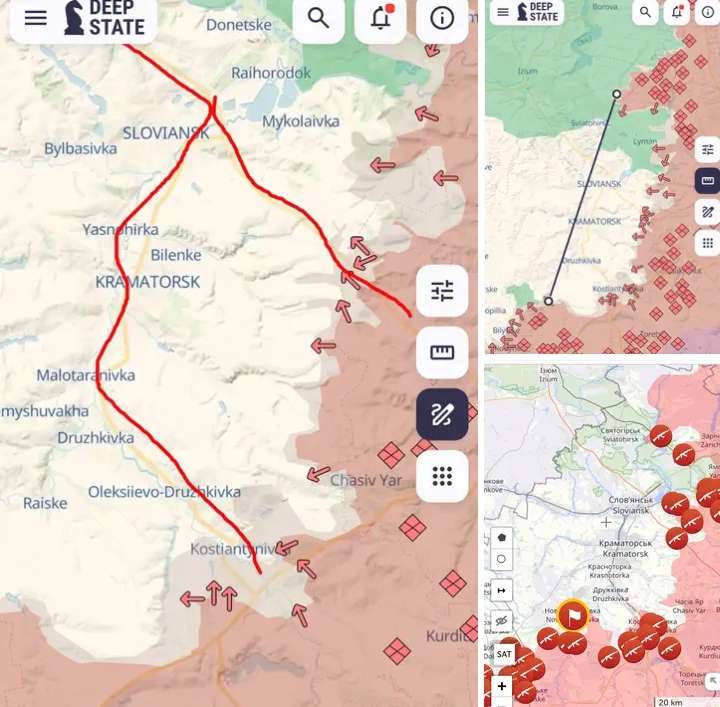
The battle for Ukraine’s Donetsk “Fortress Belt” is no longer a simple frontal contest. Russia appears to be trying to work around the defensive chain, isolate its cities and reach the logistics network behind them.
The belt stretches roughly 50 kilometers from Kostiantynivka through Druzhkivka and Kramatorsk to Sloviansk. These are not four isolated strongholds: they form one connected defensive system built around elevated terrain, fortified urban areas and the H-20 highway.
That highway is the belt’s internal spine. It allows Ukrainian forces to move ammunition, reinforcements and equipment between the cities while evacuating the wounded. Additional routes from the west and north feed into this network, meaning Russia cannot isolate the belt simply by approaching one road—it must cut or establish sustained fire control over several logistical corridors.
Kostiantynivka remains the most vulnerable southern anchor. Russian forces are attacking around the city and probing toward settlements west and northwest of it, apparently seeking a route toward Druzhkivka that would avoid the most heavily defended urban ground. Farther north, pressure around Lyman and Sviatohirsk threatens the approaches to Sloviansk. Taken together, these operations resemble an attempt to squeeze the belt from both ends.
However, creeping around the perimeter is not the same as breaking through it.
Ukraine’s drone wall—a layered zone of reconnaissance UAVs, FPV drones, artillery coordination and constantly monitored roads—continues to make Russian movement extremely costly. Small assault groups may infiltrate fields, tree lines and ruined settlements, but Russia has not converted those movements into a decisive penetration of the belt’s operational rear or severed its central logistics spine.
A direct assault through these cities would consume enormous numbers of Russian troops. A successful bypass would require Russia to push far enough west to cut Ukraine’s supply network and then hold that ground against Ukrainian drones and counterattacks. So far, it has achieved neither objective.
The calendar is also tightening. Autumn mud will complicate cross-country movement and supply, while the loss of foliage will strip away much of the concealment used by Russian infiltration groups. Frozen ground may later restore some mobility, so winter will not end the fighting—but Russia’s remaining window for a sustained campaign of maneuver before the weather deteriorates is narrowing.
The danger to Kostiantynivka is real, and the pressure should not be understated. But the wider Fortress Belt has not been penetrated, encircled or bypassed. Russia is searching for a way around Ukraine’s defenses because it still has not found a way through them.