

By Hopewell Chin’ono
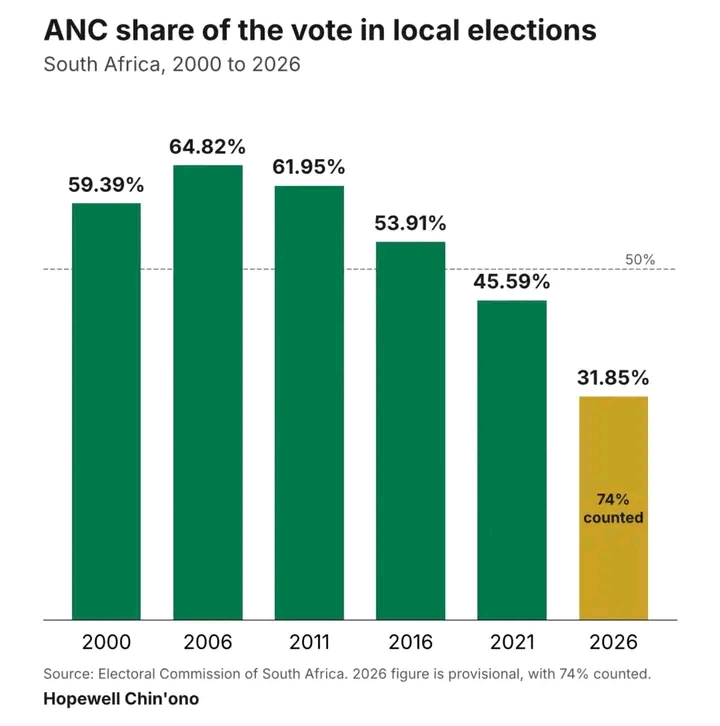
The African National Congress was South Africa’s colossus party, but it is dying slowly. With 74% of the vote counted this morning, the ANC stands at 31.85% in the local elections, less than half of its 64.82% peak in 2006. Its share was 59.39% in 2000, then 61.95% in 2011, 53.91% in 2016 and 45.59% in 2021. Official results are due on Sunday, but the direction is now clear
The ANC was still growing in its first decade. In 2000, the Democratic Alliance (DA) held large parts of the Karoo, but by 2006 most of that area had turned green, after the DA’s partner, the New National Party, walked out and later dissolved into the ANC.
By 2011, Jacob Zuma had helped turn much of KwaZulu-Natal from Inkatha Freedom Party territory into ANC territory. The man who delivered that province would later take it away in 2023.
The break came in 2016. The ANC lost about eight points, and the Economic Freedom Fighters (EFF), formed in 2013 by Julius Malema after his expulsion from the ANC, won about 8% in their first local elections. That does not prove every EFF voter came from the ANC, but the arithmetic is striking. Nkandla, the Guptas and the corruption charges facing Zuma hung over that vote, and the ANC lost Nelson Mandela Bay, Tshwane and Johannesburg.
In 2021, many supporters simply stayed at home. On the electoral commission’s tally, which adds the ward, proportional and district ballots together, the ANC fell from 16.1 million votes to 10.7 million.
Turnout dropped to a record low of 45.79%, and the party’s spokesperson, Pule Mabe, read low turnout in its strongholds as a sign of disappointment over slow progress in fixing local government.
Load shedding, water cuts and sewage leaks had reached people’s homes. The EFF rose only to 10.32%, so a breakaway could no longer explain the ANC’s losses.
Zuma’s uMkhonto weSizwe (MK) Party then broke the ANC’s hold on KwaZulu-Natal. It won 14.59% nationally in 2024, when the ANC fell to 40.2%. MK is now on about 9% nationally, with counting still under way, and leads eThekwini on 42.95%, against the ANC’s 16.56%.
MK’s rise cannot be told as an ANC split alone. It also rests on Zulu nationalism, which Zuma has long known how to use. On his road to power, his supporters wore “100% Zuluboy” T-shirts. The ANC’s vote in KwaZulu-Natal then almost doubled, from about 1.3 million in 2004 to 2.25 million in 2009, routing the Inkatha Freedom Party (IFP), which had long claimed to be closest to the Zulu king and people.
In 2024, he turned that appeal against the ANC. MK won 45.3% in KwaZulu-Natal and became the second-largest party in Mpumalanga, which has a significant Zulu population. Not everyone accepts this reading. Some analysts say calling MK tribal is too simple, and point to factional battles, the cult of personality and anger at the ANC. But identity helps to explain why the ANC’s collapse was so deep in this one province.
The EFF has fallen to about 6%, a sign that the offshoots are now competing for the same voters.
The South African Communist Party (SACP) is different. Founded in 1921, it is an old ally, not a splinter, and it is running under its own banner in a nationwide round of local elections for the first time.
Its general secretary, Solly Mapaila, accused the ANC of failing to reconfigure the alliance, and it objected to the ANC bringing the DA into government. Its 2.4% nationally looks small, but it is third in the Eastern Cape, on more than 6%, the ANC’s historic heartland.
The ANC and the EFF together made up about 62% in 2016 and 56% in 2021. This year, the ANC, the EFF, MK and the SACP together stand at about 50%. The breakaways have divided the old Congress vote, but that vote is also shrinking.
Turnout has risen above 50% this time, which analysts link partly to suburban anger over services, and the ANC has still fallen, so the problem is no longer just voters staying at home.
The most plausible explanation is that liberation loyalty wore out where government meets people, at the tap, the light switch and the municipal office. The ANC has conceded part of this, with President Cyril Ramaphosa admitting that municipal failures have damaged public trust.
Its campaign also did it no favours, with no mayoral candidates fielded and 181 candidates missing the registration deadline, only to be saved by the courts. It remains the largest party, so 2029 is not yet decided. But the decline is clear for all to see.
In 2006, the African National Congress (ANC) won 64.82% of the vote on its own. Today, with votes still being counted, the ANC, uMkhonto weSizwe (MK), the Economic Freedom Fighters (EFF) and the SACP have about 49.8% between them.
The family has split into four, and even put back together, it is smaller than it was before the bloodletting! The greatest gift the ANC gave South Africans is democracy.
Unlike its sister liberation movements in the region, ZANUPF, Frelimo and Chama Cha Mapinduzi, the ANC has accepted the voters’ rejection with respect and dignity.
Its power is falling, and the ballot is still doing its work.