

The Assassination That Failed to Break Iran: Khamenei Stayed at His Desk While the Bombs Fell
________
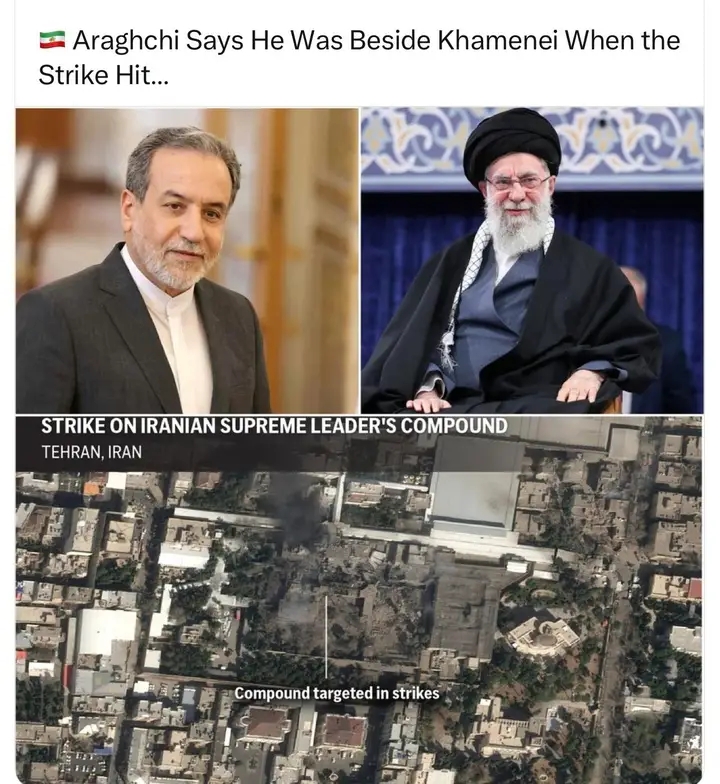
According to Iranian Foreign Minister Dr. Abbas Araghchi, he was inside the Supreme Leader’s compound when the U.S.-Israeli strike on February 28, 2026, killed Ayatollah Ali Khamenei.
In a June 2026 interview with the network Al Mayadeen, Araghchi provided his first public account of the events surrounding the assassination and the aftermath that followed.
Araghchi said he arrived at the Supreme Leader’s office at approximately 9:00 a.m. on a Saturday to deliver a critical briefing following diplomatic negotiations in Geneva. During the meeting, he informed Khamenei that the diplomatic atmosphere had deteriorated significantly and that the likelihood of war had become extremely high.
Shortly afterward, the compound came under attack.
The strike devastated large sections of the facility. Although the specific wing where Araghchi and Khamenei were located remained partially intact, the explosion left Araghchi trapped beneath the rubble.
Watch
https://x.com/RyanRozbiani/status/2062619095699177958/video/1?s=46
He recalled that when he finally managed to claw his way out of the debris, his first thought was not for his own survival. His immediate concern was the fate of the Supreme Leader.
What followed has become central to Iran’s narrative of Khamenei’s final hours.
According to Araghchi, despite being fully aware that a military strike was imminent, Khamenei refused to leave for the underground shelters. Rather than seek safety, he reportedly remained at his desk, continuing his work until the attack occurred.
To supporters, it was an act of defiance. To critics, it was a calculated decision. Regardless of perspective, the image of an aging leader refusing to abandon his post in the face of an incoming attack has become one of the defining symbols of the crisis.
The strike triggered a period of heightened military mobilization, regional confrontation, and political uncertainty across the Middle East.
Yet instead of collapsing, the Iranian state moved quickly to preserve continuity. Leadership was transferred to the new Supreme Leader, Mojtaba Khamenei, while Araghchi remained at the forefront of Iran’s diplomatic efforts abroad.
Araghchi stated that he spent the next forty days without returning home, dedicating himself entirely to managing the crisis and representing Iran during one of the most consequential periods in the country’s modern history.
Whether viewed as a story of resilience, sacrifice, political symbolism, or state survival, the account reinforces a reality that many of Iran’s adversaries have repeatedly encountered: removing a leader is one thing; breaking the state that stands behind him is another.