THE CURIOUS CASE OF KELSEA, GETRUDE AND US$6.745 MILLION:
(When a Drug Raid Starts Looking Like an Episode of CSI: First Family).
By Reason Wafawarova
There are police raids. And then there are police raids that begin with pethidine in a bedroom, pass through cannabis in a Lamborghini, discover an uncle allegedly sorting drugs into khaki envelopes, stumble upon a woman who apparently has two names, and eventually leave the entire country discussing approximately US$7 million worth of Borrowdale real estate.
At this point, even the drugs may be wondering how they became supporting actors in their own criminal case.
Welcome back to the curious case of Kelsea Tadiwa Tafirenyika. As always, the boring but extremely important paragraph must come first.
Kelsea has not been convicted of anything. The allegations against her remain allegations. Her uncle, Isaac Arab Jessub, is likewise entitled to the presumption of innocence. The courts will determine what the State can actually prove.
Now that the lawyers are comfortable, may the rest of us please examine this increasingly extraordinary story.
ENTER GETRUDE BADZA:
The latest revelation came in court. Police say they recovered Kelsea’s genuine Zimbabwean passport. Fine.
They also recovered her genuine national identity card. Still fine.
But reportedly tucked inside the passport was another Zimbabwean national identity card. Same photograph. Different woman. Getrude Badza.
Police say they checked with the Civil Registry. Kelsea exists. Getrude apparently does not.
We have therefore reached that rare administrative situation where one woman allegedly possesses two identities, while one of the identities possesses no woman.
According to evidence given in court, Kelsea allegedly told investigators that she used the Getrude Badza identity “for business.”
What business? Apparently that part of the PowerPoint presentation was postponed.
And suddenly the investigation becomes considerably more interesting. Because if police evidence about the identity document is correct, the obvious question is no longer merely: Who is Getrude Badza?
It is: What did Getrude Badza do?
Did Getrude have bank accounts? Did Getrude own companies? Did Getrude sign agreements? Did Getrude buy anything? Did Getrude sell anything? Did Getrude acquire property? Did Getrude pay taxes? Did Getrude borrow money? Did Getrude perhaps have a very productive eighteen months?
These are questions. Not accusations. There is an important difference.
THEN CAME THE PROPERTY LIST:
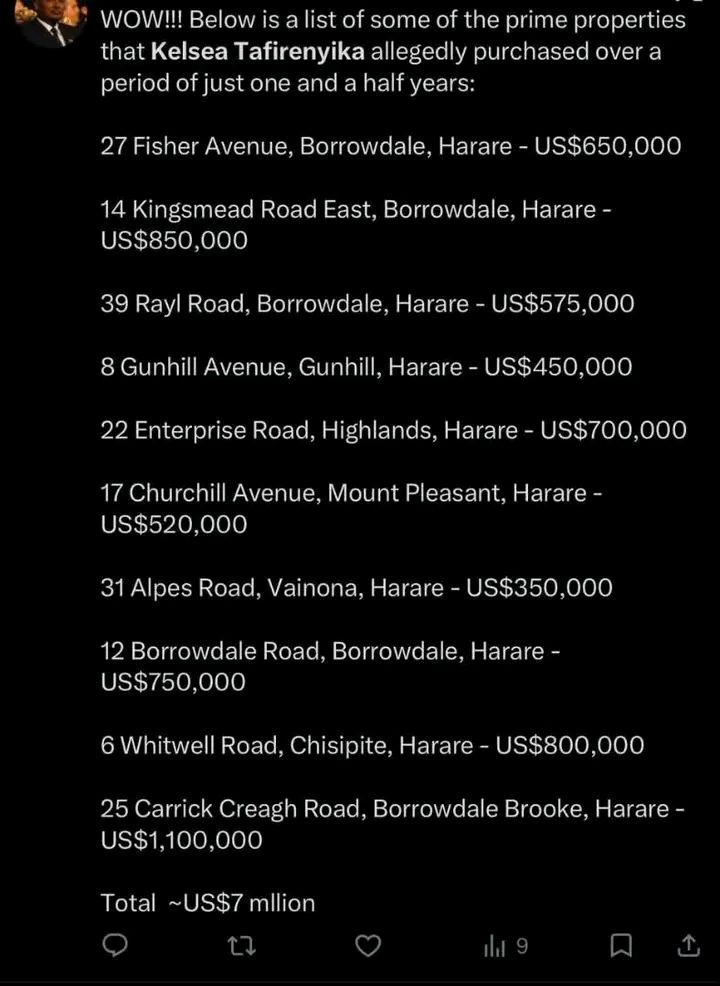
Social media has now produced a list purporting to identify ten prime Harare properties allegedly purchased by Kelsea over approximately eighteen months.
Borrowdale. Borrowdale again. Borrowdale some more. Gunhill. Highlands. Mount Pleasant. Vainona. Chisipite. Borrowdale Brooke.
Apparently whoever compiled this list became geographically exhausted before reaching anything south of Samora Machel Avenue.
The prices appearing on the circulating list total US$6.745 million. Social media, being social media, has sensibly rounded this to US$7 million because after the sixth million nobody wants cents interfering with a good story.
But there is presently a rather significant problem. Where is the evidence?
A viral graphic is not a title deed. A Facebook post is not a Deeds Registry search. A list of addresses is not proof that Kelsea purchased the properties. And a purchase price written beside a house does not establish who supplied the money.
So before anybody evicts tenants, repossesses swimming pools or sends Getrude Badza a rates bill, somebody needs to establish whether this property empire actually exists as alleged.
But if it does? Ah.
Then tea must be served. Because a 22-year-old woman accumulating approximately US$6.7 million in prime residential property over eighteen months would be an economic phenomenon deserving study at the University of Zimbabwe Business School.
Particularly when the public has yet to be shown the commercial enterprise producing this extraordinary return.
Perhaps there is a perfectly legitimate explanation. Excellent.
Let us hear it. Inheritance? Gifts? Business income? Family money? Investments? Financing? Her husband? Getrude Badza Enterprises Unlimited?
We simply do not know. And not knowing is precisely why investigation exists.
FOLLOW THE MONEY—BUT FIRST FIND OUT WHOSE MONEY:
The most dramatic version circulating online alleges that Kelsea manipulated Collins Mnangagwa through drugs, obtained control over his finances and used his money to acquire properties.
That is an enormous allegation. It has not been established. We should not repeat it as fact merely because sufficiently many WhatsApp groups have appointed themselves commissions of inquiry.
And there is another problem. Collins Mnangagwa is 39 years old. Kelsea is 22. As I have previously observed, adulthood remains an inconvenient legal concept.
If Collins voluntarily gave his wife money, bought her houses, bought her cars or financed a lifestyle, then expensive marital decisions do not retrospectively become theft merely because the marriage later develops difficulties.
Rich men have been known to spend money on younger women. This phenomenon predates both ZANU-PF and the invention of pethidine.
If, however, investigators uncover fraud, forgery, unlawful transfers, proceeds of crime or transactions conducted through false identities, that becomes an entirely different matter.
But evidence must take us there. Not angry relatives. Not anonymous sources. Not Facebook. And certainly not Getrude.
IS THIS REALLY ABOUT DRUGS?
Here is where the story becomes politically fascinating. Several publications and social-media accounts have alleged that Kelsea’s arrest followed intervention from within the First Family.
The suggestion is that relatives were concerned about Collins, his health, his finances and Kelsea’s alleged influence upon him.
Again, that remains unproven. The investigating officer reportedly denied in court that the accused were being targeted by detractors.
So, there are presently two competing stories.
Story Number One:
Professional detectives received intelligence about dangerous drugs, investigated independently, raided a residence, recovered alleged contraband and arrested suspects.
Entirely normal police work.
Story Number Two:
A powerful family developed an internal problem, somebody telephoned somebody, and suddenly Zimbabwe’s famously resource-constrained institutions discovered resources, detectives, forensic curiosity and an admirable enthusiasm for searching drawers.
We do not presently know which story is true.
There is also a third possibility. Both may contain elements of truth.
A police investigation can uncover genuine criminal conduct even if somebody influential originally caused investigators to take an interest. That distinction matters.
The central question is therefore not simply whether drugs were allegedly found. The court will deal with that.
The governance question is:
Would precisely the same investigative energy have materialised if Collins Mnangagwa’s surname had been Moyo from Mbare?
THE AMAZING RECOVERY OF THE ZIMBABWE REPUBLIC POLICE:
Whatever started this investigation, something wonderful appears to have happened.
Our police have rediscovered curiosity. They found alleged drugs. They asked where they came from. They found an identity document. They checked the Registry. The Registry said the person apparently did not exist. They asked what the ID was used for. They are pursuing an alleged supplier.
This is excellent policing. Please continue. Zimbabwe has thousands of mothers who would like to borrow these detectives.
Because if the police can follow pethidine into Greystone Park, they can follow crystal meth into every suburb.
If they can investigate Getrude Badza, they can investigate the people importing pharmaceutical drugs.
If they can search a Lamborghini, they can search a politically connected dealer’s Land Cruiser. If they can ask how Kelsea obtained controlled medicines, they can ask how every other dealer obtains them.
And if they can investigate millions in unexplained property where evidence justifies it, perhaps Zimbabwe has accidentally rediscovered financial investigation.
This could become very exciting.
PLEASE DON’T ARREST GETRUDE:
There remains one final administrative problem. If the State eventually decides to charge Getrude Badza, somebody first needs to find her.
Civil Registry apparently cannot. Kelsea may be able to assist. Perhaps Getrude is innocent. Perhaps she is merely an identity card experiencing life independently of a citizen.
Zimbabwe is, after all, a country where dead people have occasionally developed impressive political careers around election time. A ghost conducting business should therefore not shock us excessively.
But beneath the comedy lies something serious. A false identity, if proved, is not funny. Controlled narcotics entering illicit circulation are not funny. Potentially unexplained multimillion-dollar transactions are not funny.
And the possibility that State institutions become extraordinarily efficient only when powerful families need them is certainly not funny.
That is why this increasingly bizarre story deserves scrutiny without premature conclusions.
Let the police investigate the drugs. Let them find the supplier. Let them investigate the alleged ghost identity. Let them establish what business, if any, was conducted under it.
And if credible evidence emerges concerning property transactions, follow those too. But please apply exactly the same enthusiasm tomorrow when the complainant has no presidential connection whatsoever.
Because perhaps this really is the beginning of professional policing without fear or favour. Perhaps Zimbabwe has finally discovered that nobody is above the law. Perhaps.
For now, however, we have pethidine, morphine, cannabis, a Lamborghini, an uncle, an alleged US$6.745 million property portfolio, two identity cards, one photograph, and a woman called Getrude whom the Civil Registry reportedly cannot find.
And somehow this all began as a drug raid.
At this rate, by Tuesday’s bail ruling we may discover Getrude owns Belarus.