

THE DAY MICROSOFT FAILED, THE WORLD DISCOVERED HOW DANGEROUS ITS DIGITAL DEPENDENCE HAS BECOME
WHEN ONE COMPANY’S SERVERS FAIL, GOVERNMENTS STRUGGLE, HOSPITALS IMPROVISE, FINANCIAL MARKETS STUMBLE AND MILLIONS LOSE ACCESS TO ESSENTIAL COMMUNICATIONS.
By Paul Hattingh
14 November 2026
On Thursday, 12 November 2026, a failure inside Microsoft’s digital infrastructure began disrupting services across the world.
By Friday, the consequences had reached government departments, hospitals, police services, courts, financial institutions, airlines, universities and businesses on several continents.
Emails stopped arriving. Calendars became inaccessible. Business communications failed. Some organisations struggled to access information that ordinarily takes seconds to retrieve.
In Britain, a court hearing was interrupted. Pharmacies warned about prescription delays. European financial institutions returned to telephone calls and fax machines. Government agencies in Australia, Japan and the United States reported disruptions.
South Africa was not untouched. The South African Revenue Service issued its own warning about the global Microsoft outage.
Perhaps the most disturbing fact is what apparently caused it.
There was no confirmed hostile cyberattack. No evidence that hackers had seized Microsoft’s systems. No verified act of international sabotage.
Microsoft says the disruption resulted from a technical problem associated with an earlier network-capacity upgrade that surfaced following a subsequent network change.
The company was struggling with its own infrastructure.
And that raises a question far more serious than why Outlook stopped working: Have governments, institutions and businesses surrendered too much of their operational independence to a handful of technology corporations?
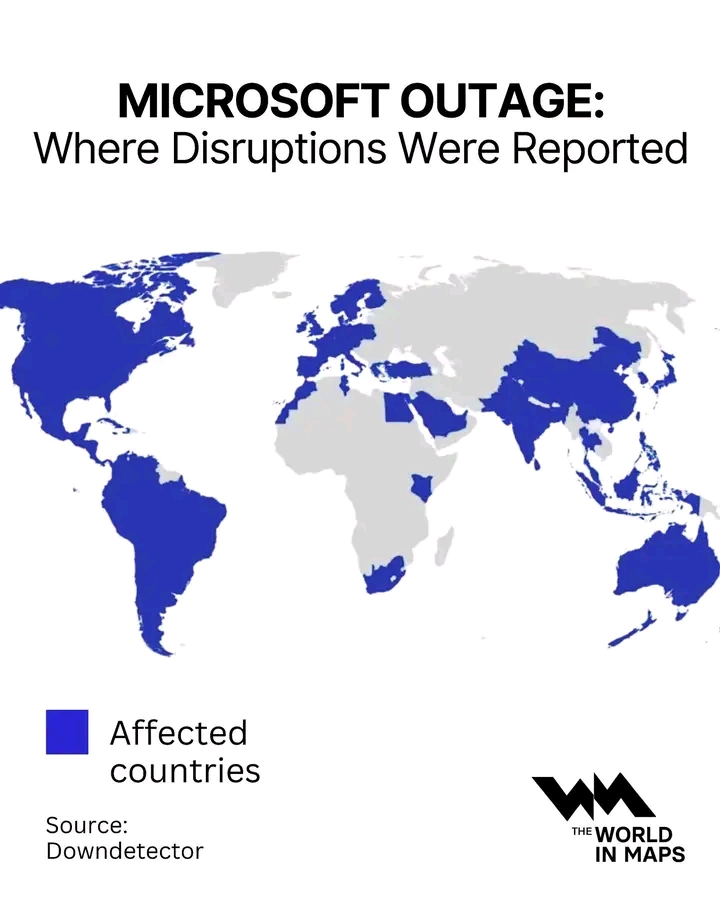
🔴 74 COUNTRIES AND MORE THAN 7.4 MILLION OUTAGE REPORTS
The geographical reach was extraordinary.
According to Downdetector, reports of problems emerged from 74 countries and territories within approximately one hour.
In the United States alone, Outlook complaints reached roughly 130,000 around the initial peak.
By Friday, Downdetector had recorded more than 7.4 million outage reports worldwide, with reporting activity reaching almost 20,000 submissions per minute at its peak.
Those figures require an important qualification.
An outage report is not necessarily a unique affected person. A user may report multiple problems, and many affected users never submit reports at all.
The figures demonstrate the extraordinary scale of public reporting. They do not establish precisely how many people lost access, how long each person was affected or how severe the disruption was in every country.
Microsoft has more than 450 million paid commercial Microsoft 365 subscriptions, according to figures it disclosed earlier in 2026.
That does not mean 450 million subscriptions were disrupted.
Nevertheless, it demonstrates the potential exposure when infrastructure supporting such a widely used platform malfunctions.
The world has become remarkably efficient at concentrating its communications systems.
It has become considerably less convincing at demonstrating what happens when those systems fail together.
🔴 THE FAILURE BEGAN INSIDE MICROSOFT’S OWN SYSTEMS
Microsoft’s technical incident records identify two important events.
Exchange Online incident EX1550543 was recorded as beginning at 16:17 UTC on 12 November.
The broader Microsoft 365 incident, MO1550821, was recorded at 18:26 UTC.
Exchange Online is Microsoft’s cloud-based email and calendar infrastructure. Its importance extends beyond the Outlook application because other Microsoft products depend on it for information and related services.
Initially, Microsoft reported unusually high loads across parts of its infrastructure.
That explanation could have suggested that excessive user demand was overwhelming available capacity.
The investigation revealed something different.
Servers were unexpectedly becoming unavailable, placing additional pressure on those still operating.
Some servers failed automated health checks. Others became unresponsive when traffic returned after attempts to restore them.
Microsoft’s engineers tried several recovery measures, including redirecting traffic, restarting servers, isolating affected infrastructure, changing configurations and adding capacity.
Several early interventions failed to deliver sustained recovery.
The company eventually reported improved stability after applying a configuration patch associated with an upstream authentication and routing component.
Microsoft subsequently stated that the underlying technical issue originated during an earlier network-capacity upgrade and surfaced after a recent network change.
It also said the incident was unrelated to cyberattacks or artificial intelligence agents.
That explanation is significant, but it is not yet a complete forensic account.
As of this article’s latest verified information, Microsoft had promised a detailed post-incident report explaining the root cause and additional safeguards.
Until that report is available, the precise chain of technical decisions, failed protections and recovery limitations cannot be considered fully established.
And that is precisely where serious scrutiny should begin.
How did the problem reach infrastructure serving customers across multiple regions?
Why were affected servers repeatedly unable to sustain returning traffic?
Why did some recovery measures initially fail?
What safeguards were supposed to prevent a technical change from causing such widespread consequences?
Those are questions Microsoft must answer with evidence.
🔴 THIS WAS NOT SIMPLY AN OUTLOOK PROBLEM
The disruption extended into numerous Microsoft 365 services and functions.
Microsoft’s incident advisory identified potential problems involving Exchange Online, Teams, SharePoint Online, Microsoft 365 Copilot, Defender XDR, Intune, Purview, Planner, Power Apps, Microsoft Graph and other connected services.
The distinction between entire applications and specific affected functions matters.
Microsoft did not report that every feature of every product had stopped working.
For example, much of Teams’ core calling and messaging functionality remained operational, while features dependent on Exchange Online, including calendar-related functions, experienced problems.
Files stored directly in SharePoint Online also remained accessible in circumstances where related features were affected.
This was not the entire internet collapsing, nor evidence that all Microsoft cloud infrastructure had failed.
It was a major disruption involving shared services and interconnected dependencies.
That distinction makes the incident particularly instructive.
A business can have functioning computers, an operational internet connection and healthy local systems while remaining unable to perform essential work because a distant service on which those systems depend has failed.
Microsoft’s infrastructure may be geographically distributed, but geographical distribution alone does not eliminate common technical dependencies.
When those dependencies are disrupted, the consequences can extend well beyond the component where the original problem occurred.
🔴 WHEN HOSPITALS AND POLICE DEPEND ON THE SAME TECHNOLOGY
The most consequential reports came from public services.
In Britain, hospitals, general practitioners and pharmacies reported difficulties involving Microsoft-dependent communications and information systems.
Some NHS organisations advised patients to telephone rather than email.
Pharmacy representatives warned that prescription services could experience delays.
Healthcare staff in some settings used alternative systems and paper records to maintain operations.
This does not establish that all hospitals stopped treating patients or that emergency healthcare across Britain ceased functioning.
Many clinical services continued operating.
But the disruption demonstrated that communication failures can affect the coordination of healthcare even when medical staff and physical facilities remain available.
Police organisations also reported problems.
London’s Metropolitan Police experienced difficulties with some online crime-reporting functions, while emergency telephone response capability remained available.
In Manchester, a Crown Court trial was interrupted, with jurors sent home amid technology-related delays.
Consider what that means.
A court can have a judge, a jury, legal representatives and a functioning courtroom, yet still be unable to continue proceedings efficiently because essential digital communication is unavailable.
That is no longer merely a problem for an information technology department.
It becomes a question of institutional resilience.
🔴 FINANCIAL MARKETS RETURNED TO TELEPHONES AND FAX MACHINES
The financial consequences were equally revealing.
European stock exchange operator Euronext advised listed companies to use telephone communications for urgent matters after its listing and corporate-actions teams experienced email disruption.
Euronext operates exchanges in major European financial centres, including Amsterdam, Paris, Brussels, Lisbon, Oslo and Milan.
In Taiwan, Reuters reported that a financial company resorted to fax machines to confirm trades.
Another financial transaction involving a bond repurchase was cancelled during the disruption.
British insurer Aviva activated contingency arrangements.
Shipping company Maersk warned customers that communications could be delayed.
In the United States, Workhorse Group postponed an earnings-related event.
These incidents did not mean the global financial system had stopped trading.
Indeed, many organisations reported that their core operational systems remained functional.
The problem was that essential supporting processes were impaired.
And those supporting processes matter.
Financial institutions depend on timely instructions, confirmations, documentation, compliance checks and reliable communication between counterparties.
A market may remain technically open while participants struggle to conduct certain transactions.
A business may remain legally operational while its ability to communicate with customers is severely restricted.
A delay of several hours can sometimes be absorbed.
A delay affecting a contractual deadline, financial settlement, medical decision or urgent legal process can have consequences that cannot simply be reversed by restoring an email server.
🔴 SOUTH AFRICA WAS PART OF THE WARNING
On 13 November, the South African Revenue Service published an official notice concerning Microsoft’s global outage.
SARS warned that the incident could affect access to Outlook, Teams and other Microsoft 365 applications.
It stated that its technical teams were engaging with Microsoft to address the disruption.
That warning is important evidence that South African public institutions were responding to the incident.
It does not, by itself, establish that SARS eFiling was unavailable or that tax records were compromised.
Those would be separate claims requiring separate evidence.
Nevertheless, the warning raises a legitimate South African question.
How many public institutions, municipalities, banks, hospitals, universities and private businesses have independently tested their ability to continue operating during a major failure of their principal technology supplier?
Not how many have purchased backup software.
Not how many have a document called a disaster recovery plan.
How many have tested whether that plan actually works when the provider supporting their email, calendars, authentication and shared applications becomes unavailable?
A backup arrangement that depends on the same failed infrastructure may offer little protection during the incident it is supposed to address.
🔴 EVEN ARTIFICIAL INTELLIGENCE PLATFORMS WERE AFFECTED
The outage produced another important warning about interconnected technology.
OpenAI and Anthropic reported problems involving their Microsoft 365 connectors.
These connectors allow supported AI services to interact with certain information and applications held in Microsoft environments.
The reports did not establish that all ChatGPT or Claude functionality was unavailable.
They concerned particular integrations dependent on Microsoft services.
But the wider significance is substantial.
Businesses are increasingly building processes in which artificial intelligence accesses documents, calendars, email and other organisational information through connected software.
An AI model can remain operational while being unable to retrieve the information required to complete a task.
A company might therefore have a working AI assistant but an interrupted workflow because an external connector or underlying service has failed.
That distinction matters for organisations considering AI-driven automation.
The reliability of an automated process depends on the reliability of every essential component in that process.
If one critical dependency fails, the wider process can fail with it.
Artificial intelligence does not eliminate infrastructure dependency.
In some circumstances, deeper integration may increase the number of processes exposed to it.
🔴 THE SECURITY IMPLICATIONS DESERVE THEIR OWN INVESTIGATION
Microsoft’s incident advisory identified possible disruption to certain security and governance functions.
These included aspects of Microsoft Defender, Purview, data-loss prevention, audit searches, information-protection policies and administrative functions.
This is important because security involves much more than preventing hackers from entering a system.
Organisations also need to monitor activity, assess access, investigate incidents and enforce information-handling rules.
If the tools supporting those responsibilities are temporarily unavailable, administrators may lose access to functions they ordinarily rely upon.
That does not prove security controls were universally disabled.
Nor does the outage establish that confidential information was stolen, that data was corrupted or that attackers gained unauthorised access.
There is no justification for inventing a data breach.
But the operational question remains legitimate.
Can an organisation maintain essential oversight and protective procedures when a supplier’s administrative or security interfaces are unavailable?
A responsible risk assessment must examine the answer before an emergency occurs.
It must also recognise that hurried workarounds can create additional vulnerabilities.
Employees bypassing approved channels, sending confidential material through personal accounts or responding to fraudulent technical-support messages may create risks unrelated to the original outage.
A technology failure should not become the reason an organisation abandons its security rules.
🔴 THE COST MAY BE ENORMOUS, BUT THE VERIFIED TOTAL IS UNKNOWN
The direct and indirect financial consequences have not been comprehensively established.
Businesses lost productive hours. Some transactions were delayed. Public institutions had to activate contingency arrangements. Employees spent time managing interruptions instead of performing ordinary duties.
The consequences varied considerably between organisations.
A financial analyst cited by Reuters estimated possible global insured losses of between $300 million and $500 million.
That is an estimate of potential insured losses, not an audited calculation of the total economic damage.
It is not evidence that insurers have already paid those amounts.
The wider cost to businesses, governments and individuals remains uncertain.
Microsoft’s share price also closed broadly unchanged on Friday, demonstrating that a serious operational disruption does not necessarily produce an immediate collapse in a technology company’s market valuation.
The problem with measuring this incident solely through financial markets is that its consequences were distributed among countless customers.
An institution experiencing missed communications or delayed operations may bear costs that do not immediately appear in Microsoft’s own financial statements.
That creates an accountability problem.
The supplier controls a critical service.
The customer absorbs many of the operational consequences when the service becomes unavailable.
🔴 ONE COMPANY’S FAILURE EXPOSED A MUCH LARGER STRUCTURAL RISK
Microsoft did not create the world’s dependence on digital technology by itself.
Nor is Microsoft uniquely vulnerable to technical failures.
Amazon, Google and other major cloud providers also face operational risks.
Cloud computing has delivered genuine benefits.
It has allowed organisations to reduce the burden of maintaining complex local infrastructure, expand services, improve collaboration and access technology that would otherwise be expensive to operate.
Those advantages should not be dismissed.
But efficiency and resilience are different questions.
An organisation may save money by concentrating its services with one supplier.
That concentration may also create dependencies that become expensive during a disruption.
The debate is therefore not whether cloud technology is good or bad.
It is whether the concentration of essential functions has exceeded the ability of institutions to maintain independent operations when something goes wrong.
The concern extends beyond one incident.
Britain’s Competition and Markets Authority concluded in July 2025 that Microsoft and Amazon possessed significant market power in public cloud infrastructure services.
Its investigation identified barriers affecting customer choice, switching and the use of multiple providers.
That investigation concerned the cloud infrastructure market, not specifically the November 2026 Microsoft 365 incident.
It nevertheless provides relevant context for the wider debate about technology dependence.
Moving an entire organisation to a different provider can involve software compatibility, licensing, security, training and substantial operational costs.
That helps explain why organisations may remain dependent on a supplier even after experiencing serious service interruptions.
The danger is not necessarily that a large technology provider is deliberately exploiting an outage.
The danger is that economic and technical realities can leave customers with fewer practical alternatives than they believe they possess.
🔴 THE 2024 CROWDSTRIKE FAILURE SHOULD HAVE BEEN A WARNING
In July 2024, a defective CrowdStrike software update caused widespread failures involving Windows computers.
Airlines, hospitals, banks and other organisations experienced major disruption.
That incident was technically different from Microsoft’s November 2026 outage.
The 2024 failure involved faulty endpoint security software affecting Windows systems. The latest incident involved Microsoft’s own cloud-service infrastructure and associated dependencies.
Conflating the two would obscure their different causes.
But they demonstrate a common risk.
Highly interconnected digital systems can transmit the consequences of a failure across institutions and international boundaries.
Two years after the CrowdStrike disaster, the underlying dependence on major technology ecosystems remains a critical question.
The issue is not whether another failure will occur.
Complex technology systems will experience failures.
The issue is how far those failures should be allowed to spread, how quickly services can recover and whether essential institutions can continue operating independently.
🔴 MICROSOFT’S RECOVERY DOES NOT ERASE WHAT HAPPENED
By Friday, Microsoft reported substantial recovery progress.
Availability improved in North America, Europe and the Asia-Pacific region.
The company also extended its email timeout window to 48 hours to help preserve delayed messages while accumulated queues were processed.
Its later incident updates described sustained recovery, with most previously affected functions believed to have been addressed.
But recovery of access and completion of email delivery are not necessarily the same thing.
An inbox may open while delayed messages are still being processed.
An application may appear operational while a related function remains unreliable.
Microsoft continued monitoring the accumulated email backlog and residual effects before formally closing the major incident.
The company also promised a complete technical report.
That report should not be treated as a public-relations formality.
Customers deserve to know what failed, why the failure spread, which protective mechanisms worked, which did not and what measurable improvements Microsoft intends to implement.
They also deserve accurate information about service availability and any contractual service-credit rights.
An apology cannot restore a missed deadline.
A retrospective explanation cannot automatically reverse an interrupted court hearing.
And a service credit cannot necessarily compensate an organisation for every consequence of lost productivity.
🔴 THE QUESTIONS EVERY GOVERNMENT AND BUSINESS SHOULD NOW ANSWER
This incident should trigger a practical review of operational dependence.
Can essential staff communicate through an independent, approved channel when Microsoft email becomes unavailable?
Can an organisation retrieve emergency contact information without relying on Microsoft authentication or cloud storage?
Are critical documents available through independently tested backup arrangements?
Can hospitals, courts, financial institutions and government departments continue their most important functions through properly designed manual or alternative procedures?
Are business continuity exercises conducted under realistic conditions, including the simultaneous failure of several connected services?
Can delayed or failed communications be identified and reconciled after services recover?
Do organisations understand which functions are genuinely independent and which secretly rely on the same provider?
And when a technology supplier suffers a serious outage, who is responsible for establishing the full consequences?
These are not questions that should be answered only after the next emergency.
Independent communication arrangements, backups, continuity procedures and regular testing all involve expense.
But so does discovering during a crisis that none of them exists.
The correct response is not automatically to abandon Microsoft or transfer every system to another large technology company.
That could merely replace one concentrated dependency with another.
The responsible response is to identify essential services, reduce unacceptable common points of failure and establish continuity arrangements that genuinely remain available when the primary supplier does not.
🔴 THE MOST IMPORTANT LESSON IS ABOUT CONTROL
The November 2026 Microsoft outage did not demonstrate that the entire internet was vulnerable to one failed software change.
It demonstrated something narrower, but deeply significant.
A major disruption inside one corporation’s infrastructure affected essential activities undertaken by governments, medical institutions, financial organisations, businesses and individuals across numerous countries.
Some systems continued operating.
Some organisations had effective contingency arrangements.
Others struggled.
That variation is itself revealing.
The danger lies in assuming that purchasing access to a globally distributed technology platform automatically guarantees operational resilience.
It does not.
Cloud services can improve reliability, but they cannot eliminate technical failure.
Large corporations can invest heavily in redundancy, but they cannot guarantee that every internal change will be harmless.
And governments can outsource technology operations without outsourcing their ultimate responsibility to the public.
The real question is whether organisations have retained sufficient independence to function when their preferred technology supplier cannot deliver.
A government cannot delegate its responsibility to govern. A hospital cannot delegate its duty to patients. A business cannot delegate accountability for its customers merely because its systems operate in someone else’s cloud.
Microsoft will repair its infrastructure.
The accumulated emails will be processed.
Most employees will return to their familiar applications.
The immediate disruption will eventually become another entry in the history of global technology failures.
But if governments and institutions respond simply by returning to their previous arrangements without examining their dependence, they will have missed the most important lesson.
The greatest danger is not that Microsoft experienced a major failure.
It is that so much of the modern world discovered how difficult it had become to function without Microsoft.🔴
⭕ EDITORIAL NOTE AND DISCLAIMER
This article is an independent analysis of the Microsoft service disruption beginning on 12 November 2026, based on publicly available technical incident records, institutional statements and contemporaneous reporting available by 14 November 2026.
Confirmed events, reported effects, preliminary financial estimates and the author’s analysis have been distinguished where materially necessary. Outage-report totals are not verified counts of unique affected users. Reported disruption to a service does not establish that every function or customer was affected.
Microsoft attributed the incident to a technical problem associated with its network infrastructure and stated that it was not caused by a cyberattack or AI agents. A comprehensive post-incident technical report had not been available at the latest verified research cutoff.
Statements concerning infrastructure concentration, organisational dependence, responsibility and recommended safeguards are analytical judgments, not allegations of criminal wrongdoing or deliberate misconduct.
Recovery status, total financial consequences and other unresolved matters may change as additional verified information becomes available.⭕