

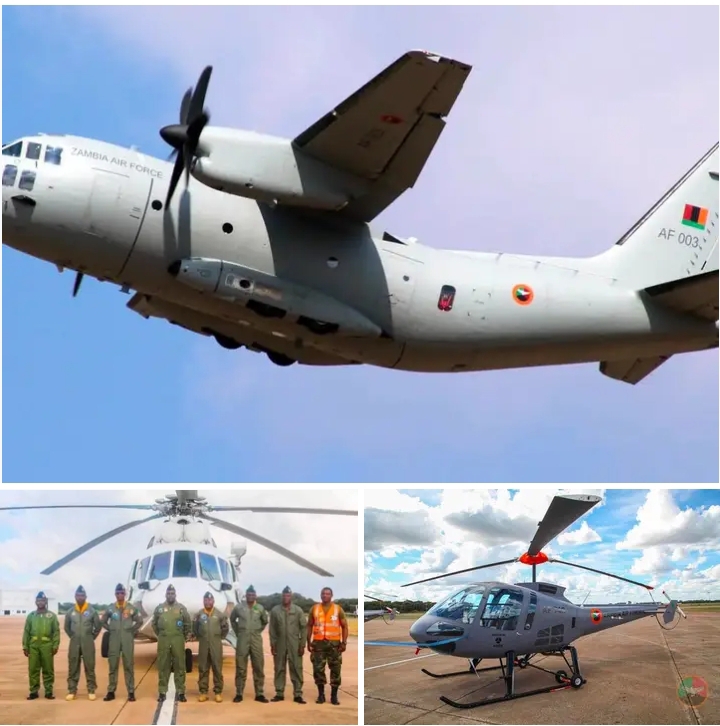
THE DEFENCE FILE: WHO CONTROLS THE SKY CONTROLS A VITAL PART OF NATIONAL SOVEREIGNTY
When most people hear the words Zambia Air Force, they immediately think about fighter aircraft, pilots and military ceremonies, but air power is much bigger than aircraft. Air power begins with Zambia’s knowledge of what is happening in its skies and having the capacity to respond when necessary.
A country’s sovereignty does not end at its borders on the ground. It extends into its airspace. That is why Zambia’s National Defence Policy recognises the defence of our interests on land, water, in cyberspace and in the air as part of the comprehensive defence of the Republic.
The Zambia Air Force therefore exists principally to defend and protect Zambian airspace and the sovereignty and territorial integrity of our nation. It means surveillance. A modern state needs situational awareness of what is moving through its airspace. Aircraft, drones and other airborne activity cannot simply be treated as invisible because they are thousands of metres above us.
You cannot defend what you cannot see. That requires appropriate radar, communications, surveillance systems, trained personnel and coordination between military and civilian aviation institutions.
Then comes air defence. Air defence does not mean Zambia is preparing to fight somebody. In fact, credible defence capability is fundamentally about deterrence. A peaceful country must nevertheless possess the ability to detect, identify, assess and appropriately respond to threats to its sovereign airspace. Peace without preparedness can become vulnerability.
Then there is reconnaissance. Aircraft and modern remotely piloted systems can provide information over enormous areas far faster than patrols travelling by road. That capability can support border awareness, disaster assessment and the protection of strategic national assets.
Then comes something that receives much less public attention. Air transport. Zambia is a vast country. In an emergency, aviation can move personnel, medical supplies, equipment and other critical resources across the country in hours rather than days. Military aviation therefore gives the Republic something extremely valuable, ie, speed. In a national emergency, speed can save lives.
Imagine serious flooding cutting communities off from roads. Imagine an aircraft going missing. Imagine a natural disaster occurring in an inaccessible part of Zambia. Imagine medical supplies urgently needing to reach an isolated population. That is when military aviation stops being an abstract defence concept and becomes a national lifesaving capability.
Zambia’s own Defence Policy implementation framework specifically assigns the Air Force responsibility for cooperating with civil authorities during emergencies, relief operations and disaster management, including search and rescue capabilities. This is why we must stop thinking about defence expenditure only in terms of war. A transport aircraft can support military operations today and humanitarian relief tomorrow.
A surveillance capability can protect national airspace and also strengthen situational awareness during emergencies. A highly trained military pilot is both a defence professional and part of a sophisticated national aviation skills base. Engineers, technicians, air traffic specialists, communications personnel and aviation maintenance professionals represent valuable national human capital.
The strategic environment itself is changing. Drones have changed the meaning of air power. Small unmanned aircraft can now perform tasks that once required much larger and more expensive platforms. They can be used in agriculture, mapping, infrastructure inspection and disaster assessment.
Drones can also create security risks. Zambia’s Civil Aviation Authority already regulates remotely piloted aircraft systems because drones share national airspace with other users. This means that the defence of Zambia’s skies in the 21st century cannot simply be about owning aircraft. It must increasingly be about information, surveillance, communications, technology, integration and rapid decision making.
There is also an important distinction. The Civil Aviation Authority regulates civil aviation safety and security, including areas such as air traffic management, communications, navigation and surveillance. The Zambia Air Force, on the other hand, has the military responsibility of defending Zambia’s sovereign airspace.
Different institutions. Different mandates, but ultimately, one Zambian sky. This brings us to the bigger strategic point. Zambia’s economic future will increasingly depend upon aviation. Tourism depends upon aviation. Trade depends upon aviation. Investment depends upon aviation. Emergency response depends upon aviation. Regional connectivity depends upon aviation, and national defence depends upon aviation.
Therefore, developing Zambia’s aviation capacity should not be viewed merely as purchasing military aircraft. It should involve developing pilots, engineers, technicians, maintenance capacity, surveillance capability, communications systems, aviation infrastructure, research, training and eventually greater domestic technological capability.
Our country must continuously build its capabilities to know what is happening on its land, along borders, in waters and increasingly, it must know what is happening in cyberspace.
Zambia is a peaceful nation, but peace must never be confused with strategic blindness.
Saviour Chishimba
President
United Progressive People (UPP)
UPND Alliance Partner