

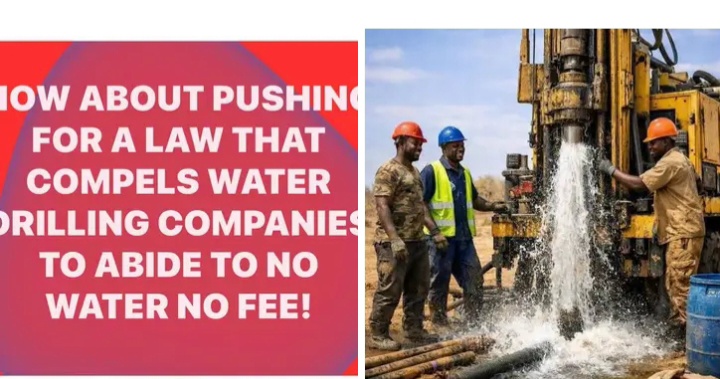
The Dry Hole Injustice: Why Zambia Needs “No Water, No Fee” Borehole Drilling Laws
By Dr Larry Mweetwa
In communities across Lusaka from the bustling residential avenues of Chelstone to the expanding outskirts water is life. Yet, for many ordinary homeowners striving to secure a reliable water source, the quest for groundwater has turned into a financial gamble where the house always wins, and the citizen always loses.
The frustration echoed by residents is entirely justified. When a private citizen hires a commercial driller, they are paying for professional expertise and technical surety, not just a heavy machine to punch a blind hole into the earth. As an old Bemba proverb reminds us, “Amenshi tabalya”—water is life, and it cannot be bargained away through exploitation. Yet, current commercial practices leave vulnerable families footing the bill for professional failure.
The Accountability Gap
The current landscape highlights a stark accountability gap between commercial private contracting and public institutional procurement. When government projects or institutional contractors drill for water, contracts typically operate on performance-based milestones or clear risk-sharing clauses. If a contractor fails to deliver a functional water source due to poor siting or execution, public funds are protected from wasteful expenditure.
Why, then, should everyday citizens—who are far more vulnerable to financial shocks—be held to a lower standard of protection? As the wise say, “What is good for the goose is good for the gander.” If public institutions demand results, citizens deserve that exact same layer of commercial protection.
Why the “No Water, No Fee” Argument Holds Weight
1. Information Asymmetry
The average homeowner has zero geological training. They rely entirely on the driller’s site assessment, hydrogeological surveys, and equipment capabilities. When a driller takes on a site, drills down hundreds of meters, hits dry rock, and still demands full payment for a “dry hole,” they are shifting 100% of the commercial risk onto an unsuspecting consumer. It is a partnership where the expert takes all the reward and the amateur takes all the risk.
2. The Burden of Misguided Siting
Water is hidden beneath our feet, but finding it is a science, not a lottery. When a driller miscalculates or rushes a survey just to collect mobilization fees, the financial penalty ruins families who have emptied their savings to build a home.
Where Regulation Stands and Where the Gaps Lie
Commercial drilling in Zambia is not entirely lawless on paper, but enforcement and consumer protection need teeth.
The Regulators: Operations fall broadly under the Water Resources Management Authority (WARMA), which handles the licensing of drillers through statutory instruments like the Water Resources Management (Licensing of Drillers and Constructors) Regulations. Alongside WARMA, the Competition and Consumer Protection Commission (CCPC) oversees general consumer unfair trading practices, while local authorities and the National Council for Construction (NCC) look after site compliance.
Despite these bodies, a glaring policy gap remains. While technical and environmental licenses are regulated, commercial contract terms and pricing models are left entirely to predatory free-market loopholes.
A Call for Action
It is time for regulatory bodies—backed by a dedicated Statutory Instrument—to protect Zambian citizens. A simple policy shift mandating “No Water, No Fee” or strict risk-sharing contingency models would clean up the industry overnight.
As the saying goes, “He who builds by the well should not die of thirst.” It is time to ensure that our citizens are protected, accountable standards are enforced, and the exploitation of homeowners from chalala to Dundumwezi up shabulile and beyond comes to an end.
Mweetwa making noise again. Drillers are in business. They risk their money through man power and fuel. As an educated man you demonstrate the naiveity of one who lacks the forthwith and eduacation.
You sought public office at some point. To think that this is the kind of contribution you would have been making is sad.
In business there is what is known as risk mitigation. Do your own siting. Stop relying on the same person to site and drill your borehole. Those machines that drill and their recent prevalence means people invested too took a risk. Drillers dont make money everyday. For example in the Rain Season when land is water bogged. What weight laddened drillibg machine would venture into any land?
Linear thinking is not one would expect from a man of your said stature. PhD? Awe…
Mulenga I think you as well is having some mental issues or you are a beneficiary of bore hole and these surveys that has popped up all working together. Early August i engaged a water sitting individual who even recommended a driller company I have all their names, cell numbers and company, now the amazing thing is the drill team Arrived on site at 19 hrs set up their equipment and ready to start drilling, I noticed that the angle wasnt 90⁰ to the supposedly 180⁰ of the ground i confronted the driller and I explained to him that if you take 5⁰ at starting point when at 50 meters you would be a 5 meter away from the water vien or stream he argued and drilled,after not find water his Indian boss argued that 50 meters was drilled, now mulenga here since his a beneficiary of drilling fraud sees not problem with that, a dry bore hole yes a percentage should paid but not profit based cost that these untrained driller are collecting merccyless regardless of the situation.