

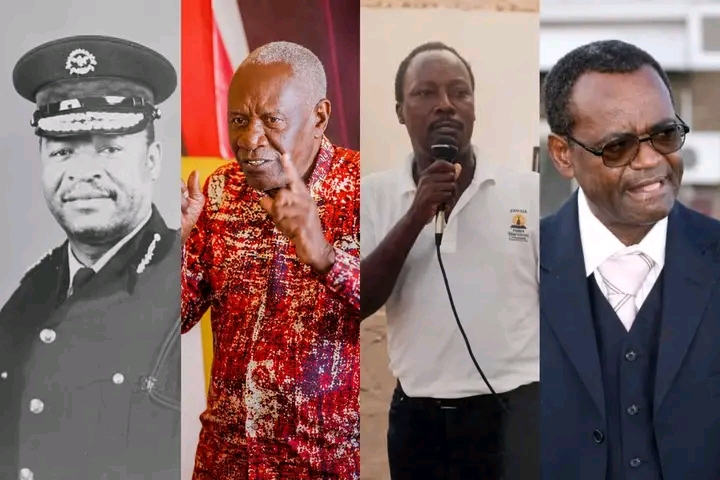
THE ETHNIC CARD: WHEN “ZAMBIAN” NEEDED A POLITICAL REFERENCE LETTER
In the Zambia of the mid-1990s, there was apparently a new qualification for being Zambian: you had to pass an immigration test whenever your politics became inconvenient.
Being born in Zambia was no longer necessarily enough. Having lived in Zambia since independence was not necessarily enough. Having parents, grandparents and an entire family tree rooted in the country could still leave you explaining yourself to immigration officers.
And, conveniently, this new enthusiasm for genealogy seemed to become particularly vigorous when someone happened to be an opposition politician or a government critic.
Take Henry Mtonga, former Inspector General of Police and prominent UNIP figure.
On August 29, 1995, immigration officials began questioning his nationality. They even travelled to his home village in Lundazi and interviewed his mother as if the Republic had suddenly become a giant ancestry detective agency.
By August 1996, Mtonga was telling the press that if government wanted to deport him, they should take him to Natal, South Africa. His explanation was worthy of a historical epic: his great-grandfather had been among Zwangendaba’s impis, had crossed into Zambia and married the daughter of Chief Mwas’e.
And Mtonga had been born in what is now Zambia.
But apparently, in the politics of the day, being born Zambian could still come with an asterisk.
Then came William Banda, a senior UNIP figure who had lived in Zambia since independence in 1964.
Suddenly, the state decided he was actually Malawian.
The Chipata High Court ruled against him, and he was deported to Malawi on August 31, 1994 as a “prohibited immigrant.” His lawyers protested. The judge himself reportedly expressed doubts about aspects of the State’s case, but the machinery had already started moving.
The Supreme Court later upheld the decision, arguing that Banda had failed to prove his Zambian residence and that investigations indicated his parents came from Malawi.
Banda only returned to Zambia in May 2002. Upon his return from Malawi, Banda held senior positions in the MMD. Banda is still actively involved in Zambian politics and plays a vital role in the ruling UPND government.
So there you had it:
Independence in 1964: Welcome home.
Opposition politics decades later: Please produce your ancestors.
Then there was John Chinula, another UNIP politician deported to Malawi in September 1995.
His nationality had never previously been questioned. Then immigration officials arrived asking questions about his father, his father’s wives and their origins.
Chinula maintained that everything about him and his family was Zambian. His parents were still living on their farm in the Copperbelt.
But government officials apparently had a different opinion.
President Frederick Chiluba’s press secretary, Richard Sakala, defended the deportation with an argument that was almost beautifully circular: Malawi had accepted Chinula, and if he wasn’t Malawian, surely Malawi would have deported him.
The logic was simple: if another country takes you, congratulations you must belong there.
And it wasn’t only UNIP members.
Dean Mun’gomba, president of the Zambia Democratic Congress, also found himself under investigation over allegations that he was actually “a Tanzanian.”
Then the card was played against George Kunda, who later became chairperson of the Law Association of Zambia.
Immigration officials reportedly visited his family and travelled to his home village to investigate his origins. Newspapers carried allegations that he was Malawian. Government officials repeated the allegations in Parliament.
Kunda maintained that he was Lala and that both his parents were Zambian by birth or descent.
The timing was rather interesting.
The nationality questions intensified while the Law Association of Zambia was criticizing the government’s 1996 Constitutional Amendment Act.
What a remarkable coincidence.
Civil society leaders were not spared either.
Bishop Mambo. Alfred Zulu. Lucy Sichone.
People who had apparently been sufficiently Zambian for years suddenly discovered that their citizenship came with a political terms-and-conditions agreement.
Immigration officials questioned relatives and associates. Government figures attacked critics as “foreigners.” Even Catholic clergy were dragged into the argument, with Deputy Minister Valentine Kayope declaring that Zambia belonged to Zambians and suggesting that foreigners in priestly cassocks should not dictate to the country.
It was a fascinating period in our political history.
The Constitution said one thing.
Citizenship documents said another.
Birth certificates said something else.
But the political mood could apparently overrule all three.
The ethnic card was simple:
If you disagreed with us, prove you’re Zambian.
And if you were inconvenient enough, your family tree could suddenly become a matter of national security.
The irony is that Zambia is a country whose borders were drawn across communities that existed long before the modern state. Families, languages, kingdoms and traditional territories did not conveniently stop at the colonial boundary.
Yet politicians discovered that ethnicity could be turned into a weapon and nationality into a political loyalty test.
The question was no longer simply:
“Are you Zambian?”
It became:
“Are you Zambian enough for the government of the day?”
And that is where the ethnic card becomes particularly dangerous.
Because once politicians start deciding who is really Zambian based on tribe, ancestry, accent, province, parentage or political allegiance, nobody’s citizenship is completely safe.
Today, it is your opponent.
Tomorrow, it could be you.
Because sometimes the most revealing chapter of our political history is not what politicians said about the country but who they decided belonged to it.