

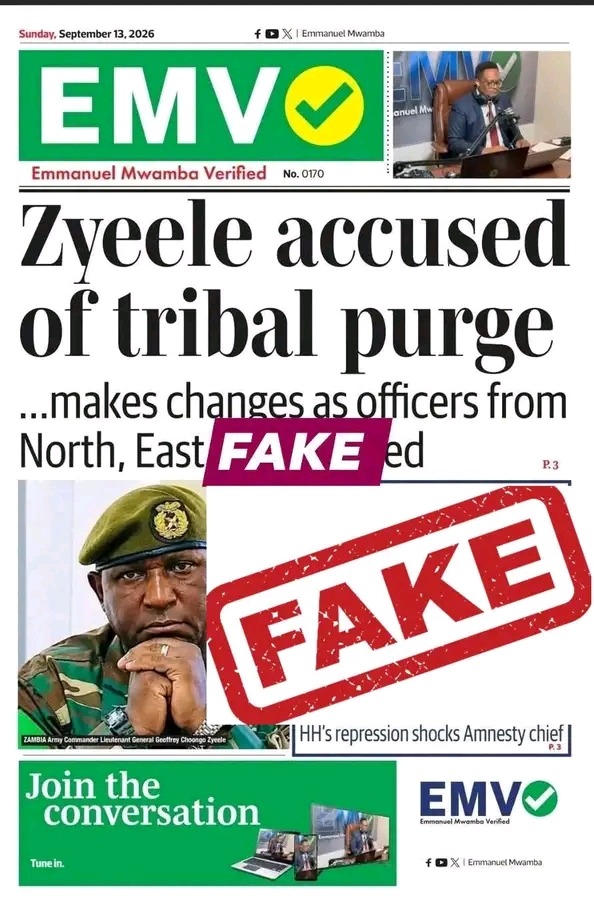
THE FACTS BEHIND THE POSTINGS: WHY THE “TRIBAL PURGE” NARRATIVE DOES NOT ADD UP
A Response to the Allegations Against Zambia Army Commander Lt Gen Geoffrey Choongo Zyeele
The headline “Zyeele accused of tribal purge” makes a serious allegation. But when the article itself is examined carefully, the evidence presented does not establish a tribal purge. What it largely presents is a list of military postings and appointments, followed by allegations from unnamed sources about the ethnic backgrounds of some officers.
That distinction matters.
A military posting is not, by itself, evidence of tribal discrimination. For the allegation of a “tribal purge” to be credible, the article would need to demonstrate a consistent pattern in which officers were removed, denied promotion, or disadvantaged because of their tribe, and ideally provide verifiable evidence linking specific decisions to that alleged motive.
The article does not do this.
1. The article confuses postings with persecution
The bulk of the article is a long list of officers who have been posted from one appointment to another.
But what does the list actually show?
It shows officers being moved between formations, directorates, training institutions, headquarters, operational units and other appointments. Several officers are being appointed to substantive and senior positions, including battalion commanders, brigade commanders, directors, deputy directors, commandants and other leadership roles.
That is normal military administration
The mere fact that an officer has been transferred from one institution to another cannot reasonably be presented as proof that the officer has been “purged.”
In fact, the article’s own list contains numerous examples of officers receiving important appointments after being moved.
2. Where is the evidence that the postings were based on tribe?
This is the central question.
The article repeatedly uses phrases such as “sources alleged,” “reportedly,” “raising concerns,” and “deemed unfit.”
But allegations are not evidence.
If the accusation is that Lt Gen Zyeele is deliberately targeting officers from Northern and Eastern provinces, the article should provide evidence demonstrating:
– who was removed specifically because of their tribal identity;
– who made the alleged discriminatory decisions;
– what official instruction linked the postings to ethnicity;
– how many officers from the alleged targeted groups were affected;
– how many officers from other regions were treated differently in comparable circumstances;
– and evidence that the stated reason for the postings was tribal rather than professional, operational or administrative.
Without that evidence, the headline goes considerably further than the material presented in the article.
3. Being posted to ZDU does not automatically mean being “dumped”
Perhaps the most important allegation concerns officers said to be operating from an office associated with the Zambia Defence University at Arakan Barracks.
The article describes this as a “pool where officers deemed unfit to hold substantive appointments are thrown.”
But who officially designated these officers as “unfit”?
Where is the official document making that determination?
And, most importantly, where is the evidence that their alleged lack of substantive appointments is connected to their tribal background?
The article provides none of these answers.
A new, developing or reorganised institution can naturally have officers assigned to it while its establishment, structures, programmes and administrative arrangements are being developed.
Calling such an arrangement a “dumping ground” is an interpretation. It is not established fact.
4. The article itself undermines its own tribal-purge argument
There is an important contradiction in the story.
The article lists officers from different backgrounds being moved across numerous branches and formations and receiving different appointments.
Some are moved into command positions.
Others become directors or deputy directors.
Others go to training institutions.
Others move to operational formations.
Others move into headquarters appointments.
Others enter or leave pools.
That is precisely what one would expect from a broad organisational restructuring or routine military posting exercise.
If the objective were genuinely to conduct a tribal purge, the article would need to demonstrate a systematic pattern of disadvantaging one ethnic group while favouring another.
A collection of postings does not establish that pattern.
5. Senior military appointments cannot simply be reduced to tribal geography
The Zambia Army is a national institution.
Appointments in a professional military are ordinarily influenced by factors such as experience, qualifications, rank, command requirements, specialisation, institutional needs, operational requirements, succession planning and the needs of particular formations.
An officer being moved from one province, formation or institution to another does not mean that officer has been punished.
Indeed, military service inherently involves movement.
An officer cannot reasonably expect to remain permanently in one formation simply because of where they come from.
6. The article relies heavily on anonymous sources
There is nothing inherently wrong with protecting sources. However, serious allegations require particularly strong corroboration.
The article makes an extraordinary accusation against a serving Army Commander — that he is conducting a “tribal purge” — but the central accusation is attributed to unnamed sources.
That should invite scrutiny.
Where are the affected officers willing to publicly state that they were removed specifically because of their tribe?
Where are the official records demonstrating discriminatory criteria?
Where is the comparative data showing that officers from particular provinces were systematically treated differently?
Without such evidence, readers are being asked to accept a very serious conclusion primarily on the basis of anonymous allegations.
7. The timing of postings does not prove motive
The article notes that the postings became effective on 21 August and 31 August 2026.
But timing alone does not establish discrimination.
Military institutions routinely conduct postings at particular periods for administrative, operational and personnel-management reasons.
The relevant question is not simply “When were these officers posted?”
The relevant question is:
“Why were they posted, and what evidence proves that the reason was tribal discrimination?”
The article does not satisfactorily answer that question.
8. Criticism is legitimate. Tribal accusations require evidence.
Lt Gen Geoffrey Choongo Zyeele, as Zambia Army Commander, is a public officer whose decisions can and should be scrutinised.
If there are genuine concerns about military administration, personnel management, promotions or postings, those concerns deserve proper investigation through appropriate institutional channels.
But there is a major difference between legitimate scrutiny and attaching a highly inflammatory tribal motive to administrative decisions without sufficient evidence.
The word “purge” carries a very specific implication: that people are systematically being removed because of an identifiable characteristic.
That is a claim requiring evidence of systematic discrimination.
The article has not demonstrated that.
9. Judge the commander by the entire record, not one controversial headline
Lt Gen Zyeele’s tenure should ultimately be assessed through the broader record of his leadership: command effectiveness, training, professionalism, troop welfare, operational readiness, infrastructure development, discipline, international military cooperation, peacekeeping responsibilities and the overall development of the Zambia Army.
Individual postings should not automatically be interpreted as evidence of prejudice.
A commander can make decisions that some officers or observers disagree with without those decisions being tribal.
THE QUESTION THAT REMAINS
After reading the entire article, one fundamental question remains unanswered:
Where is the evidence that Lt Gen Geoffrey Choongo Zyeele made these decisions because the affected officers were from Northern or Eastern provinces?
Until that evidence is produced, calling the exercise a “tribal purge” is an allegation, not an established fact.
Zambia’s Defence Force belongs to the entire nation. Its leadership must be judged on professionalism, constitutional responsibility and institutional performance — not on speculation about the tribe of officers being transferred from one appointment to another.
If there are legitimate concerns about specific postings, let them be examined on their individual merits.
But serious accusations of tribal discrimination should never be established by headline, insinuation and anonymous claims alone.
Facts must come before accusations. Evidence must come before conclusions. And professionalism must come before tribal politics.
The author is a retired senior military personnel with a distinguished service.