

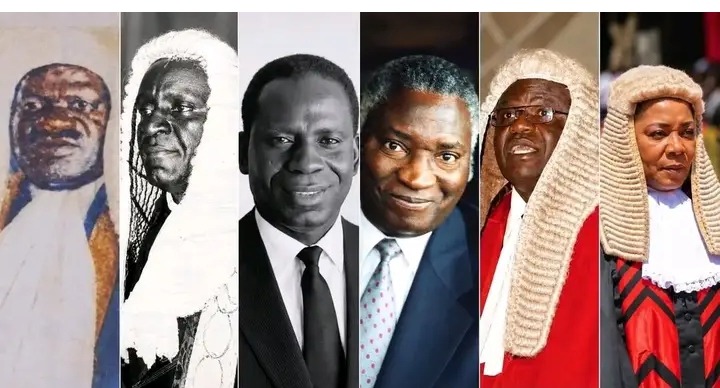
The five men and woman who have held the Speaker’s Gavel
Since independence in 1964, Zambia has had six Speakers of the National Assembly, a relatively small club whose members have presided over everything from historic legislation to the occasional parliamentary theatre that makes Parliament look like a very expensive community meeting.
The first indigenous Speaker of independent Zambia was Wesley Nyirenda, who served from 1964 to 1968. Nyirenda had already been a politician, having represented Fort Jameson today’s Chipata Central as an MP from 1964 to 1973.
Before him, the chair had been occupied during the colonial era by Sir Thomas S. Page and Sir Thomas William, who served as Speakers of the Legislative Council of Northern Rhodesia between 1948 and independence in 1964.
In other words, Zambia inherited the chair, changed the flag above the building and eventually started making its own parliamentary noise.
Nyirenda was succeeded in 1968 by Robinson M. Nabulyato, who became one of the most enduring figures ever to occupy the Speaker’s chair. Nabulyato had already served on the Legislative Council of Northern Rhodesia from 1954 to 1958, giving him parliamentary experience before Zambia even became a republic.
He went on to serve as Speaker from 1968 to 1988, returned to the chair from 1991 to 1998, and remains the longest-serving Speaker in Zambia’s history. Clearly, the gavel had found its favourite owner.
After Nabulyato came Fwanyanga Mulikita, Speaker from 1988 to 1991 and previously MP for Mongu Central from 1973 to 1978.
Then came Amusaa Mwanamwambwa, who served from 1998 to 2011. A representative of Liuwa, Mwanamwambwa had also served as a Cabinet Minister under President Frederick Chiluba.
Then came Patrick Matibini, who served from 2011 to 2021. Unlike most of his predecessors, Matibini came to the Speaker’s chair as a lawyer rather than a career politician.
In 2021, Nelly Mutti became the sixth Speaker and first ever female to occupy the position.
Like Matibini, Mutti entered the Speaker’s office as a lawyer rather than having first built a career as an elected politician.
Geographically, the Speaker’s chair has also had a distinctly Western Province flavour. Of the six, Mulikita, Mwanamwambwa and Mutti have roots in Western Province, meaning the province has supplied half of Zambia’s post-independence Speakers.
And despite the name leading some Zambians to immediately conclude he is Lozi, Matibini is actually Lenje from Central Province.
So, from Nyirenda → Nabulyato → Mulikita → Mwanamwambwa → Matibini → Mutti, the Speaker’s chair has witnessed six different personalities, generations and political eras.
And here is an interesting contrast with the executive arm of government: the legislative arm still has a surviving former office holder in Matibini.
Six Speakers. Six eras. One gavel.
© ZPA