

By Seba Boston
THE KAFWAYA CASE, THE ALLEGED MILITIA AND THE QUESTIONS THE LAW REQUIRES US TO ASK
As a student of law, I have been following the different public statements surrounding the joint security operation conducted in Kabulonga and the death of Hon. Mutotwe Kafwaya.
I do not claim to have all the facts, and I am not writing to pronounce anyone guilty or innocent. I am also not accusing any government official or security officer of committing an offence. My purpose is to examine the information placed in the public domain and identify areas that require legal and factual clarification.
National security is a serious responsibility of the State. If the Government had credible intelligence that an armed group was planning to threaten the constitutional order, it had a duty to investigate and intervene lawfully.
However, the protection of national security must operate together with the rule of law, due process, accountability and the protection of human life.
WHAT DOES THE ALLEGED “MILITIA” MEAN?
A militia is generally understood as a privately organised group that is armed, trained or structured to perform functions resembling those of a military force without being part of the country’s legally established defence and security institutions.
The Central Joint Operations Committee, or CJOC, alleges that some of the people apprehended during the Kabulonga operation were former commandos and retired police officers. It also reports that firearms, ammunition, tactical equipment and electronic devices were recovered from the premises.
Government says the eleven apprehended persons are being investigated for alleged offences relating to treason and any other offences that may be established.
These are very serious allegations. However, under the presumption of innocence, the suspects remain innocent until their guilt is established through admissible evidence before a competent court.
Being a former commando, retired police officer, opposition member or person present at a particular residence does not, without further evidence, establish membership of a militia.
HOW THE PUBLIC ACCOUNT DEVELOPED
President Brian Mundubile initially reported that security personnel had raided the residence where he was staying and that gunshots had been fired. He further alleged that Hon. Mutotwe Kafwaya had been shot.
At that point, this was an allegation attributed to President Mundubile and had not been independently established.
Government officials subsequently rejected reports that Hon. Kafwaya had been shot and admitted to Maina Soko Medical Centre.
Defence Permanent Secretary Maambo Haamaundu reportedly stated that checks conducted with hospital management had found no record of Hon. Kafwaya being treated there during the preceding 48 hours.
Information and Media Permanent Secretary Thabo Kawana similarly said that there was no patient by that name at Maina Soko. Home Affairs and Internal Security Permanent Secretary Dickson Matembo warned against statements that could alarm the public.
Citizens also received an SMS appearing under the sender identification “GRZ MM,” which read:
“Beware of false reports of shootings & abductions. Stay calm and peaceful. Let ECZ verify votes transparently. Respect the people’s will. One Zambia, One Nation.”
I cannot independently authenticate the technical origin of that sender identification. However, that is how the message appeared on recipients’ phones, and its wording could reasonably have created the impression that reports of shootings and abductions connected to the unfolding events were false.
THE LATER GOVERNMENT CONFIRMATION
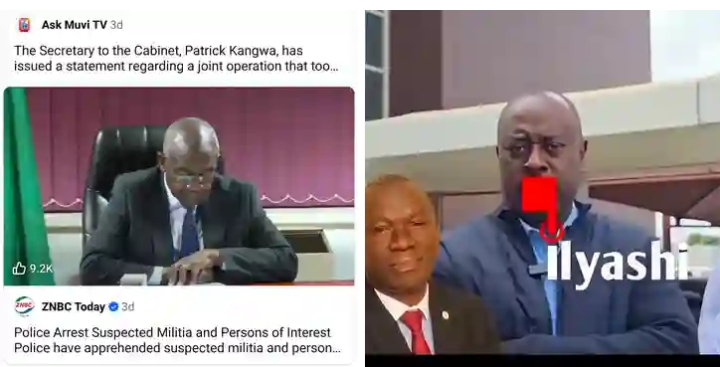
Secretary to the Cabinet Patrick Kangwa subsequently confirmed that a joint security operation had taken place at a premises in Kabulonga.
According to the Government’s account, the operation targeted suspected militia members and persons of interest. It alleged that restricted military weapons and ammunition were recovered and that occupants fired at officers, resulting in an exchange of gunfire.
The statement accounted for eleven people who had been apprehended and indicated that others escaped. However, it did not disclose that a person had been fatally wounded during the operation.
Meanwhile, the family of Hon. Kafwaya continued appealing to the Government for information about his whereabouts.
His wife, Dinis Ng’andu Kafwaya, eventually applied to the Lusaka High Court for permission to commence urgent habeas corpus proceedings.
HABEAS CORPUS AND WHY IT MATTERS
Habeas corpus is a legal procedure designed to protect a person against unlawful or undisclosed detention. It allows a court to require the authority holding a person to produce that individual and explain the lawful basis of the detention.
The application did not automatically prove that the Government was unlawfully holding Hon. Kafwaya. It showed that his wife believed judicial intervention was necessary to establish where her husband was and under what legal authority he was being held.
It is deeply concerning that a family had to resort to such a powerful legal procedure merely to obtain clarity about the whereabouts of their relative.
THE CJOC STATEMENT
The CJOC later issued a more detailed statement confirming that a joint intelligence-led operation had been conducted at a residence in Kabulonga at approximately 19:30 on 14 August 2026.
According to the CJOC, officers were met with gunfire and resistance from unidentified individuals and returned fire. In the process, one unidentified man was fatally wounded, and a firearm was recovered.
The statement says the injured man was taken to a hospital and pronounced dead on arrival. Following reports about Hon. Kafwaya’s disappearance, his family was called and positively identified the body.
One fact is therefore officially confirmed: Hon. Mutotwe Kafwaya was fatally wounded during a joint state security operation.
However, several important questions remain unanswered in the information currently available to the public.
THE LEGAL AND FACTUAL GAPS
1. What exactly did the initial denial cover?
Were the Permanent Secretaries denying only that Hon. Kafwaya had been admitted to Maina Soko, or were they also denying that he had been shot?
If the verification was limited to the hospital’s patient register, was that sufficient to dismiss the broader shooting allegation?
2. What was the basis of the Government SMS?
If the message appearing under “GRZ MM” was officially authorised, who approved it?
What specific reports was it referring to when it warned citizens about “false reports of shootings and abductions”?
3. When did Government first know that someone had died?
The CJOC says the operation occurred on 14 August and that the injured man was pronounced dead on arrival at a hospital.
Was an operational casualty report prepared that night? Which commanders and senior officials received it?
4. Why was the fatality not mentioned earlier?
The Secretary to the Cabinet’s statement confirmed the operation, exchange of gunfire and arrests but did not mention that a person had died.
Was the casualty information unavailable when the statement was prepared? If so, why had it not reached the relevant officials?
This is a request for clarification and not an allegation that anyone deliberately concealed information.
5. Where exactly was the operation conducted?
Was the “named premises” the residence referred to by President Mundubile?
Who owned or occupied the premises, and what legal authority was used to enter and search them?
6. Who authorised and commanded the operation?
Which institution exercised overall command?
What roles were performed by the police, Zambia Army, Drug Enforcement Commission and any other agencies involved?
Was a warrant obtained? If the operation was conducted without one because of urgency, what legal provision permitted that action?
7. Who fired first?
Government alleges that the officers were met with gunfire. President Mundubile disputes this account.
How many shots were fired by each side? Were any officers injured? Which weapons were found to have been discharged?
This question should be answered through ballistic evidence and witness testimony, not political statements.
8. Was Hon. Kafwaya armed?
The CJOC statement says that one unidentified man was fatally wounded “and the firearm was recovered.” That wording is unclear.
Was the firearm recovered from Hon. Kafwaya’s person or immediate possession? Had it been fired? Were his fingerprints or DNA found on it?
Asking this question does not suggest that evidence was either present or absent.
9. Who fired the fatal shot?
How many gunshot wounds did Hon. Kafwaya sustain? From what direction and distance was he shot? Which firearm discharged the fatal ammunition?
Has an independent post-mortem examination been conducted, and will the relevant findings be shared with his family?
10. Why did his identity remain unknown?
Eleven people were reportedly apprehended at the same premises. Could any of them identify the injured man?
Did he have identification documents, a mobile phone or any personal property that could have helped establish his identity?
11. Why was the family not informed promptly?
When a person dies during a state operation, what procedure governs identification and notification of the family?
Why did Hon. Kafwaya’s wife have to appeal publicly and commence a court process before receiving definitive information about her husband?
12. Which hospital received him?
The CJOC statement says he was taken to “the hospital.”
Which hospital was it? At what time did he arrive? Who transported him, and who pronounced him dead?
13. What evidence establishes the existence of a militia?
The previous military experience of some suspects may be relevant, but experience alone does not prove the existence of an organised militia.
What evidence allegedly demonstrates recruitment, command structures, training activities, financing, communications or an operational plan to use force against the State?
Some evidence may properly be presented first before a court if immediate public disclosure could prejudice the investigation.
14. Where were the alleged weapons recovered?
Were the weapons found on particular individuals, inside specific rooms, in vehicles or within common areas?
Who controlled those locations? Were any weapons legally registered? Has their source been established, and has a proper chain of custody been maintained?
15. Are the detainees being accorded due process?
Have they been informed of the grounds for their detention? Have they received access to lawyers and relatives? Have they been brought before a competent court within the period required by law?
National-security investigations do not suspend constitutional protections.
16. Will there be an independent investigation?
The security institutions involved in the operation should not be the only bodies examining a death arising from that operation.
Will an independent institution be permitted to examine the post-mortem report, ballistic evidence, operational records, scene photographs, CCTV footage, recovered DVR and eyewitness accounts?
WHY THESE QUESTIONS MATTER
The Government has the constitutional responsibility to protect Zambia and its citizens from genuine threats. Citizens must not interfere with legitimate investigations or declare suspects guilty or innocent before the courts determine the evidence.
At the same time, state power must remain subject to the law. Where lethal force results in the death of a citizen, the State has a duty to provide a lawful, consistent and evidence-based account.
The official information developed in stages: reports of a shooting were initially rejected; an operation and exchange of gunfire were later confirmed; and it was eventually confirmed that Hon. Mutotwe Kafwaya had been fatally wounded.
That sequence naturally raises questions. Asking those questions peacefully and responsibly is not an attack on the Government or security institutions. It is part of constitutional accountability.
This article is not a verdict. It is a request for the facts to be independently established.
Trust in public institutions is not created by demanding silence. It is earned through lawful conduct, accurate communication, transparency and accountability.
May the family of Hon. Mutotwe Kafwaya receive the truth, dignity and justice guaranteed by the law.
One thing is crystal clear. The government lied that there was no shooting and no casualties.
This makes it difficult to believe subsequent statements from government officials.
The militia story also sounds a bit farfetched. However, one lesson I have learnt from this unfortunate incidence is to wait. I never believed that Mr. Kafwaya had been shot dead until the police command owned up.
I was shocked.