

🇿🇲 INSIGHT | The ‘Mwewa Effect’: From Vlogger to Mayor, Can He Change Lusaka?
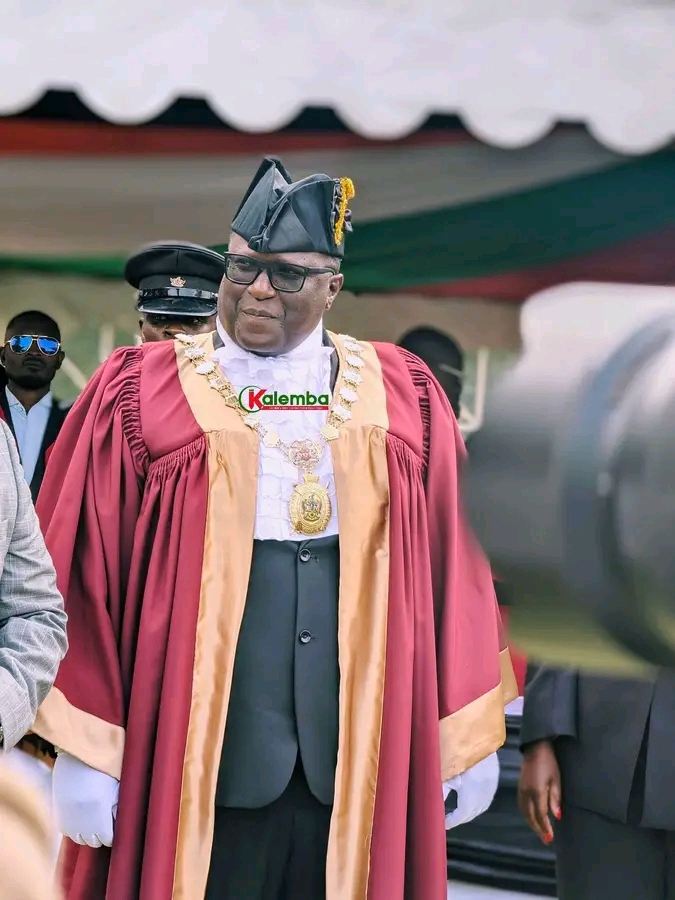
The reflector has given way to a mayoral chain. On Wednesday, October 7, Chitambala Mwewa stood in maroon robes edged with gold, white gloves and a black ceremonial hat. The chain lay across his broad chest, completing a transformation few could have imagined when he was patrolling the streets of Lusaka in a reflective vest. The towering, outspoken man who once demanded order from outside City Hall was now its mayor.
Mwewa has never been difficult to notice. A former vlogger with an American-accented command of English, he built a following through blunt commentary, public confrontations and an almost theatrical confidence. His enthusiasm for correcting other people’s grammar earned him the description of a grammar bully. Others have called him the Clean Goliath or the boasting monster. Admirers see a fearless man prepared to challenge disorder. Critics see a personality sometimes too fond of his own voice. Neither side can accuse him of being inconspicuous.
His arrival at City Hall carries a family significance. His father, Simon Mwewa, was also Mayor of Lusaka during Kenneth Kaunda’s presidency. The son has now followed him into the same office, decades later and under vastly different political circumstances. It is an unusual inheritance, not merely of a family name but of a place in the city’s history.
Mwewa has also faced criticism over the wealth and business interests associated with his father. Yet the argument that inherited wealth somehow diminishes every subsequent achievement overlooks an important distinction. Receiving an asset is one thing; preserving it is another. Zambia has seen family enterprises disappear within a generation. The survival of a business does not, by itself, establish exceptional managerial ability, but neither should inheritance be treated as evidence of failure. What matters is what happens to the assets entrusted to the next generation.
Around Simoson Building near City Market, Mwewa became known for his insistence on cleanliness and order. This reputation followed him into politics. His approach to the city centre, therefore, has not emerged from nowhere. The difficulty is that Lusaka is not a privately managed property. It is a sprawling capital of competing interests, limited resources and residents whose livelihoods often depend on the very activities municipal authorities seek to regulate.
Nor did Mwewa arrive with an overwhelming electoral mandate. He won the August mayoral contest with 200,029 votes against Gabriel Kibombwe’s 195,041, a margin of 4,988. A subsequent election petition delayed his installation before it was withdrawn. His victory gave him the office, but the closeness of the result is a reminder that public enthusiasm, however visible, is not the same as political consensus.
Even before taking the ceremonial oath, Mwewa had become the face of a renewed campaign to reclaim Lusaka’s streets. Council officers, supported by police, moved against unauthorised trading along Cairo Road, Freedom Way, Lumumba Road and other busy routes. Makeshift stalls were removed, pavements cleared and sanitation operations intensified. The changes attracted attention almost immediately. Supporters began calling it the “Mwewa Effect”.
For a capital long troubled by congestion, litter and disorderly trading, the appeal is easy to understand. Clear pavements make walking easier. Unobstructed roads improve movement. Proper waste disposal reduces health risks. Residents should not have to negotiate piles of rubbish or roadside stalls simply to move through their city.
But restoring order is rarely as straightforward as removing what appears disorderly. Street vendors are not merely an inconvenience to motorists and pedestrians. They are also workers, parents and small traders operating in an economy where formal employment remains scarce. A pavement may be an unsuitable place to sell vegetables, but for the person selling them, it may also be the difference between earning something and returning home empty-handed.
Mwewa has pointed to more than 14,000 trading spaces across 28 markets for approximately 8,000 affected vendors. Those figures, if matched by genuinely available facilities, suggest relocation is possible. Yet an empty market stand is not necessarily a viable business location. Traders need customers, affordable fees, security and access to transport. Moving someone away from a busy road without addressing these conditions may clear a street while merely transferring the economic hardship elsewhere.
Lusaka’s history makes the challenge harder. Street vending has repeatedly become entangled with political patronage, uneven enforcement and the influence of cadres. Rules imposed firmly under one administration have sometimes weakened under another. If the current campaign is to outlast the excitement surrounding Mwewa, enforcement must be consistent, lawful and insulated from political favour.
There is also a limit to what personal energy can achieve. A mayor can inspect a market, confront an offender or lead a clean-up. He cannot personally collect every bin, unblock every drain or supervise every council officer. Those tasks belong to institutions that must function whether the mayor is present or not.
At his installation, Mwewa outlined nine priorities, including waste management, drainage, roads and markets. The agenda reaches well beyond the city centre. In residential neighbourhoods, residents contend with uncollected rubbish, poor drainage, damaged roads and inadequate services. A cleaner Cairo Road may provide the most immediate photographs, but a cleaner Lusaka requires less visible work across the city.
This is the real distinction between Mwewa the commentator and Mwewa the mayor. Behind a camera, he could identify problems and demand that someone act. In office, he must work through budgets, council procedures, competing priorities and the limits of municipal authority. Criticism can be delivered in minutes. Reform requires planning, negotiation and years of consistent administration.
His forceful personality may prove useful in drawing attention to neglected problems. It may also invite resistance where enforcement is perceived as selective or unnecessarily confrontational. Municipal leadership requires both authority and restraint. Residents need rules they can understand and institutions they can trust, not simply an official willing to shout louder than everyone else.
There is something compelling about a son returning to an office once occupied by his father. There is also something distinctly Zambian about a former vlogger, known as much for correcting English as for demanding clean surroundings, finding himself responsible for the country’s capital. But family history and public charisma can only take the story so far.
The early clean-up campaign has given Mwewa visibility. The harder test will come when the cameras leave, the novelty fades and the council must maintain order through ordinary administration. Streets should remain clean because waste is collected. Markets should function because they are properly managed. Regulations should be obeyed because enforcement is fair and predictable.
The reflector has been replaced by a mayoral chain, but the task is considerably larger. Mwewa no longer has an audience to entertain or a building to supervise. He has a city to serve.
And if the “Mwewa Effect” is to become more than a passing expression, its greatest achievement will not be that Lusaka needs a giant to keep it clean. It will be that the city no longer needs one.
INSIGHT | Beyond the headline. We examine the forces, choices and consequences shaping the story.
The People’s Brief | Ollus R. Ndomu
October 8, 2026