

THE NUMBERS BEHIND BM’S LOSS
Why Southern deserves scrutiny, and why BM’s own provinces held the pathway to victory
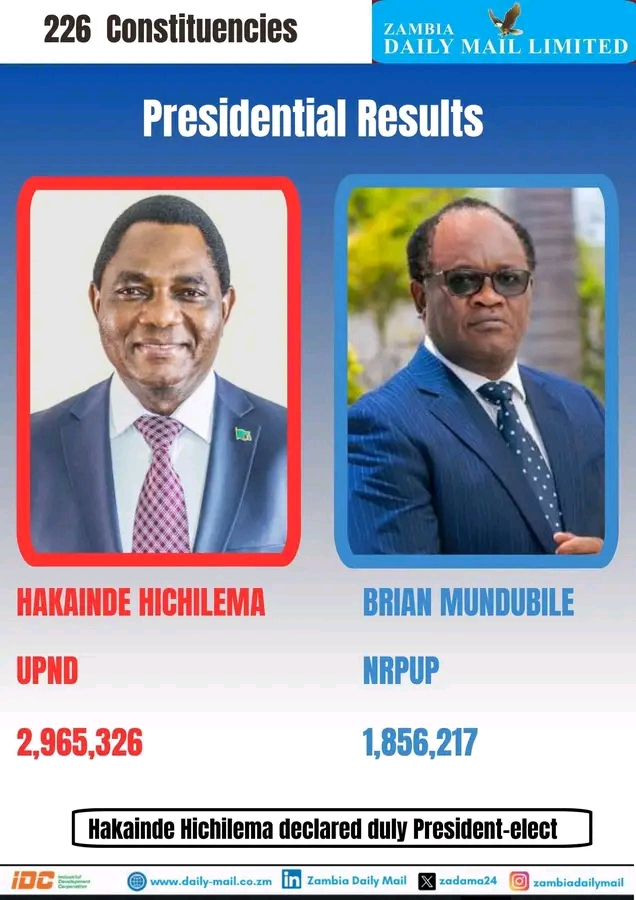
The 2026 presidential election deserves to be studied beyond the headline that Hakainde Hichilema won 60.7% of the vote while Brian Mundubile received 38.0%.
The more interesting story is in the provincial numbers.
Mundubile won six of Zambia’s ten provinces, yet still lost the presidency by 1,111,109 votes. So the real question is not simply where BM won or lost. It is how effectively each side converted its registered electorate into presidential votes.
Southern deserves a serious study
Southern had 1,103,275 registered voters.
HH received 718,569 votes against BM’s 26,260, giving HH an extraordinary 692,309 vote margin.
HH’s vote alone represented about 65.1% of everyone registered in Southern.
The combined HH and BM vote represented 67.5% of the registered electorate.
That raises a serious question for BM’s campaign:
What exactly happened in Southern that enabled HH to convert such a large proportion of the electorate into votes, while BM struggled to make a comparable impact?
Southern should not simply be written off as “HH territory”. It should be studied as a mobilisation case study.
But Copperbelt and Lusaka raise an even bigger question
This is where the numbers become particularly interesting.
Copperbelt had 1,296,446 registered voters. Lusaka had 1,430,889.
Together, that is more than 2.7 million registered voters.
Yet the combined HH and BM vote represented only 57.2% of registered voters on the Copperbelt and 45.5% in Lusaka.
Compare that with Southern at 67.5%, Western at 71.3%, and North-Western at 76.8%.
These are not official turnout figures because votes for other presidential candidates are excluded. But the contrast is still striking.
And this is where political analysts, researchers and social commentators should be asking difficult questions.
Why would Zambia’s capital, Lusaka, and the Copperbelt, the heartbeat of the nation’s economy, register such enormous numbers of voters yet appear to convert a much smaller proportion of that electorate into votes for the two leading presidential candidates?
Why would voters in rural Southern, Western and North-Western appear to participate in the presidential contest at a higher rate than voters in the country’s major urban and industrial centres?
Is it voter apathy?
Is it urban fatigue?
Are people registered in cities but living or working elsewhere?
Is election-day mobilisation weaker in urban areas?
Are rural political structures simply more effective?
Or has politics in our cities become so fragmented that registration no longer translates into participation?
These questions deserve serious research, not just political commentary.
Copperbelt should particularly concern BM
Copperbelt had almost 1.3 million registered voters, yet BM’s margin over HH was only 1,639 votes.
A province widely regarded as one of BM’s strongest political bases produced virtually no presidential advantage.
Lusaka presents a similar problem.
With 1.43 million registered voters, BM’s advantage was only 18,768 votes.
For BM, these figures should trigger a serious mobilisation audit.
How many potential BM voters were registered but did not vote?
How many voted for other candidates?
How many were persuaded but did not turn up?
And how many simply could not be reached by the campaign?
Because if BM had converted even a fraction of that enormous urban electorate into a stronger presidential margin, the national arithmetic could have looked very different.
And HH should not ignore the warning either
For the incumbent, there is another question.
How loud is it when Lusaka, the capital of Zambia, and Copperbelt, the heartbeat of Zambia’s economy, produce such competitive results?
Winning nationally is the ultimate objective, and HH achieved that.
But an incumbent should still want to know why these two strategically important provinces did not produce the kind of overwhelming support seen in Southern, Western and North-Western.
The rural versus urban contrast is particularly worthy of study.
Southern, Western and North-Western produced exceptionally strong HH margins and high combined HH/BM vote conversion relative to their registered electorates.
Meanwhile, Lusaka and Copperbelt, with some of the largest concentrations of registered voters in the country, produced much smaller margins.
That is a political story in itself.
The lesson for BM
BM’s six provinces contained approximately 5.71 million registered voters.
Yet his combined advantage across them was only about 499,000 votes.
HH’s four provinces produced approximately 1.61 million votes of net advantage.
That is why BM lost despite winning more provinces.
The lesson is therefore not simply to find more provinces to win.
It is to maximise the electorate in the provinces already won.
For BM, Copperbelt and Lusaka should be the starting point.
For HH, those same provinces should be a warning.
And for political pundits and social commentators, the bigger question is perhaps this:
Why did rural Zambia appear more electorally engaged in the presidential contest than its major urban centres, despite those urban centres having some of the largest registered electorates in the country?
That question may tell us as much about Zambia’s changing politics as the final winner itself.
Because the 2026 election was not only a contest between HH and BM.
It was also a story about who turned up, where they turned up, and how effectively each campaign converted the voters it had registered into votes.
TJ