

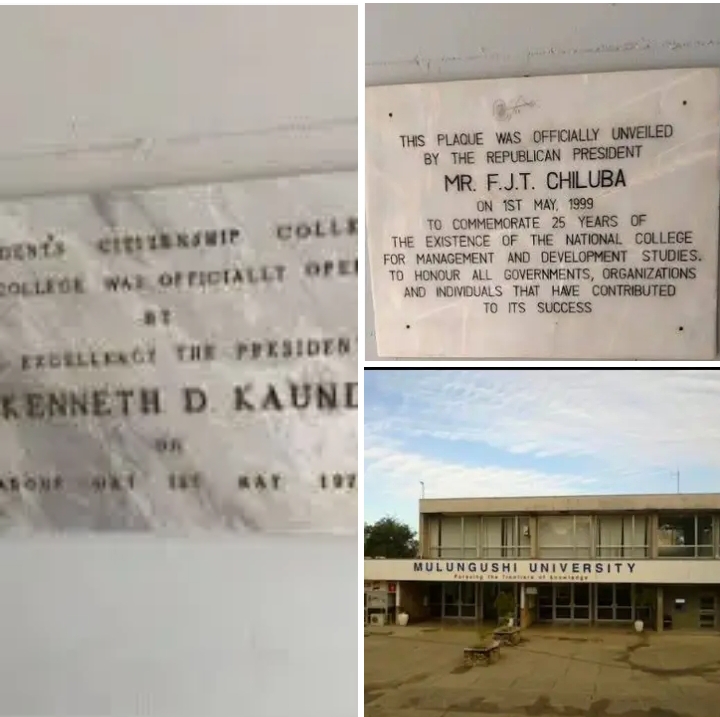
THE PEOPLE’S CITIZENSHIP: WHEN ZAMBIA HAD A PRESIDENT’S CITIZENSHIP COLLEGE (THIS IS A DETAILED EDUCATIONAL ARTICLE)
Our founders believed citizenship, leadership and national development had to be taught. There was a time when Zambia had an institution with a name that would probably surprise many young Zambians today, PRESIDENT’S CITIZENSHIP COLLEGE. It was not a social media slogan. It was not somebody’s proposal. It was an institution created by an Act of Parliament. President’s Citizenship College was established in 1972 under Act No. 21 of 1972. Its purpose was providing leadership training to officers of Government (civil servants), parastatal organisations and the labour movement.
That alone should make us pause. Why would a young Republic, only eight years after Independence, establish something called President’s Citizenship College? The answer takes us into one of the most important questions we can ask in THE PEOPLE’S CITIZENSHIP. What kind of citizen does a Republic need in order to survive, develop and remain truly independent and united?
CITIZENSHIP WAS NOT SUPPOSED TO BE JUST AN NRC. Our early nation builders were grappling with an enormous task. On 24 October 1964, Northern Rhodesia disappeared and the sovereign Republic of Zambia was born. The Union Jack came down. Our own flag went up. Political authority was transferred to Zambians, but obtaining Independence did not automatically create a population that understood the State, national development, public responsibility, leadership, economic sovereignty and the obligations that came with self government.
A colonial subject could become a citizen legally overnight. Building a citizen intellectually was a much longer project. That distinction remains important today. Your National Registration Card is extraordinarily important. It identifies you as belonging to this Republic. The Constitution itself recognises a citizen’s entitlement to identification issued by the State, but citizenship is considerably bigger than possessing an NRC.
Citizenship means belonging. Citizenship means rights. Citizenship means responsibilities. Citizenship means having a stake in the Republic. Citizenship means knowing that Zambia belongs to its citizens and understanding what that ownership demands of us.
WHAT DID PRESIDENT’S CITIZENSHIP COLLEGE ACTUALLY DO?
President’s Citizenship College was not simply the equivalent of the modern American naturalisation programme, where prospective citizens study civics and take a citizenship test. PCC was principally a leadership training institution serving Government officers, parastatal organisations and the labour movement, but its activities show something broader about the philosophy behind the institution.
Historical records connect the College with Zambia’s system of national guidance and citizenship education. Academic literature examining Zambia during this period discusses President’s Citizenship College alongside national guidance, Zambia National Service, schools, teacher training colleges, universities and non formal education as mechanisms through which the new State sought to develop national consciousness and participation.
The College was also involved in practical national development education. For example, in August 1976, the Central Statistical Office and President’s Citizenship College jointly organised a seminar on statistics required for economic and social planning. The proceedings were subsequently published. Records also show material produced through the College for cooperative educators, while former students obtained qualifications in areas such as industrial relations and personnel management.
This therefore was not citizenship reduced to memorising the colours of the flag. It connected citizenship and leadership to the practical problems of building a country.
WHAT HAPPENED TO THE COLLEGE?
The institution did not simply disappear. Its history is fascinating. In 1994, Parliament enacted the President’s Citizenship College (Amendment) Act No. 34 of 1994. The legislation formally removed the name “President’s Citizenship College” and substituted, “National College for Management and Development Studies.” Its academic portfolio subsequently expanded into programmes including management, business studies, human resource management and social work. Government later decided that the institution should become a public university. In 2005, Parliament repealed the National College for Management and Development Studies Act as part of the process of transforming the institution into a public university.
The former President’s Citizenship College became MULUNGUSHI UNIVERSITY. So when you look at Mulungushi University today, you are looking at the institutional descendant of President’s Citizenship College. That is a remarkable piece of Zambian educational history.
SOMETHING WAS LOST IN THE TRANSFORMATION
Mulungushi University is performing the very different and important role of a modern public university. My question is therefore not whether we should reverse Mulungushi University back into President’s Citizenship College. Absolutely not.
Where did the original idea go? Where today is the national institution whose principal business is systematically teaching Zambian citizenship? Who teaches the citizen what the Republic is? Who teaches the Constitution beyond examination preparation? Who teaches why Independence matters? Who teaches the difference between Zambia, Government and a political party? Who teaches the duties that accompany rights? Who teaches how Parliament works? Who teaches why taxes are paid? Who teaches why elections matter? Who teaches what sovereignty means? Who teaches economic citizenship? Who teaches media literacy? Who teaches national unity? Who teaches why tribalism can eventually destroy a Republic? Who teaches citizens how foreign investment, international trade, debt, technology and ownership can affect national sovereignty? Who teaches the meaning of One Zambia, One Nation beyond repeating the words?
INDEPENDENCE CAN BE LOST WITHOUT ANOTHER FLAG BEING RAISED
This is where modern citizenship education becomes extremely important. When Africans speak about colonialism, our minds understandably return to physical occupation. Foreign administrators. Foreign flags. Foreign armies. Foreign laws. However, in the modern world, a people can gradually surrender significant control over their national destiny without anybody formally recolonising their country.
A country may be politically independent while failing to develop sufficient domestic productive capacity. Its citizens may own very little of the commanding heights of their economy. Its minerals may leave while most of the value chain belongs elsewhere. Its shops may sell almost everything but manufacture very little. Its major contracts may continually bypass domestic enterprises. Its technology may be entirely external. Its food systems may become excessively dependent on imports. Its strategic infrastructure may depend on decisions made elsewhere.
None of this means foreign investment is undesirable. Zambia needs foreign direct investment. We need international capital. We need technology. We need markets. We need expertise. We need partnerships. The real citizenship question is, “How do Zambians participate in the prosperity being created inside Zambia?” That is why local content is not merely an economic policy expression. It has a citizenship dimension.
President Hakainde Hichilema has repeatedly argued for increased local participation alongside investment. That policy has now acquired concrete legal expression in the mining sector. Under Zambia’s Local Content Regulations, mining companies must progressively allocate part of their core procurement to qualifying Zambian owned and citizen empowered businesses, beginning at 20 per cent and rising towards at least 40 per cent, while specified non core services are reserved for local companies.
Think about what that means philosophically. Investment comes. Production grows, but the citizen must not remain merely a spectator standing outside the mine gate watching trucks carrying national wealth away. The citizen should increasingly become a worker. A technician. An engineer. A supplier. A contractor. A manufacturer. An investor. An entrepreneur. Eventually, an owner. That gives economic substance to citizenship.
CITIZENSHIP IS CAPITAL
We normally think of capital as money. Land is capital. Education is human capital. Machinery is capital. Knowledge is capital, but there is another enormous asset we seldom recognise. CITIZENSHIP ITSELF IS CAPITAL. That NRC in your pocket connects you to a sovereign Republic. It gives you membership in a political community. It carries constitutional entitlements. It gives you a voice in choosing those who govern. It ives you an interest in Zambia’s resources. It connects your future to the future of this country, but capital that is not understood can easily be squandered.
A citizen who does not understand citizenship can sell a vote for a temporary benefit. A citizen can destroy public property without understanding that it belongs ultimately to the public. A citizen can celebrate corruption because the corrupt person belongs to his tribe. A citizen can spread hatred without understanding how fragile national unity can become. A citizen can ignore elections and later complain about those elected. A citizen can demand public services while believing taxes are somebody else’s responsibility. A citizen can watch national economic opportunities pass by without asking how citizens can participate in them. A citizen can inherit peace and begin believing that peace is the natural condition of every country. It is not.
Peace is built. Unity is built. Democracy is built. Institutions are built. Sovereignty is defended. Independence has to be sustained from one generation to another.
OUR OWN CONSTITUTION ALREADY TELLS US THAT CITIZENSHIP REQUIRES EDUCATION
This is not merely my philosophical argument. Look at Article 43 of the Constitution of Zambia. Among other responsibilities, it says a citizen should endeavour to acquire a basic understanding of the Constitution and promote its ideals and objectives; register and vote where eligible; develop his or her abilities through knowledge, continuous learning and skills development; foster national unity and live in harmony with others; and understand and enhance Zambia’s place in the international community.
Read those obligations carefully. Our Constitution effectively expects a citizen to be educated about citizenship. How then do we expect that education to occur? By accident? Through Facebook arguments? During election campaigns? Through occasional school lessons which many adults have forgotten? There is an institutional gap here.
PERHAPS ZAMBIA NEEDS A NATIONAL CENTRE FOR CITIZENSHIP AGAIN
I believe the historical idea behind President’s Citizenship College deserves serious reconsideration for the twenty first century. Not necessarily by recreating exactly the institution of 1972. Zambia today is a very different country. Instead, we could establish a modern NATIONAL CENTRE FOR CITIZENSHIP AND DEVELOPMENT STUDIES.
Its mandate could include developing national citizenship curricula, Researching citizenship and national identity, Producing teaching materials, Training civic educators and civil servants, Supporting citizenship education in schools, Developing programmes for universities and colleges, Running adult citizenship programmes, Preparing orientation programmes for people acquiring Zambian citizenship, Teaching constitutional literacy, Developing courses for elected leaders and public officers, Producing programmes in Zambian languages, Training communities in media and digital literacy, Teaching economic citizenship and local participation, Preserving the history of Zambia’s Independence and nation building, and Conducting research on national unity, tribalism, democratic culture, patriotism and civic participation.
It could become the intellectual custodian of citizenship education in Zambia.
Saviour Chishimba
(Yehudah Ben David)
Founder & Principal
THE PEOPLE’S ACADEMY