

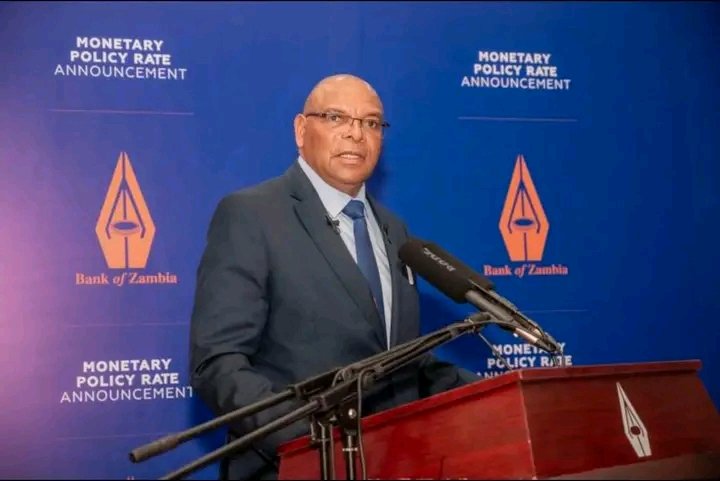
THE PEOPLE’S ECONOMICS: MONETARY POLICY (HOW THE CENTRAL BANK INFLUENCES INTEREST RATES, MONEY AND ECONOMIC GROWTH)
One of the most common mistakes in public discussions about economics is to confuse fiscal policy with monetary policy. Fiscal policy concerns how Government raises revenue through taxes, borrows money and spends through the national budget. Monetary policy is different. In Zambia, monetary policy is determined by the Bank of Zambia (BoZ), our central bank. The Bank has operational independence and its primary monetary policy responsibility is price stability. This distinction is important because not every decision concerning interest rates, credit and the supply of money is made by the President, Cabinet or the Ministry of Finance.
What, then, is monetary policy? It is the use of monetary instruments by the central bank to influence inflation, interest rates, liquidity, credit conditions and ultimately economic activity. One of the most important instruments is the Monetary Policy Rate (MPR). Think of the policy rate as the central bank’s principal signalling interest rate. When the Bank of Zambia raises it, monetary conditions generally become tighter. When it lowers it, monetary conditions can become easier. The policy rate does not dictate the exact interest rate that your commercial bank must charge you, but it influences the wider cost of money in the financial system.
Another important instrument is the Statutory Reserve Ratio (SRR). Commercial banks receive deposits, but they cannot deploy every kwacha they receive into lending. A prescribed proportion must be maintained as statutory reserves with the central bank. Imagine, purely for illustration, that a bank has K100 available. If more of that K100 must be held as reserves, less remains available for lending and other uses. If the statutory reserve requirement is reduced, more liquidity can potentially become available to the banking system. This is why the reserve ratio matters to the farmer seeking agricultural finance, the SME trying to buy machinery, the manufacturer expanding a factory and the family seeking a mortgage. Money held as statutory reserves cannot simultaneously be used to finance productive activity elsewhere in the economy.
This brings us to expansionary and contractionary monetary policy. When inflation is dangerously high, a central bank may pursue contractionary monetary policy. It can raise the policy rate or use other monetary instruments to reduce liquidity and moderate demand. When economic and inflationary conditions permit, monetary policy can become more expansionary. Lower interest rates and greater liquidity can encourage borrowing, investment, production and employment. There is, however, a balance to maintain. Excessive monetary expansion can create inflationary pressures and weaken the purchasing power of money. Monetary policy therefore involves managing the relationship between price stability, liquidity, credit conditions and economic activity.
There is another concept every citizen should understand. It is called the monetary policy transmission mechanism. A central bank can reduce its policy rate today, but that does not necessarily mean that your commercial bank will reduce your loan rate by exactly the same amount tomorrow. The transmission of monetary policy takes place through several channels. A decision by the Bank of Zambia first affects conditions in the financial system, including the cost and availability of money. These changes can influence the funding costs and liquidity positions of commercial banks. Banks, in turn, may adjust their lending rates and the conditions under which they extend credit to households and businesses. Changes in the cost and availability of credit can then influence borrowing, investment and household spending.
Eventually, these effects can be felt in production, employment, incomes, economic growth and inflation. The process is not automatic. Banks must also consider the risk of borrowers defaulting, operating costs, the cost of deposits and other funding, Government borrowing, competition within the banking sector and expectations about future inflation. This explains why citizens may hear that the Monetary Policy Rate has been reduced and still ask, “Why is my loan so expensive?”
Monetary policy becomes particularly important when a country wants to accelerate economic growth. Zambia has an ambition to substantially increase the size of its economy. Economic growth requires investment. Mines require capital to expand production. Farmers require finance to mechanise and increase output. Manufacturers require capital to purchase machinery and expand factories. SMEs require working capital. Entrepreneurs require finance to establish and grow businesses. Families may require mortgages to build or purchase homes.
The cost and availability of money therefore have consequences throughout the economy. Monetary policy cannot create economic growth by itself, but it influences the financial conditions under which investment, production, employment and consumption take place. At the same time, maintaining price stability is important because persistent high inflation reduces purchasing power, increases uncertainty and can discourage long-term investment.
This is why monetary policy should not be understood merely as a technical discussion taking place inside the central bank or among economists and commercial bankers. Its effects eventually reach ordinary people. Decisions concerning the policy rate, statutory reserves and liquidity can influence the cost and availability of credit. Credit conditions can affect whether a farmer expands production, whether a business purchases another machine, whether an entrepreneur can finance a new enterprise and whether a household can afford a mortgage.
The Bank of Zambia, commercial banks, businesses, farmers, households and the wider economy are therefore connected through the monetary system. Understanding that relationship allows us to understand something fundamental about economics. Monetary policy may begin with decisions made at the central bank, but its consequences can eventually reach the factory, the farm, the small business, the workplace and ultimately the household kitchen table.
Saviour Chishimba
(Yehudah Ben David)
Founder & Principal
THE PEOPLE’S ACADEMY